
Quick Answer
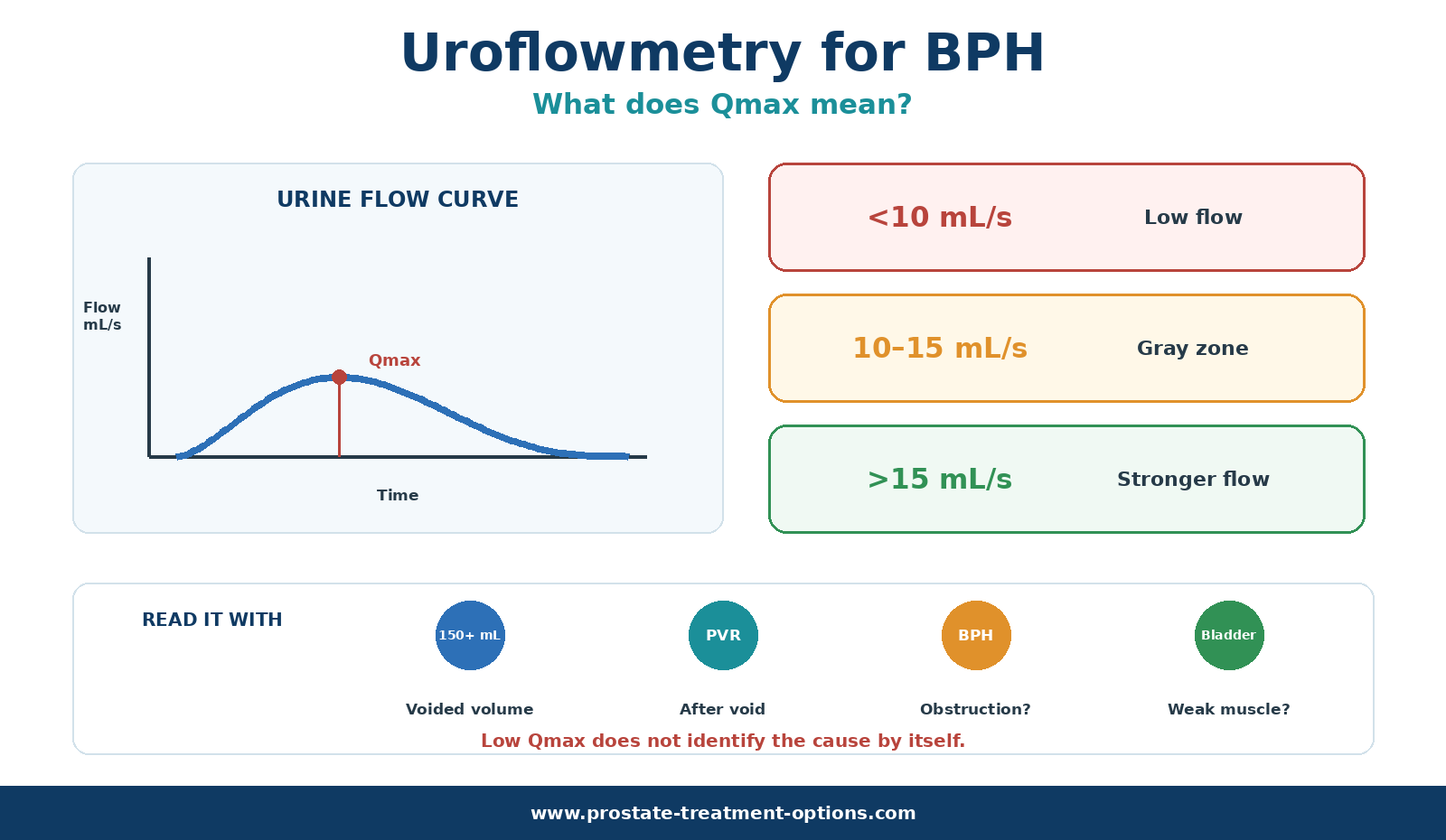
Uroflowmetry is a simple, non-invasive test that measures how quickly urine leaves the bladder. The main number is Qmax, the maximum urinary flow rate, measured in milliliters per second (mL/s).
For men with lower urinary tract symptoms, a Qmax below 10 mL/s increases suspicion for bladder-outlet obstruction, but it does not prove that BPH is the cause. Low flow can also result from a weak bladder muscle, too little urine in the bladder during the test, urethral narrowing or other voiding problems.
A Qmax between roughly 10 and 15 mL/s is difficult to interpret in isolation. A Qmax above 15 mL/s makes severe obstruction less obvious, but current EAU guidance specifically states that bladder-outlet obstruction still cannot be excluded.
The test is best interpreted together with post-void residual (PVR), symptoms, prostate anatomy and the amount of urine actually voided during the test. Uroflowmetry is most reliable when the bladder/voided volume is around 150 mL or more.
What Is Uroflowmetry?
Uroflowmetry measures urine flow while you urinate into a specialized collection device.
The machine records the flow continuously and produces both numbers and a flow curve.
EAU 2026 identifies the main uroflowmetry parameters as:
- Qmax: maximum urinary flow rate;
- voided volume: how much urine was passed during the test;
- flow pattern: the shape of the urine-flow curve;
- PVR: usually measured separately after voiding to show how much urine remains.
The test is painless, does not require a catheter and is commonly performed in a urology clinic.
Why Is It Used in Men With BPH Symptoms?
Symptoms such as:
- weak stream;
- hesitancy;
- straining;
- intermittent flow;
- prolonged urination;
- incomplete emptying
suggest a voiding problem but do not reveal how severe the flow abnormality actually is.
Uroflowmetry converts that subjective complaint into an objective measurement.
EAU 2026 gives a strong recommendation to perform uroflowmetry before medical or invasive treatment for male LUTS and a weaker recommendation for its use during the initial assessment.
For the broader diagnostic pathway, see Prostate & Urinary Tests.
What Is Qmax?
Qmax means maximum urinary flow rate.
It is the fastest measured urine flow during the void and is reported in:
mL/s = milliliters per second.
For example, a Qmax of 9 mL/s means that at the fastest point in the test, urine was flowing at approximately nine milliliters per second.
Is Qmax the Average Flow?
No.
Qmax is the highest flow reached.
Some machines also report average flow, often called Qavg or Qmean. This may add context but Qmax remains the most commonly discussed parameter in male LUTS/BPH evaluation.
Qmax Does Not Measure Bladder Pressure
This limitation is crucial. Uroflowmetry tells us how fast urine comes out, but not how hard the bladder had to squeeze to produce that flow. Only pressure-flow urodynamics can measure detrusor pressure during voiding and reliably separate outlet obstruction from weak bladder contractility when the mechanism remains uncertain.
What Do Different Qmax Results Mean?
There is no single Qmax number that diagnoses BPH obstruction, but some values are more suspicious than others.
| Qmax | Practical Interpretation | What It Does Not Prove |
|---|---|---|
| <10 mL/s | Clearly low flow. Raises suspicion for bladder-outlet obstruction or detrusor underactivity. | Does not prove BPH obstruction. |
| 10–15 mL/s | Intermediate / gray zone. Needs interpretation with volume, curve shape, PVR and symptoms. | Cannot distinguish obstruction from weak bladder function. |
| >15 mL/s | Stronger flow and less suggestive of marked obstruction. | Does not exclude bladder-outlet obstruction. |
How Accurate Is Qmax Below 10 mL/s for Obstruction?
EAU 2026 reports that using Qmax = 10 mL/s as a threshold for bladder-outlet obstruction provides approximately:
- 70% specificity;
- 70% positive predictive value;
- but only about 47% sensitivity.
In practical language, very low flow makes obstruction more plausible, but many obstructed men will not fall below 10 mL/s.
What About 15 mL/s?
Using 15 mL/s increases sensitivity but substantially reduces specificity.
EAU reports approximately:
- 82% sensitivity;
- 38% specificity;
- 67% positive predictive value.
This is why interpreting Qmax as a simple “pass/fail” test is medically incorrect.
Why Does the Amount You Urinate Matter So Much?
A uroflow result can be misleading if you urinate only a small amount.
Flow rate is strongly influenced by bladder volume.
EAU states that uroflowmetry is best conducted with a bladder volume above approximately 150 mL and recommends repeating measurements when the voided volume is below 150 mL or when an abnormal result does not reflect the patient’s usual urination.
Example
Suppose a man produces:
- Qmax = 8 mL/s;
- but voids only 70 mL.
That result may underestimate his normal flow because his bladder was not full enough to generate a representative void.
If the same man later voids 280 mL with Qmax 16 mL/s, the second test may better represent his ordinary urinary function.
Do Not Interpret Qmax Without the Voided Volume
A printed flow rate without knowing how much urine was voided can be misleading. This is one reason repeated uroflowmetry is useful when the first test is abnormal or performed with a small bladder volume.
What Does the Uroflowmetry Curve Shape Mean?
The machine records flow continuously, producing a graph of urine flow over time.
Bell-Shaped Curve
A smooth bell-shaped curve is typical of an efficient void.
That does not guarantee the prostate is normal, but it is generally more reassuring than a persistently low, prolonged or interrupted pattern.
Flattened or Prolonged Flow
A low, prolonged curve can occur with outlet obstruction.
BPH-related obstruction may produce a flattened/asymmetric pattern with an early peak followed by a long taper.
Plateau-Like Flow
A very flat plateau pattern can raise suspicion for a more fixed narrowing, such as a urethral stricture.
Intermittent Flow
Flow that repeatedly stops and starts can occur with:
- detrusor underactivity;
- abdominal straining;
- outlet obstruction;
- poor coordination between bladder and pelvic floor;
- or other voiding dysfunction.
The curve therefore provides clues, but curve shape alone does not establish the diagnosis.
What Can Cause a Low Qmax?
EAU highlights three important possibilities:
1. BPH / Bladder-Outlet Obstruction
The bladder contracts against increased resistance at the prostate/bladder outlet.
The pressure may be high even though flow is low.
2. Weak Bladder / Detrusor Underactivity
The outlet may not be severely obstructed, but the bladder muscle does not generate enough pressure or sustain the contraction long enough.
3. Underfilled Bladder
Trying to perform the test without enough urine in the bladder can produce an artificially low or unrepresentative Qmax.
4. Other Outlet Problems
Urethral stricture, bladder-neck dysfunction and dysfunctional voiding can also reduce urinary flow.
This distinction is especially important before surgery.
If the true problem is severe bladder underactivity without meaningful outlet obstruction, removing prostate tissue may not restore normal urinary flow.
See Weak Bladder or Enlarged Prostate? Detrusor Underactivity vs BPH Obstruction.
Why Should Qmax Be Interpreted With PVR?
Qmax describes how fast urine leaves.
PVR describes how much urine remains afterward.
Together they provide a more complete picture than either number alone.
| Example Pattern | Possible Interpretation | What May Be Needed Next |
|---|---|---|
| Low Qmax + low PVR | Slow flow but reasonably complete emptying. | Interpret with symptoms, prostate anatomy and repeat testing. |
| Low Qmax + high PVR | Significant emptying dysfunction; could be BOO, DU or both. | Closer evaluation, especially before invasive treatment. |
| Good Qmax + low PVR | Efficient void more likely. | Look for non-obstructive causes if symptoms remain severe. |
| Good Qmax + high PVR | Less common pattern; may reflect variable bladder function or testing conditions. | Repeat/clarify if clinically important. |
Neither PVR nor Qmax has a universal standalone threshold that dictates surgery.
When Is Pressure-Flow Urodynamics Needed?
Most men with routine BPH symptoms do not need invasive urodynamics before treatment.
EAU recommends urodynamic studies selectively when the underlying mechanism remains uncertain and the result is likely to change invasive treatment decisions.
What Does Pressure-Flow Testing Add?
It measures bladder pressure and urine flow at the same time.
This allows clinicians to distinguish:
- high pressure + low flow: supports bladder-outlet obstruction;
- low pressure + low flow: supports detrusor underactivity.
This is something standard uroflowmetry cannot do.
When Is It Especially Useful?
EAU suggests selective urodynamics before invasive treatment in situations such as:
- previous unsuccessful invasive LUTS treatment;
- inability to void more than about 150 mL;
- bothersome predominantly voiding symptoms with Qmax above 10 mL/s when surgery is being considered;
- or other cases where the cause of poor voiding remains unclear.
Can You Have BPH Obstruction With Qmax Above 15 mL/s?
Yes.
EAU specifically cautions that bladder-outlet obstruction cannot be excluded when Qmax is above 15 mL/s.
Some men compensate for increased outlet resistance by generating stronger bladder pressure.
This can preserve a relatively good flow despite obstruction.
This is another reason clinicians interpret the flow test together with:
- symptoms;
- PVR;
- prostate size and shape;
- median-lobe protrusion;
- and, in selected cases, pressure-flow studies.
For anatomy, see Median Lobe BPH.
Does a Qmax Below 10 mL/s Mean You Need Surgery?
No.
A low Qmax is one objective sign of voiding dysfunction.
Surgery depends on the complete clinical situation, including:
- how bothersome symptoms are;
- whether BPH obstruction is actually the cause;
- prostate size and anatomy;
- PVR;
- bladder contractility;
- response to medication;
- and whether BPH complications are present.
Complications that may make surgery more compelling include:
- recurrent or refractory retention;
- recurrent UTI;
- bladder stones;
- treatment-resistant BPH bleeding;
- hydronephrosis or kidney impairment due to obstruction.
A man with Qmax 8 mL/s who is comfortable, empties reasonably well and has no complications may be managed very differently from a man with the same Qmax plus 500 mL PVR and repeated retention.
How Is Uroflowmetry Used Before and After BPH Treatment?
Before Treatment
The test provides an objective baseline.
This can be compared with:
- IPSS symptom score;
- PVR;
- prostate volume;
- and the patient’s subjective impression of his stream.
After Medication
Alpha blockers can improve urinary flow in many men.
Changes in Qmax can provide objective evidence of response, although symptom improvement remains important.
Finasteride and dutasteride work over months and may gradually improve flow as the prostate shrinks.
See Finasteride vs Dutasteride.
After Surgery or a Procedure
Uroflowmetry is useful for documenting objective improvement after procedures such as:
- TURP;
- HoLEP;
- Aquablation;
- and other de-obstructive treatments.
A major rise in Qmax after surgery supports successful reduction of outlet resistance.
If symptoms remain poor and Qmax remains low despite a technically successful prostate procedure, clinicians may reconsider:
- persistent obstruction;
- urethral stricture;
- bladder-neck narrowing;
- or weak bladder contractility.
See HoLEP vs TURP and Aquablation vs HoLEP.
How Should You Prepare for a Uroflowmetry Test?
The clinic may give specific instructions, but the general aim is to arrive with a comfortably full bladder.
- Drink normally unless your clinician gives different instructions.
- Try not to urinate immediately before the appointment.
- Do not deliberately overdrink to the point of severe discomfort.
- Tell the clinician if the test void did not feel like your usual urination.
- Avoid forcing or straining unless that is genuinely how you normally void.
What If You Cannot Urinate in the Clinic?
This is common.
Anxiety, unfamiliar surroundings or an inadequately full bladder can affect the result.
A non-representative test should not be overinterpreted.
EAU specifically supports repeating uroflowmetry when:
- voided volume is below about 150 mL;
- Qmax is abnormal;
- the flow pattern is abnormal;
- or the patient says the void did not resemble normal urination at home.
A Weak Flow Is Not the Same as Acute Urinary Retention
A chronically weak stream can usually be evaluated in a planned clinic setting.
Seek urgent medical attention if you:
- cannot urinate at all;
- have a painfully distended lower abdomen;
- have fever/chills with worsening urinary symptoms;
- have heavy blood or clots;
- or develop rapidly worsening kidney/upper-tract symptoms.
Complete inability to urinate can be acute urinary retention and typically requires prompt bladder drainage.
Dr. Albana’s Note
If a patient tells me, “My Qmax is 8, so I definitely have prostate obstruction,” I would correct that conclusion.
A Qmax of 8 mL/s is clearly low and deserves attention. But the number tells us that flow is abnormal—not why.
I would immediately look at how much urine was actually voided during the test. If it was only 60 or 80 mL, I would be cautious about interpreting the result and would often want a repeat measurement.
I would then compare the flow with PVR, symptoms, prostate size and shape, and the patient’s usual voiding pattern.
If Qmax is low and PVR is high, the important question becomes whether the bladder is pushing strongly against a blocked outlet or whether the bladder muscle itself is weak. Standard uroflowmetry cannot answer that.
If an invasive procedure is being considered and that distinction remains uncertain, pressure-flow urodynamics can be much more informative.
So the practical rule is: Qmax is a useful clue and an excellent treatment-tracking measurement, but it should never be interpreted as a stand-alone BPH diagnosis.
— Dr. Albana Greca, MD, MMedSc, Family Physician / General Practitioner
Frequently Asked Questions About Uroflowmetry and Qmax
What is a good Qmax for a man?
There is no single universal “normal” value because flow depends on age, bladder volume and other factors. A Qmax above 15 mL/s is generally less suggestive of marked obstruction, but EAU states that obstruction still cannot be excluded.
Is Qmax below 10 mL/s bad?
It is clearly low and raises suspicion for abnormal voiding. It may result from BPH obstruction, weak bladder contractility, low test volume or another outlet problem.
Does Qmax below 10 mean BPH?
No. Low flow is not specific for BPH. The prostate, bladder and urethra all need to be considered.
What does Qmax 12 mL/s mean?
It falls into an intermediate range where the result is difficult to interpret by itself. Voided volume, PVR, symptoms and flow-curve pattern are particularly important.
What does Qmax 20 mL/s mean?
It represents relatively strong flow, but it does not absolutely rule out bladder-outlet obstruction, especially in a man whose bladder generates high pressure.
Why must I urinate at least about 150 mL?
Urinary flow is volume-dependent. A small void may produce an artificially low or unrepresentative Qmax. EAU recommends repeating measurements when voided volume is below about 150 mL.
Can a weak bladder cause low Qmax?
Yes. Detrusor underactivity and BPH obstruction can both produce low flow. Pressure-flow urodynamics is used when clinicians need to distinguish the two reliably.
Can a urethral stricture cause weak uroflow?
Yes. A fixed urethral narrowing can produce low flow and often a prolonged plateau-shaped curve. Cystoscopy or urethral imaging may be needed when stricture is suspected.
Does low Qmax mean I need TURP or HoLEP?
No. Treatment depends on the cause, symptom burden, PVR, prostate anatomy, complications and patient preference—not Qmax alone.
Can Qmax improve after BPH surgery?
Yes. De-obstructive operations such as TURP, HoLEP and Aquablation often produce substantial increases in maximum urinary flow.
Should uroflowmetry be repeated?
Often yes when the first void is too small, the result is abnormal or the patient says the test did not reflect normal urination. Qmax varies within the same person from one void to another.
Related Prostate Test Guides
Medical References
- European Association of Urology. Guidelines on the Management of Non-neurogenic Male Lower Urinary Tract Symptoms: Diagnostic Evaluation. 2026. Uroflowmetry parameters include Qmax, voided volume, PVR and flow pattern; testing is best performed with bladder/voided volume above approximately 150 mL; low Qmax can result from BOO, detrusor underactivity or underfilled bladder.
- European Association of Urology. 2026. At Qmax threshold 10 mL/s, reported specificity and positive predictive value for BOO are approximately 70%, with sensitivity approximately 47%; Qmax above 15 mL/s does not exclude obstruction.
- American Urological Association. Management of Lower Urinary Tract Symptoms Attributed to Benign Prostatic Hyperplasia. Uroflowmetry is a useful office-based adjunct before intervention; an adequate voided volume of approximately 150 mL is generally needed for interpretation; pressure-flow studies should be considered when diagnostic uncertainty exists.
- International Continence Society/urodynamic literature. Flow-curve patterns provide useful screening clues but cannot reliably distinguish the mechanism of low urinary flow without pressure information.
Medical information notice: Qmax is affected by bladder volume, effort, bladder contractility, outlet resistance and test conditions. Low urine flow is not a stand-alone diagnosis of BPH and should be interpreted with symptoms, PVR, prostate anatomy and, when necessary, urodynamic testing.
Written & medically reviewed by Dr. Albana Greca, MD, MMedSc • Family Physician / General Practitioner • Founder & Lead Medical Author • Last medically reviewed: September 2026