
Quick Answer
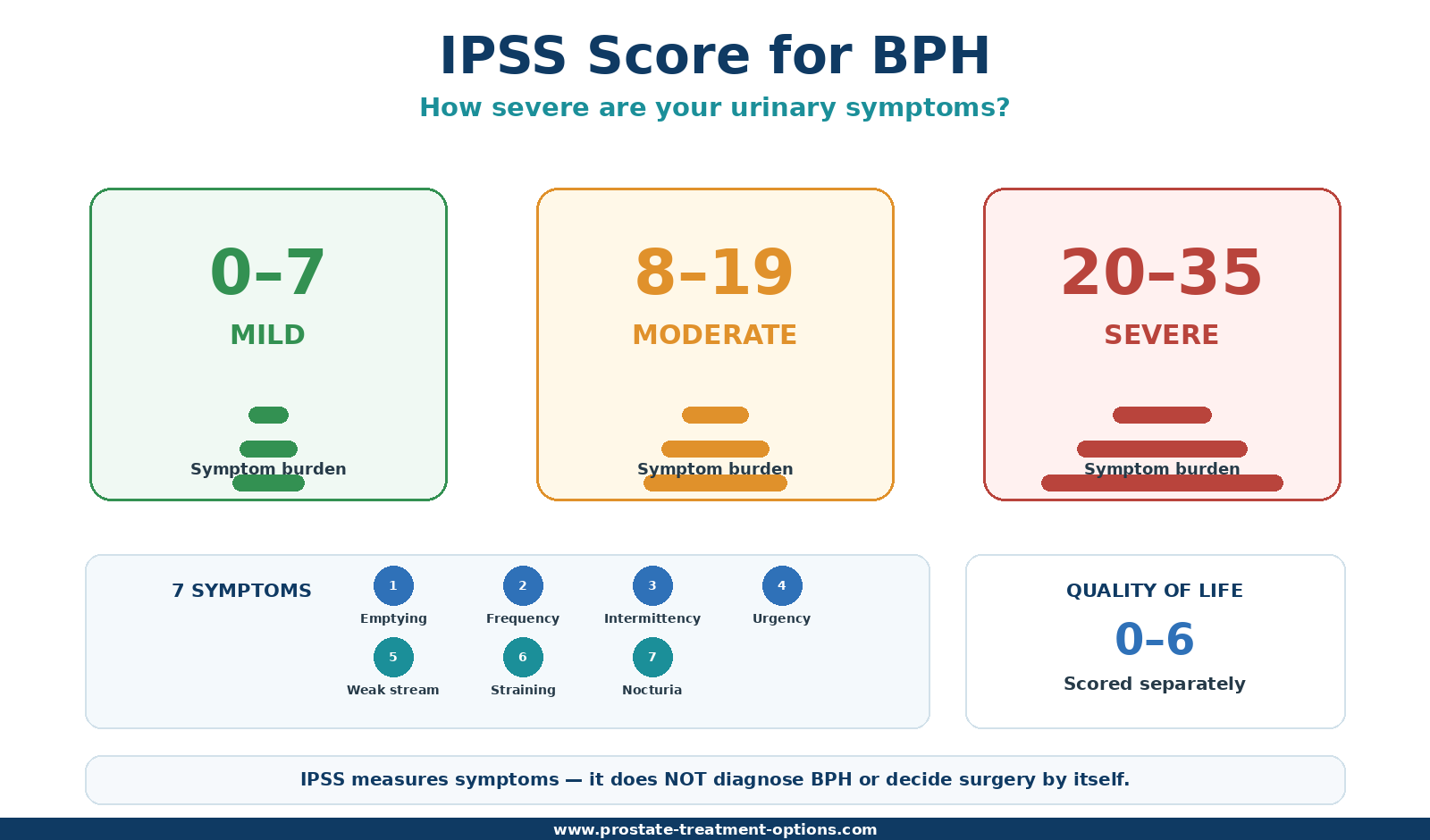
The International Prostate Symptom Score (IPSS) is a validated questionnaire used to measure the severity of male lower urinary tract symptoms. Seven symptom items are each scored from 0 to 5, giving a total symptom score from 0 to 35.
Current EAU guidance classifies the score as:
- 0: asymptomatic;
- 1–7: mildly symptomatic;
- 8–19: moderately symptomatic;
- 20–35: severely symptomatic.
A separate quality-of-life question is scored from 0 to 6 and is not added to the 0–35 total.
Most importantly, IPSS measures symptom burden; it does not diagnose BPH, measure prostate size, prove bladder-outlet obstruction, detect prostate cancer or decide whether surgery is needed. Treatment depends on how bothered you are, the likely cause of the symptoms, objective testing, complications and your priorities.
What Is the IPSS?
The International Prostate Symptom Score is one of the most widely used questionnaires for men with lower urinary tract symptoms.
It developed from the American Urological Association Symptom Index. The AUA states that the AUA Symptom Index and IPSS use the same seven symptom questions, responses and interpretation, while the IPSS is conventionally used together with a separate urinary quality-of-life question.
EAU 2026 strongly recommends using a validated symptom score that includes bother and quality-of-life assessment during:
- the initial assessment of male LUTS;
- re-evaluation during treatment;
- and follow-up after treatment.
Why Is It Useful?
The IPSS turns subjective urinary symptoms into a reproducible number.
This helps clinicians:
- quantify symptom severity;
- identify whether storage or flow/emptying symptoms predominate;
- establish a baseline before treatment;
- measure improvement or worsening over time;
- and discuss whether symptoms are bothersome enough to justify treatment.
IPSS Is a Symptom Tool, Not a Prostate Test
A man can have a high IPSS without having important BPH obstruction, and another man can have significant obstruction or retention with a relatively modest symptom score. The questionnaire describes what you experience; tests such as PVR, uroflowmetry and imaging help explain why.
Which 7 Urinary Symptoms Are Included in the IPSS?
The questionnaire covers seven symptom areas during the preceding month:
| IPSS Item | Symptom Area | What It Reflects |
|---|---|---|
| 1 | Incomplete emptying | The sensation that the bladder has not fully emptied after urination. |
| 2 | Frequency | Having to urinate again relatively soon after a previous void. |
| 3 | Intermittency | The urinary stream stopping and starting. |
| 4 | Urgency | Difficulty postponing the need to urinate. |
| 5 | Weak stream | Reduced perceived force of urinary flow. |
| 6 | Straining | Needing to push or strain to start or continue urinating. |
| 7 | Nocturia | Getting up from sleep to urinate at night. |
Storage vs Flow/Emptying Symptoms
For practical interpretation, the IPSS contains two broad symptom patterns:
- storage-related: frequency, urgency and nocturia;
- flow/emptying-related: incomplete emptying, intermittency, weak stream and straining.
This pattern can be useful, but it is not diagnostic.
For example, urgency and frequency may come primarily from overactive bladder rather than prostate obstruction, while weak flow may result from BPH or a weak bladder muscle.
How Is the IPSS Score Calculated?
Each of the seven symptom items receives a score from 0 to 5.
For the first six symptom areas, the score increases according to how frequently the symptom occurred during the previous month. Nocturia is scored according to how many times a person typically gets up to urinate at night, capped at the questionnaire’s highest score.
Add the seven symptom scores:
Maximum total = 35 points.
Simple Example
If a patient’s seven symptom scores are:
2 + 3 + 1 + 3 + 3 + 1 + 2 = 15
the total IPSS is 15, which falls into the moderate symptom range.
That does not automatically mean he needs medication. The next questions are:
- How bothered is he?
- Which symptoms dominate?
- What is causing the symptoms?
- Is his bladder emptying safely?
- Are there complications?
What Do Mild, Moderate and Severe IPSS Scores Actually Mean?
Mild Symptoms
EAU technically separates score 0 as asymptomatic and 1–7 as mildly symptomatic.
A man with mild, uncomplicated symptoms who is minimally bothered is often suitable for watchful waiting, lifestyle measures and periodic monitoring.
Moderate Symptoms
Symptoms are more frequent or noticeable, but treatment still depends heavily on bother and the clinical findings.
Some men choose medication; others with moderate symptoms and little bother can still reasonably use watchful waiting.
Severe Symptoms
A high score indicates a heavy symptom burden and deserves careful evaluation.
Active treatment is commonly appropriate when symptoms are bothersome, but severe IPSS alone does not automatically mean prostate surgery.
Why the Category Is Only the Beginning
Two men can both have an IPSS of 18 but need completely different treatment.
One may have:
- urgency and nocturia from overactive bladder;
- a normal flow;
- and almost no residual urine.
The other may have:
- a very weak stream;
- large residual urine;
- and clear benign prostatic obstruction.
The same total score does not mean the same disease.
What Is the IPSS Quality-of-Life Score?
The quality-of-life question asks how the patient feels about living with the urinary condition in its current state.
It is scored from:
- 0 = delighted;
- through intermediate levels of satisfaction/dissatisfaction;
- to 6 = terrible.
This score is separate from the seven symptom questions and should not be added to the 0–35 IPSS total.
Why Can QoL Matter More Than the Total Score?
Symptoms affect people differently.
For example:
- one man may tolerate a weak stream with little concern;
- another may find getting up three times every night exhausting;
- a third may be most distressed by sudden urgency when away from home.
EAU therefore recommends assessment of both symptoms and bother/quality of life rather than treating the number alone.
Moderate IPSS + High Bother Can Matter More Than Severe IPSS + Low Bother
Treatment is patient-centered. The severity category provides structure, while the QoL score helps show whether those symptoms are interfering enough with daily life to justify escalating treatment.
What Does the IPSS Not Tell You?
This is the most important part of interpreting the score correctly.
IPSS Does Not Diagnose BPH
EAU explicitly states that symptom scores are not disease-specific.
A high IPSS can occur with:
- benign prostatic obstruction;
- overactive bladder;
- urinary infection;
- prostatitis;
- urethral stricture;
- bladder stones;
- detrusor underactivity;
- neurological bladder dysfunction;
- or combinations of these conditions.
IPSS Does Not Prove Bladder-Outlet Obstruction
EAU reviewed symptom questionnaires against urodynamic testing and found that individual symptoms and questionnaires do not reliably diagnose bladder-outlet obstruction.
A man with severe symptoms may not be obstructed.
A man with mild symptoms may be obstructed.
IPSS Does Not Measure Prostate Size
A 25 mL prostate and an 80 mL prostate can produce similar symptom scores.
Likewise, a large prostate can cause relatively mild symptoms.
See Normal Prostate Size by Age.
IPSS Does Not Measure Residual Urine
You cannot estimate PVR reliably from the symptom score.
A bladder scan is needed to measure urine left after voiding.
IPSS Does Not Diagnose Prostate Cancer
Urinary symptoms and prostate cancer do not have a simple one-to-one relationship.
Prostate-cancer assessment uses a different pathway involving factors such as PSA, examination, MRI and biopsy when indicated.
See PSA Testing.
IPSS Does Not Cover Every Important Urinary Problem
EAU notes that the questionnaire does not adequately assess:
- urinary incontinence;
- post-micturition symptoms;
- and the bother caused by each individual symptom.
It also does not score pain, burning or blood in the urine. Those symptoms deserve separate evaluation.
Does Your IPSS Score Decide BPH Treatment?
No.
The score is one piece of the treatment decision.
Mild or Moderate and Minimally Bothered
EAU 2026 strongly recommends watchful waiting for men with mild or moderate uncomplicated LUTS who are minimally bothered.
That can include:
- education;
- fluid timing;
- reducing excess caffeine/alcohol;
- double voiding;
- monitoring symptoms;
- and periodic clinical review.
Moderate-to-Severe and Bothered
Medication may be appropriate depending on the symptom pattern, prostate size and progression risk.
Options can include:
- alpha blockers such as tamsulosin;
- tadalafil 5 mg daily in appropriate men;
- finasteride or dutasteride in enlarged glands;
- combination treatment;
- OAB-directed medication when storage symptoms dominate and bladder emptying is appropriate.
See BPH Medications and Tadalafil vs Tamsulosin.
When Surgery Is Considered
Surgery may be chosen because symptoms remain severe and bothersome despite appropriate treatment.
But surgery may also be needed because of complications even when the IPSS is not especially high.
EAU compelling indications include:
- recurrent or refractory urinary retention;
- recurrent UTIs;
- bladder stones;
- treatment-resistant visible BPH bleeding;
- upper urinary-tract dilation due to obstruction with or without kidney impairment.
How Is IPSS Used to Track Treatment?
One of the score’s strongest uses is comparing the same patient’s symptoms over time.
For example:
- before starting medication;
- after several weeks or months;
- before a procedure;
- and during follow-up after treatment.
Is a 1-Point Change Meaningful?
Usually not by itself.
AUA evidence reviews have historically used an IPSS difference of about 3 points as a threshold for a minimally detectable or clinically important treatment effect in trials.
However, the exact amount that feels meaningful to an individual patient can vary.
A 2025 patient-centered study reported a mean minimal important difference of approximately 5.3 points overall, with about 4 points in men starting with moderate symptoms and a larger change in men starting with severe symptoms. That study came from a single randomized trial, so it should not replace established interpretation by itself.
Look at the Trend, Not One Small Score Change
IPSS can fluctuate because symptoms vary from week to week. A meaningful interpretation should consider the size and persistence of the change, how the patient actually feels, and whether objective findings such as flow or PVR also changed.
Can You Have a High IPSS With a Small Prostate?
Yes.
A high symptom score does not require a large gland.
Possible explanations include:
- overactive bladder;
- a small/moderate gland with a strategically obstructing median lobe;
- bladder-neck dysfunction;
- urethral stricture;
- prostatitis;
- weak bladder function;
- or mixed lower urinary tract dysfunction.
This is one reason not to prescribe a prostate-shrinking medicine solely because the IPSS is high.
A 5-alpha-reductase inhibitor is chosen based on demonstrable prostate enlargement and progression risk—not symptom score alone.
See Median Lobe BPH.
Can You Have a Low IPSS but Still Have Serious BPH?
Yes.
Symptoms and objective obstruction do not always match.
For example, a man may adapt gradually to:
- very slow flow;
- large residual urine;
- chronic retention;
- or reduced bladder sensation.
He may report surprisingly little bother despite clinically important poor emptying.
Research has shown that some men with mild symptom scores still have urodynamically demonstrated bladder-outlet obstruction.
This matters especially when there are complications such as:
- recurrent retention;
- recurrent urinary infection;
- bladder stones;
- hydronephrosis;
- or kidney impairment.
Do Not Let a Low IPSS Reassure You During Urinary Retention
Sudden inability to urinate, painful bladder distension, kidney obstruction, recurrent infection or other complications require medical assessment regardless of the symptom-score category.
Which Other Tests Should Be Interpreted Alongside IPSS?
Depending on the clinical situation, the symptom score may be combined with:
- medical history and medication review;
- physical examination and DRE;
- urinalysis;
- PSA when it would change management;
- post-void residual;
- uroflowmetry;
- prostate volume/anatomy;
- a 3-day bladder diary, especially for nocturia;
- kidney-function testing when indicated;
- and selective cystoscopy or urodynamics.
EAU strongly recommends validated symptom scoring, but it places IPSS within a broader diagnostic evaluation rather than using it as a stand-alone BPH test.
Dr. Albana’s Note
I find the IPSS useful because it turns a patient’s urinary experience into something we can measure and compare over time.
But I would never tell a patient, “Your score is 22, so you need surgery.” That is not what the score means.
A score of 22 tells me the symptoms are severe. I still need to know which symptoms are causing the score, how bothered the patient is, whether the prostate is enlarged, whether flow is poor, whether significant urine remains in the bladder and whether there are complications.
Likewise, a score of 6 does not prove everything is safe. A patient can have relatively few perceived symptoms but still have chronic retention, infection, stones or upper-tract obstruction.
The quality-of-life question is also important. A moderate IPSS can be very significant when one symptom—such as urgency or nocturia—is dominating the patient’s life.
My practical approach is therefore: use IPSS to measure symptoms, then use clinical evaluation to explain them.
— Dr. Albana Greca, MD, MMedSc, Family Physician / General Practitioner
Frequently Asked Questions About the IPSS Score
What is a normal IPSS score?
A score of 0 means no symptoms on the questionnaire. Scores of 1–7 are categorized as mild. There is no requirement for every healthy man to score zero, and treatment depends on bother and clinical findings.
What does an IPSS of 5 mean?
A score of 5 falls in the mild symptom range. If symptoms are minimally bothersome and there are no complications, watchful waiting and lifestyle measures are often reasonable.
What does an IPSS of 10 mean?
A score of 10 is moderate. Whether treatment is needed depends on bother, the symptom pattern, prostate/bladder findings and patient preference.
What does an IPSS of 18 mean?
A score of 18 is near the upper end of the moderate range. It indicates substantial symptoms but does not diagnose obstruction or automatically require surgery.
What does an IPSS of 25 mean?
A score of 25 is severe. A thorough evaluation and active treatment discussion are appropriate if symptoms are bothersome, but the score alone does not determine the treatment.
Does IPSS diagnose an enlarged prostate?
No. IPSS measures urinary symptoms. Prostate enlargement is assessed separately using examination, ultrasound or other appropriate imaging.
Does a high IPSS mean the prostate is blocking the bladder?
No. EAU guidance states that symptom scores do not reliably diagnose bladder-outlet obstruction. PVR, uroflowmetry, anatomy and sometimes urodynamics are needed to understand the mechanism.
Is the quality-of-life score included in the IPSS total?
No. The seven symptoms total 0–35. The QoL question is scored separately from 0–6.
How many points should IPSS improve after treatment?
Around 3 points has historically been used as a minimally important/detectable threshold in many AUA evidence reviews, but individual perception varies and newer patient-centered research suggests larger changes may be needed for some men.
Can IPSS detect prostate cancer?
No. IPSS is not a prostate-cancer screening or diagnostic tool.
Can I have severe BPH with a low IPSS?
Yes. Symptoms do not always correlate closely with obstruction or complications. Objective assessment is especially important when retention, infection, stones, hydronephrosis or kidney dysfunction is suspected.
Related BPH Test & Symptom Guides
Medical References
- European Association of Urology. Guidelines on the Management of Non-neurogenic Male Lower Urinary Tract Symptoms: Diagnostic Evaluation. 2026. IPSS consists of seven symptom questions plus one QoL question; categories are 0 asymptomatic, 1–7 mild, 8–19 moderate and 20–35 severe. Symptom questionnaires quantify LUTS but do not diagnose bladder-outlet obstruction.
- European Association of Urology. Guidelines on the Management of Non-neurogenic Male Lower Urinary Tract Symptoms: Disease Management. 2026. Watchful waiting is recommended for mild/moderate LUTS when minimally bothersome; treatment selection depends on evaluation findings, bother, patient preferences, expected benefits, adverse effects and progression risk.
- American Urological Association. Benign Prostatic Hyperplasia Guideline. The AUA Symptom Index and IPSS use the same seven symptom items and scoring; the urinary quality-of-life question is scored separately from 0–6.
- Barry MJ, et al. The American Urological Association symptom index for benign prostatic hyperplasia. J Urol. Validation of the seven-item symptom index.
- Barry MJ, et al. Benign prostatic hyperplasia specific health status measures in clinical research: how much change is perceptible to patients? J Urol. 1995. Foundation for interpretation of clinically meaningful symptom-score change.
- Defining the Minimal Important Difference in International Prostate Symptom Score for Men with Lower Urinary Tract Symptoms Using a Patient-centered Anchor Measure. 2025. PMID 41079976. Reported an overall MID of approximately 5.3 points in one randomized-trial dataset.
Medical information notice: IPSS is a symptom-severity questionnaire, not a stand-alone diagnosis. Urinary symptoms may result from BPH, OAB, infection, prostatitis, stricture, bladder stones, detrusor underactivity, neurological disease or mixed causes. Urgent urinary retention or BPH complications require assessment regardless of IPSS category.
Written & medically reviewed by Dr. Albana Greca, MD, MMedSc • Family Physician / General Practitioner • Founder & Lead Medical Author • Last medically reviewed: September 2026