
Quick Answer
A weak urine stream does not automatically mean an enlarged prostate is blocking the bladder. The same symptoms can occur when the bladder muscle itself does not contract strongly or long enough to empty normally.
The medical term detrusor underactivity (DU) is reserved for a bladder-contractility problem demonstrated during urodynamic testing. Symptoms suggesting a weak bladder are often described as underactive bladder (UAB). BPH-related obstruction is different: the bladder may contract normally or even strongly, but it is pushing against increased resistance at the prostate/bladder outlet.
Unfortunately, weak stream, hesitancy, prolonged urination, incomplete emptying, high post-void residual and even urinary retention can occur with either condition—or both together. Prostate size, PVR and uroflowmetry provide clues but cannot reliably separate them. When the distinction will change an invasive treatment decision, a pressure-flow urodynamic study is the accepted test for distinguishing low-pressure/low-flow detrusor underactivity from high-pressure/low-flow bladder-outlet obstruction.
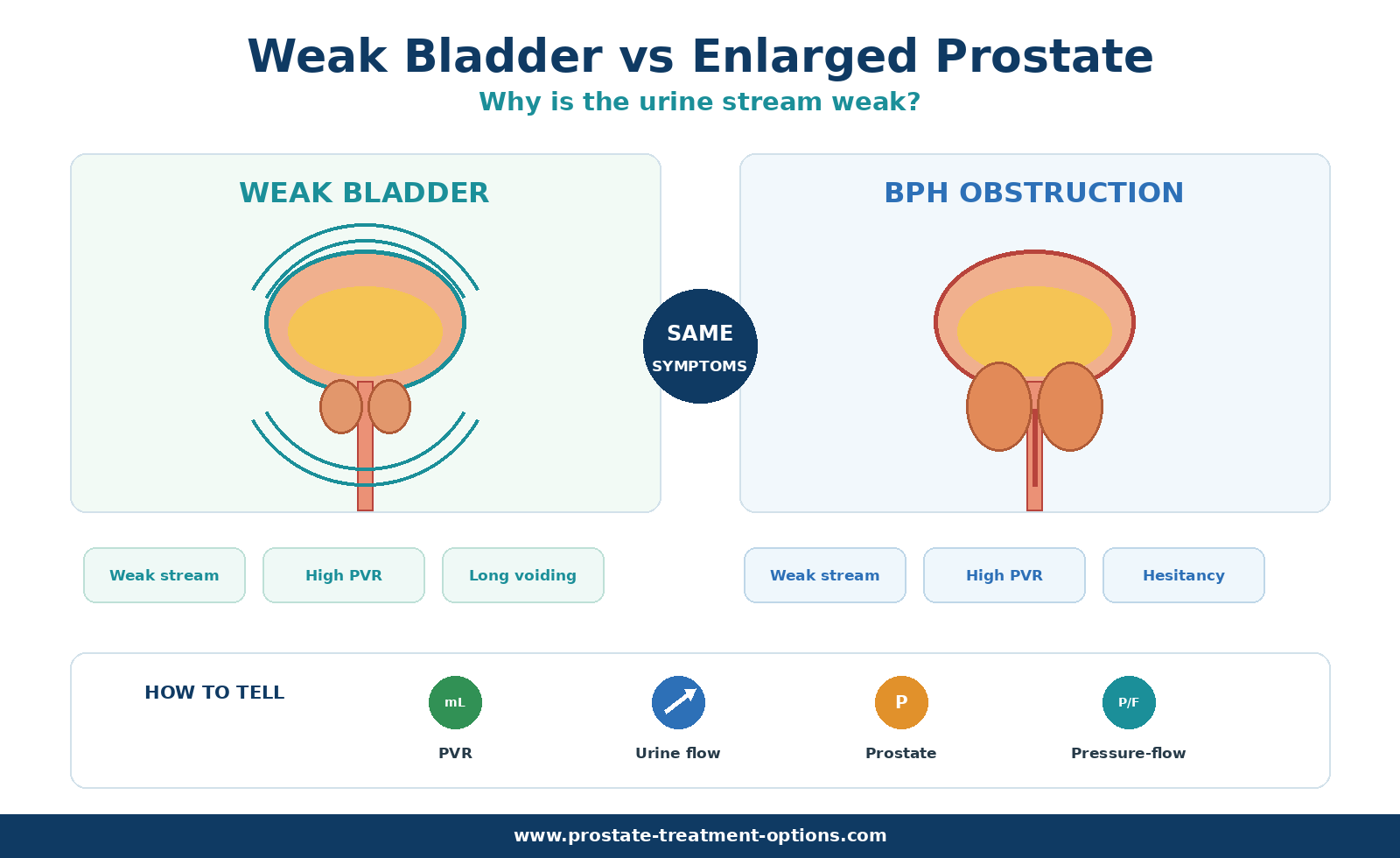
Weak Bladder vs Enlarged Prostate: What Is the Real Difference?
Urination requires two things to happen at the same time:
- the bladder muscle must contract strongly enough;
- and the bladder outlet must open with sufficiently low resistance.
A problem with either side can produce poor flow.
Detrusor Underactivity: The Pump Is Weak
The detrusor is the smooth muscle in the bladder wall. In DU, its contraction has reduced strength and/or duration, so bladder emptying takes too long or remains incomplete.
BPH Obstruction: The Outlet Is Resistant
The bladder contracts against increased resistance created by benign prostate enlargement and the bladder outlet. The bladder may generate substantial pressure yet still produce a low flow.
EAU uses several related terms carefully:
- BPH technically describes benign histological prostate hyperplasia;
- benign prostatic enlargement (BPE) describes an enlarged gland;
- benign prostatic obstruction (BPO) means the enlargement is actually contributing to bladder-outlet obstruction;
- underactive bladder (UAB) refers to a symptom/clinical syndrome suggesting poor bladder contraction;
- detrusor underactivity (DU) is a urodynamic diagnosis.
The Simplest Way to Think About It
BPH obstruction = the bladder is pushing against a narrowed outlet. Detrusor underactivity = the bladder’s push is too weak or too short. Both can produce the same weak stream.
Do Weak Bladder and BPH Cause Different Symptoms?
Sometimes the pattern gives clues, but there is substantial overlap.
| Symptom / Finding | Detrusor Underactivity / Weak Bladder | BPH / Bladder-Outlet Obstruction |
|---|---|---|
| Weak stream | Very common | Very common |
| Hesitancy | Common | Common |
| Prolonged urination | Common clue | Can occur |
| Reduced sensation of bladder filling | Can support UAB | Less characteristic |
| Straining | May be used to compensate for weak contraction | May occur when pushing against obstruction |
| Incomplete emptying | Common | Common |
| High PVR | Common | Common |
| Urinary retention | Possible | Possible |
| Urgency/frequency | Can occur | Can occur, especially when bladder overactivity coexists |
| Large prostate | May be incidental | Supports BPE, but does not prove BPO |
This overlap explains why symptom questionnaires cannot reliably distinguish the two mechanisms.
If urgency and frequency dominate rather than weak flow, also see BPH vs Overactive Bladder.
Why Does the Bladder Muscle Become Underactive?
There is no single cause of detrusor underactivity.
Potential contributors include:
- age-related changes in bladder muscle and nerve function;
- diabetes and diabetic neuropathy;
- neurological disease or spinal disorders;
- pelvic surgery;
- pelvic radiotherapy;
- impaired bladder sensation;
- some medications;
- and other disorders affecting detrusor or neural function.
In older men, more than one mechanism can be present.
Does BPH “Wear Out” the Bladder?
This is often stated too confidently.
Severe obstruction and detrusor dysfunction can certainly coexist, and relieving obstruction may allow better emptying in selected men with DU. However, current evidence does not support telling every man that an enlarged prostate will inevitably weaken the bladder over time.
EAU notes that the natural history of detrusor contractility is incompletely understood. Some observational evidence has not shown that persistent obstruction necessarily causes progressive detrusor deterioration, nor that TURP automatically restores contractility.
Do Not Assume the Cause From Age Alone
Older age increases the prevalence of DU, but an older man can still have primarily mechanical BPH obstruction. Likewise, a younger man with weak flow may have bladder-neck obstruction, dysfunctional voiding or another problem rather than either classic BPH or DU.
Can You Have a Weak Bladder and an Enlarged Prostate at the Same Time?
Yes.
This is one of the most important reasons the diagnosis can become difficult.
A man may have:
- a genuinely obstructing enlarged prostate;
- reduced detrusor contractility;
- and sometimes detrusor overactivity as well.
In that situation, there are two questions:
- How much resistance is the prostate creating?
- How much contractile strength does the bladder still have?
The answers matter before prostate surgery because surgery can lower outlet resistance, but it cannot directly guarantee that a severely weak bladder will regain normal contraction.
Can Post-Void Residual Tell Whether the Bladder Is Weak?
No—not by itself.
A high post-void residual (PVR) tells us that the bladder did not empty efficiently.
EAU explicitly states that high PVR may result from:
- bladder-outlet obstruction;
- detrusor underactivity;
- or both.
There is also no single PVR cutoff that diagnoses DU.
EAU states that although high PVR is associated with detrusor underactivity, no consensus diagnostic cutoff has been established and one may never exist.
Does a PVR Above 300 mL Prove a Weak Bladder?
No.
In the EAU underactive-bladder section, persistently high residuals above about 300 mL are associated with increasing UTI concern and may lead to consideration of intermittent catheterization, but 300 mL is not a diagnostic threshold for DU and is not an automatic surgery cutoff.
Trend, symptoms, bladder capacity, kidney/upper-tract findings and the mechanism of poor emptying all matter.
Can Uroflowmetry Separate BPH Obstruction From a Weak Bladder?
Not reliably.
Both conditions can produce:
- low Qmax;
- prolonged voiding;
- an interrupted or flattened flow pattern;
- and incomplete emptying.
A low Qmax tells you that urine flow is poor. It does not explain whether the problem is:
- high outlet resistance;
- weak bladder pressure;
- or both.
EAU recommends uroflowmetry as part of male LUTS evaluation, but it does not accept free-flow testing as a substitute for pressure-flow urodynamics when a definitive diagnosis of obstruction is required.
Two Men Can Both Have Qmax = 7 mL/s
One may be generating high bladder pressure against an obstructing prostate.
The other may be generating very little pressure through a relatively open outlet. Their flow number looks the same, but the treatment implications are very different.
Does Prostate Size Tell You Whether the Prostate Is the Cause?
No.
A larger gland increases the likelihood that BPH may be clinically important, but prostate size and obstruction are not equivalent.
A man can have:
- a large prostate but relatively little outlet obstruction;
- a moderate-size prostate with substantial obstruction;
- or a prominent median lobe that obstructs strongly despite a modest total gland volume.
Intravesical prostatic protrusion (IPP), particularly a protruding median lobe, correlates more closely with obstruction than prostate size alone, but even IPP is not a perfect replacement for urodynamic pressure-flow testing.
What Test Can Actually Tell Weak Bladder From BPH Obstruction?
Pressure-flow urodynamics is the accepted invasive test for this distinction.
During the test, a catheter measures bladder pressure while urinary flow is recorded.
Bladder-Outlet Obstruction Pattern
Obstruction is characterized by:
higher detrusor pressure + reduced urinary flow.
The bladder is pushing hard, but the outlet is resistant.
Detrusor Underactivity Pattern
DU is characterized by:
reduced detrusor pressure + reduced urinary flow.
The bladder is not generating enough pressure or sustaining the contraction long enough.
Bladder Outlet Obstruction Index (BOOI)
For technically interested readers, EAU describes:
BOOI = detrusor pressure at Qmax − (2 × Qmax)
- BOOI >40 = obstructed;
- 20–40 = equivocal;
- <20 = unobstructed.
Bladder Contractility Index (BCI)
A commonly used contractility measure is:
BCI = detrusor pressure at Qmax + (5 × Qmax)
- >150 = strong;
- 100–150 = normal;
- <100 = weak contractility.
These indices help describe pressure-flow findings, but EAU also notes that there is still no universally accepted single urodynamic criterion defining every case of DU.
Does Every Man With BPH Need Urodynamics Before Surgery?
No.
EAU specifically states that pressure-flow studies are not routine before prostate surgery for every patient.
Urodynamics is used selectively when the result is likely to change management—for example:
- the mechanism remains uncertain;
- prior invasive LUTS treatment failed;
- the patient cannot void more than about 150 mL for testing;
- voiding symptoms are bothersome but Qmax is above 10 mL/s;
- or other clinical features make bladder function particularly important before an invasive procedure.
See the broader Prostate & Urinary Tests guide.
What Other Tests Are Usually Done First?
Before invasive urodynamics, the evaluation commonly includes:
- medical and medication history;
- IPSS or another validated symptom score;
- physical examination and DRE;
- urinalysis;
- PVR;
- uroflowmetry;
- prostate volume/anatomy when relevant;
- PSA when it would affect management;
- renal function or ultrasound when retention/hydronephrosis is a concern.
These tests can often make the likely mechanism clear enough that invasive urodynamics is unnecessary.
If the Enlarged Prostate Is the Main Problem, What Treatment Helps?
When there is clinically meaningful BPH obstruction and bladder contractility is adequate, treatment targets the outlet.
Alpha Blockers
Tamsulosin, alfuzosin and related drugs reduce smooth-muscle tone at the prostate/bladder outlet and can improve flow and symptoms quickly.
Finasteride or Dutasteride
When the gland is demonstrably enlarged and progression risk is meaningful, 5-alpha-reductase inhibitors can:
- shrink prostate volume over time;
- lower the risk of acute urinary retention;
- and reduce the future need for BPH surgery.
See Finasteride vs Dutasteride for BPH.
Procedures and Surgery
If obstruction remains severe or complications develop, procedures such as:
- HoLEP;
- TURP;
- Aquablation;
- selected minimally invasive procedures;
- or simple prostatectomy in selected very large glands
may lower outlet resistance substantially.
If the Bladder Muscle Is Weak, What Treatment Helps?
There is no medicine that reliably “strengthens” a weak detrusor back to normal in the way an alpha blocker relaxes an outlet or a 5-ARI shrinks a prostate.
Address Reversible Contributors
Management starts by reviewing:
- medications;
- diabetes control;
- neurological disease;
- constipation;
- pelvic-floor relaxation during voiding;
- and coexisting outlet obstruction.
Timed and Double Voiding
In selected patients, timed voiding and double voiding can help reduce retained urine.
Evidence in non-neurogenic men is limited, so these should be viewed as practical strategies rather than proven cures.
Intermittent Catheterization
When PVR remains persistently high and complete bladder drainage is necessary, EAU prefers intermittent catheterization over a long-term indwelling catheter when feasible.
This can reduce complications associated with chronic indwelling catheters.
Bethanechol and Similar “Bladder-Stimulating” Drugs
EAU strongly recommends not routinely using parasympathomimetic drugs such as bethanechol for men with underactive bladder because convincing efficacy is lacking and adverse effects can occur.
Alpha Blocker in UAB
EAU gives a weak recommendation to offer an alpha blocker before more invasive techniques in men with UAB, particularly where reducing outlet resistance may help.
Sacral Neuromodulation
For selected men with refractory DU and no BPO, sacral neuromodulation may be considered. Current male evidence is limited but suggests some patients can improve voided volume, PVR and flow.
If the Bladder Is Weak, Will BPH Surgery Still Help?
Sometimes—especially when genuine obstruction is also present.
This is one of the most important clinical messages on this page.
EAU 2026 summarizes evidence that men with DU or even an acontractile detrusor who also have BPO can experience improvements after de-obstructive prostate surgery in:
- IPSS;
- quality of life;
- Qmax;
- PVR;
- and, in some studies, bladder contractility.
A systematic review/meta-analysis comparing men with and without DU found that men with DU often had worse short-term functional outcomes after BPH surgery, but symptom and quality-of-life outcomes became more similar with longer follow-up.
Who Is Less Likely to Benefit?
Outcomes tend to be less favorable when there is:
- little or no actual bladder-outlet obstruction;
- very poor bladder contractility;
- older age;
- coexisting detrusor overactivity;
- or more advanced bladder dysfunction.
This is why prostate surgery should not be presented as a guaranteed cure for a weak bladder.
What About HoLEP?
EAU’s evidence review suggests that men with DU and BPO can improve after HoLEP, although objective outcomes may remain less favorable than in men with normal contractility.
Observational EAU evidence also associates laser enucleation with better outcomes than TURP or prostate photovaporization in this specific DU population, although evidence quality is not high enough to treat this as a universal rule.
If surgery is being discussed, see HoLEP vs TURP and Aquablation vs HoLEP.
A Large Prostate Alone Does Not Prove Surgery Will Fix Retention
If the bladder has very poor contractility and the prostate is not truly obstructing the outlet, removing prostate tissue may not restore normal voiding. This is precisely the situation in which pressure-flow urodynamics can prevent an incorrect assumption.
Can Bladder Contractility Recover After the Obstruction Is Removed?
It can in some men, but it is not guaranteed.
EAU cites studies in which a proportion of men with DU or even acontractile bladder recovered measurable detrusor contractions after de-obstructive surgery.
For example, one prospective HoLEP series in men with DU or acontractile detrusor plus BPO reported:
- return of significant bladder contractility in many patients;
- and spontaneous voiding with acceptable residual urine in most patients at follow-up.
Other studies show more modest recovery, and the long-term natural history remains uncertain.
The safest message is:
removing genuine obstruction can make it easier for a weak bladder to empty, but no operation can promise that the bladder muscle itself will become normal.
Weak Bladder, Chronic Retention and Kidney Risk
Severe incomplete emptying can become clinically important regardless of whether the cause is obstruction or DU.
Potential complications include:
- recurrent urinary infection;
- overflow incontinence;
- bladder stones;
- chronic catheter dependence;
- and, in high-pressure obstruction, hydronephrosis or kidney impairment.
A weak bladder with low pressure is not identical to high-pressure BPH obstruction in terms of upper-tract risk.
This is another reason not to infer kidney risk from PVR alone.
When Poor Bladder Emptying Needs Prompt Care
Seek urgent medical attention if you:
- cannot urinate at all;
- have a painful, increasingly full lower abdomen;
- have fever/chills with urinary symptoms;
- have heavy blood or clots in the urine;
- have new hydronephrosis or worsening kidney function;
- or develop new neurological symptoms such as leg weakness, saddle numbness or loss of bowel control.
Complete inability to urinate may be acute urinary retention and generally requires prompt bladder drainage.
Dr. Albana’s Note
If a patient tells me that he has a very weak stream and 300 mL left in his bladder, I would not automatically conclude that the prostate is blocking him.
Those findings tell me the bladder is emptying poorly. They do not tell me whether the problem is high outlet resistance, weak bladder contraction, or both.
I would look at the whole picture: prostate volume and median-lobe anatomy, uroflowmetry, repeated PVR, medications, diabetes or neurological disease, prior retention, and whether he has already failed treatment.
If prostate surgery is being considered and the mechanism remains uncertain, pressure-flow urodynamics can be extremely valuable. A high-pressure/low-flow pattern supports obstruction. A low-pressure/low-flow pattern supports detrusor underactivity.
This distinction matters because surgery removes resistance; it does not directly strengthen a weak detrusor. On the other hand, I would not deny surgery simply because DU is present if urodynamics also shows meaningful BPH obstruction. Current evidence shows that selected men with both conditions can improve substantially after de-obstruction.
— Dr. Albana Greca, MD, MMedSc, Family Physician / General Practitioner
Frequently Asked Questions About Weak Bladder vs Enlarged Prostate
Can a weak bladder cause a weak urine stream?
Yes. Detrusor underactivity can produce low flow, prolonged urination, hesitancy, incomplete emptying and urinary retention even when the prostate is not strongly obstructing the outlet.
Can BPH and a weak bladder occur together?
Yes. A man can have both reduced bladder contractility and genuine benign prostatic obstruction. Treatment decisions should account for both.
Does high PVR mean the bladder muscle is weak?
No. High PVR can result from obstruction, detrusor underactivity or both. EAU states that no PVR cutoff reliably diagnoses DU.
Does a large prostate prove BPH is causing the poor flow?
No. Prostate size increases suspicion but does not prove outlet obstruction. Prostate shape, median-lobe protrusion and functional testing can matter more.
Can uroflowmetry tell the difference?
Not reliably. Both obstruction and DU can produce a low Qmax. Pressure-flow urodynamics is the accepted test when a definitive distinction is needed.
What does low-pressure low-flow mean?
It suggests that the bladder is generating insufficient detrusor pressure, which supports detrusor underactivity. Interpretation must be made in a formal urodynamic context.
What does high-pressure low-flow mean?
It is the classic pressure-flow pattern of bladder-outlet obstruction: the bladder contracts strongly but urine flow remains restricted by outlet resistance.
Can tamsulosin help a weak bladder?
Tamsulosin does not strengthen the detrusor, but reducing outlet resistance may help some men empty more effectively. EAU gives alpha blockers a weak recommendation before more invasive approaches in male UAB.
Does bethanechol strengthen the bladder?
Evidence is inadequate to support routine use. EAU strongly recommends against routinely prescribing parasympathomimetics for male underactive bladder.
Will TURP or HoLEP work if my bladder is weak?
It can when genuine prostate obstruction is also present. Men with DU may have less predictable outcomes, especially when obstruction is absent or contractility is extremely poor. Urodynamic assessment and individualized counselling may therefore be important.
Can a weak bladder recover after HoLEP?
Some men regain better contractility and spontaneous voiding after obstruction is relieved, but recovery is not guaranteed. Surgery primarily reduces outlet resistance.
When is intermittent catheterization used?
It may be used when residual urine remains persistently high and the bladder cannot empty adequately. EAU generally prefers intermittent catheterization to long-term indwelling catheterization when feasible.
Related Prostate & Bladder Guides
Medical References
- European Association of Urology. Guidelines on the Management of Non-neurogenic Male Lower Urinary Tract Symptoms: Diagnostic Evaluation. 2026. High PVR may reflect BOO and/or detrusor underactivity; pressure-flow studies distinguish obstruction from DU; urodynamics is reserved for selected patients rather than routine use before all prostate surgery.
- European Association of Urology. Guidelines on the Management of Non-neurogenic Male Lower Urinary Tract Symptoms: Management of Underactive Bladder. 2026. DU is a urodynamic diagnosis; no PVR cutoff diagnoses DU; parasympathomimetics should not routinely be used; intermittent catheterization and selected sacral neuromodulation have roles in appropriate patients.
- Functional and safety outcomes after benign prostatic enlargement surgeries in men with detrusor underactivity compared with normal detrusor contractility: systematic review and meta-analysis. Neurourol Urodyn. 2024. PMID 38010924.
Medical information notice: “Weak bladder” is a nontechnical phrase. Underactive bladder describes a clinical symptom complex, while detrusor underactivity is formally diagnosed with urodynamic pressure-flow testing. Poor urine flow or high PVR alone cannot reliably distinguish DU from BPH obstruction.
Written & medically reviewed by Dr. Albana Greca, MD, MMedSc • Family Physician / General Practitioner • Founder & Lead Medical Author • Last medically reviewed: September 2026