
Quick Answer
Yes. An enlarged prostate can contribute to bladder-stone formation when it obstructs the bladder outlet and leaves urine behind after urination. Stagnant residual urine, concentrated minerals, infection, bladder diverticula and other factors can allow crystals to grow into bladder stones.
In adults, the European Association of Urology identifies bladder-outlet obstruction as the most common predisposing factor for bladder stones, accounting for roughly 45–79% of adult vesical calculi. BPH/BPO is therefore an important cause in older men—but a bladder stone does not prove that the prostate is the only problem.
Most secondary bladder stones require active removal. The key next decision is whether to remove the stone alone or remove the stone and treat the prostate obstruction at the same time. Current EAU guidance considers bladder stones a compelling indication for BPH surgery when they occur as part of clinically significant benign prostatic obstruction, but bladder function, PVR, flow and anatomy should still be assessed before assuming prostate surgery is necessary.
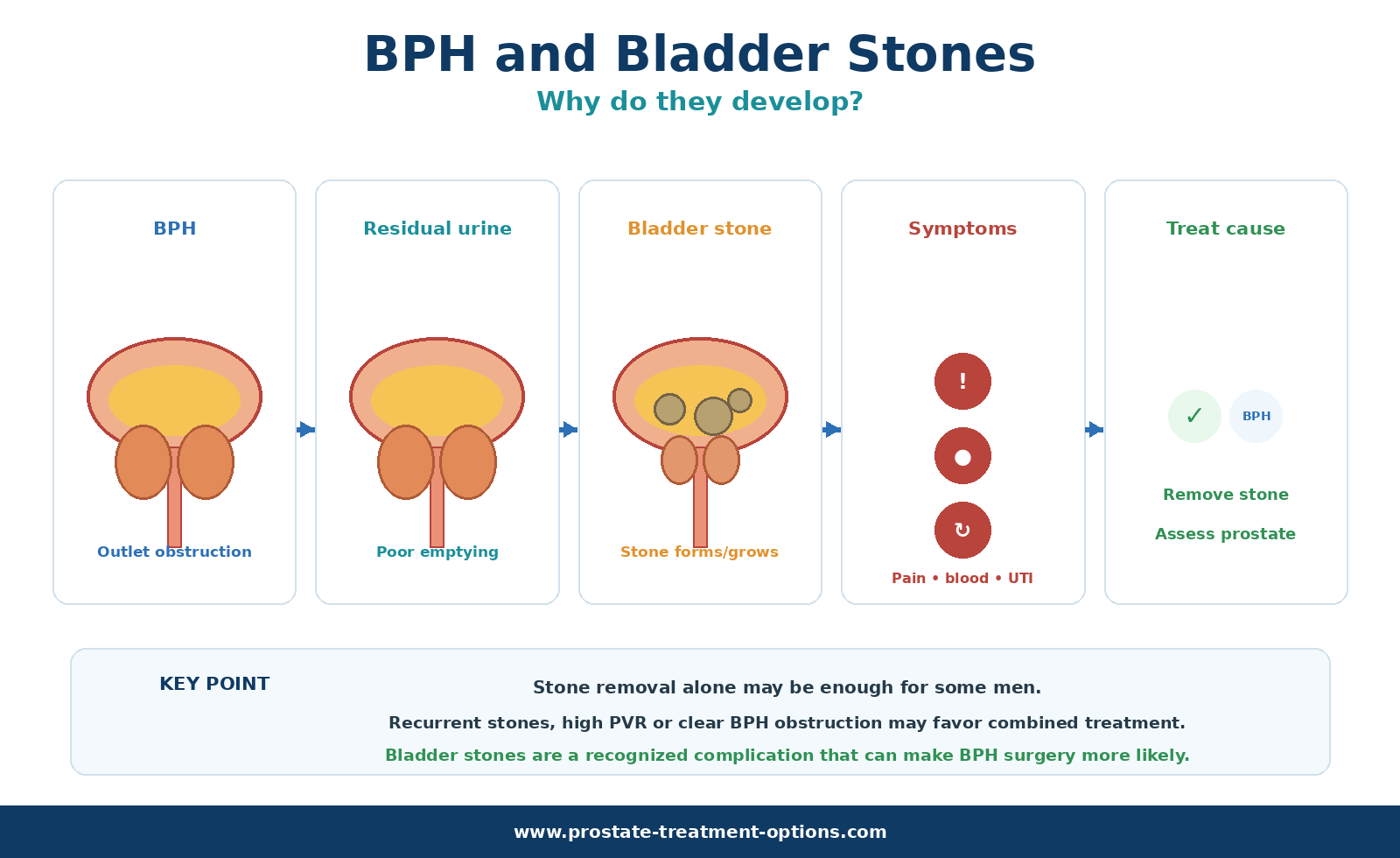
Why Can an Enlarged Prostate Cause Bladder Stones?
The bladder normally empties most of its urine with each void.
When benign prostate enlargement narrows the bladder outlet, urine may remain behind.
This creates several conditions that favor stone formation:
- urinary stasis: minerals remain in the bladder longer;
- concentrated residual urine: crystals have more opportunity to precipitate;
- chronic bacteriuria or infection: some infections alter urine chemistry and contribute to stone formation;
- foreign material: chronic catheters can act as a nidus for stone growth;
- bladder diverticula: urine can become trapped in outpouchings of the bladder wall.
EAU bladder-stone guidance states that adult bladder stones are often multifactorial, but bladder-outlet obstruction is the most common predisposing factor in adults.
Does Every Man With BPH Develop Bladder Stones?
No.
Bladder stones occur in only a minority of men with benign prostatic obstruction.
EAU reports that approximately 3–4.7% of men undergoing surgery for BPO have formed bladder stones.
Risk is not determined by prostate size alone.
Studies cited by EAU have found that larger intravesical prostatic protrusion (IPP), older age and lower urinary flow are associated with greater bladder-stone risk.
This fits with the practical concept that a protruding median lobe may obstruct the bladder strongly even if total prostate volume is not enormous.
What Symptoms Can Bladder Stones Cause?
Bladder stones may produce:
- pain or burning during urination;
- urinary frequency;
- urgency;
- interrupted or stop-start urinary stream;
- difficulty emptying the bladder;
- lower abdominal or suprapubic discomfort;
- blood in the urine;
- recurrent urinary infection;
- and, occasionally, acute urinary retention.
Some men have surprisingly few symptoms, particularly when the stone is found during imaging for another urinary problem.
Why Can the Stream Suddenly Stop?
A bladder stone can move toward the bladder outlet during urination and intermittently block urine flow.
The stream may:
- stop suddenly;
- restart after changing position;
- or become painful near the end of urination.
That pattern differs somewhat from the more consistent weak stream of uncomplicated BPH, although the two conditions often coexist.
For blood in the urine, see Can BPH Cause Blood in the Urine?.
Who Is More Likely to Develop a Bladder Stone?
Risk factors include:
Bladder Emptying Problems
- benign prostatic obstruction;
- high post-void residual;
- detrusor underactivity / weak bladder;
- neurogenic bladder;
- urethral stricture.
Other Predisposing Factors
- chronic bacteriuria;
- long-term catheter use;
- bladder diverticula;
- foreign bodies;
- prior urinary stones;
- metabolic stone risk.
This is important because the stone may be a marker of poor bladder emptying, but the cause of that poor emptying may not always be prostate obstruction.
How Are Bladder Stones Diagnosed?
Ultrasound
EAU strongly recommends ultrasound as first-line imaging when bladder stones are suspected.
Ultrasound can also provide useful information about:
- post-void residual;
- bladder wall changes;
- prostate size;
- and sometimes hydronephrosis.
Cystoscopy or CT
If symptoms strongly suggest a stone but ultrasound is negative, EAU recommends further investigation with:
- cystoscopy;
- CT;
- or, in selected situations, a plain KUB X-ray.
Cystoscopy has the advantage of directly visualizing the bladder stone, bladder lining and prostate/bladder-outlet anatomy.
Urinalysis and Culture
Urine testing helps look for:
- blood;
- infection;
- urine pH;
- and other abnormalities.
Stone Analysis and Metabolic Assessment
EAU recommends investigating the cause of bladder-stone formation and includes stone analysis and metabolic assessment when appropriate.
This matters because not all bladder stones are simply “BPH stones.”
Why Are PVR and Uroflowmetry Important?
EAU specifically recommends that patients with bladder stones be evaluated for the cause of stone formation, including:
- uroflowmetry;
- post-void residual;
- urine dipstick/pH and culture when needed.
A high PVR supports significant incomplete bladder emptying.
However, a high residual can occur because of:
- BPH obstruction;
- a weak bladder muscle;
- or both.
A low Qmax likewise suggests poor voiding but cannot, by itself, prove that the prostate is the cause.
If the mechanism is uncertain before an invasive procedure, see Weak Bladder or Enlarged Prostate?.
A Bladder Stone Does Not Automatically Prove Severe Prostate Obstruction
EAU cites a prospective urodynamic study of men over 60 with bladder stones in which only about 51% had bladder-outlet obstruction. About 10% had detrusor underactivity and some had normal urodynamic findings.
That is why a stone should trigger evaluation of the bladder outlet and bladder function rather than automatic assumption that every patient needs prostate surgery.
Do Bladder Stones Need to Be Removed?
Most secondary bladder stones—including those that develop because of outlet obstruction—are unlikely to pass spontaneously and usually require active treatment.
Very small migratory stones that have dropped from the kidney may occasionally pass if there is no bladder-outlet obstruction, bladder dysfunction or catheter, but that is a different clinical situation.
Transurethral Cystolithotripsy
This is the most common endoscopic approach in adults.
A scope is passed through the urethra into the bladder, and the stone is fragmented using an energy source such as:
- laser;
- pneumatic lithotripsy;
- ultrasonic energy;
- or another endoscopic fragmentation system.
The fragments are then removed.
EAU evidence supports transurethral cystolithotripsy as an effective approach with shorter hospital stay, less pain and shorter convalescence than percutaneous cystolithotripsy in adults.
Percutaneous Cystolithotripsy
The bladder is accessed through a small tract in the lower abdomen.
This may be used in selected cases when the transurethral route is less suitable.
Open Cystolithotomy
Open surgery is now less common but can still be appropriate for very large stones or specific anatomical circumstances.
Does a Bladder Stone Mean BPH Surgery Is Required?
Not automatically—but it makes the BPH question much more important.
EAU male-LUTS guidance lists bladder stones among the compelling/absolute indications that usually lead to surgical treatment when they are part of clinically significant benign prostatic obstruction.
However, EAU bladder-stone guidance takes a more nuanced view:
older teaching treated every bladder stone in an older man as proof that prostate surgery was necessary, but subsequent studies showed that some men with stones do not have urodynamically proven obstruction.
Therefore the decision should consider:
- prostate size;
- median-lobe protrusion;
- urinary flow;
- PVR;
- history of retention;
- recurrent infection;
- previous stone episodes;
- bladder contractility;
- and symptom severity.
Practical Interpretation
A first bladder stone does not force every man into prostate surgery. But if the stone formed in the setting of clear BPH obstruction, high residual urine or recurrent BPH complications, treating the obstruction becomes much more compelling.
Can the Bladder Stone and Enlarged Prostate Be Treated in the Same Operation?
Yes, and this is commonly done when significant BPH obstruction is present.
EAU reviews large studies supporting the safety of treating bladder stones and BPO during the same operation.
Stone Removal + TURP
Transurethral cystolithotripsy can be combined with TURP.
In a large observational study of more than 2,000 TURP patients, simultaneous bladder-stone treatment did not increase major complications, although urinary infection was slightly more frequent.
Stone Removal + HoLEP
HoLEP can also be combined with cystolithotripsy.
EAU cites studies showing no major long-term increase in complications.
One study found more early temporary urinary leakage when HoLEP and stone fragmentation were performed together, but long-term continence was similar.
For the broader procedure comparison, see BPH Surgery & Procedures and HoLEP vs TURP.
What If the Stone Is Removed but the Prostate Is Treated With Medication?
This can be reasonable in selected men who do not have a compelling need for immediate prostate surgery.
EAU discusses studies in which men underwent bladder-stone fragmentation and then received medical treatment for BPH with:
- an alpha blocker;
- or an alpha blocker plus a 5-alpha-reductase inhibitor.
Outcomes were mixed.
In one study, no men treated medically had a recurrent stone during about 28 months, but 34% ultimately required TURP. High PVR predicted later need for prostate surgery.
Another small observational study found that about 17% developed recurrent bladder stones during medical BPH management.
An RCT comparing simultaneous TURP with medical BPO treatment found that both groups improved in symptoms, flow and residual urine, but men with larger prostates and higher PVR were more likely to need TURP later.
This reinforces the individualized approach:
stone removal alone plus BPH medication can work for selected men, but persistent poor emptying increases the chance that definitive prostate treatment will eventually be needed.
Can BPH Medicines Prevent Another Bladder Stone?
They can reduce one important driver—outlet obstruction—but they are not direct stone-dissolving medicines.
Alpha Blockers
Alpha blockers such as tamsulosin can improve urinary flow and reduce symptoms relatively quickly.
They do not shrink the prostate or prevent long-term BPH progression.
Finasteride or Dutasteride
When the prostate is demonstrably enlarged, a 5-alpha-reductase inhibitor can shrink prostate volume over time and reduce:
- BPH progression;
- acute urinary retention;
- and future BPH surgery risk.
For selected patients after stone removal, this may reduce persistent outlet obstruction and poor emptying.
See Finasteride vs Dutasteride for BPH.
Can Bladder Stones Be Dissolved With Medication?
Most cannot.
EAU notes that uric acid bladder stones may sometimes be dissolved by sustained urinary alkalinisation to a pH above about 6.5 using agents such as citrate or sodium bicarbonate, with careful monitoring.
That approach applies only to suitable stone chemistry and should not be confused with treating the BPH obstruction that allowed the stone to form.
How Can Bladder-Stone Recurrence Be Reduced?
Prevention depends on the cause.
For a man with BPH, the most important questions are:
- Does the bladder empty adequately?
- Is the prostate truly obstructing the outlet?
- Is a median lobe contributing?
- Is chronic infection present?
- Is a catheter or foreign body contributing?
- Does the stone analysis reveal a metabolic risk that also needs treatment?
Improve Bladder Emptying
This may involve:
- BPH medication;
- definitive prostate surgery when indicated;
- management of a weak bladder;
- or catheter strategies in selected patients.
Treat Infection
Recurrent or chronic bacteriuria can promote secondary bladder stones.
Hydration
Adequate hydration reduces urinary concentration, although simply drinking more water cannot overcome significant bladder-outlet obstruction.
Analyze the Stone
Stone composition can guide metabolic prevention when relevant.
When a Bladder Stone Needs Prompt Medical Care
Seek urgent assessment if you develop:
- complete inability to urinate;
- severe lower-abdominal pain with a full bladder;
- fever or chills;
- heavy blood in the urine or blood clots;
- severe persistent pain;
- markedly reduced urine output;
- or symptoms of kidney obstruction/infection.
A stone can occasionally obstruct the bladder outlet and cause acute urinary retention.
Dr. Albana’s Note
When a man with BPH develops a bladder stone, I would see the stone as a clue that we need to understand how well the bladder is emptying—but not as proof that the prostate alone is responsible.
I would want to know the PVR, urinary flow, prostate size and shape, whether there is a median lobe, whether infections have been recurring and whether the bladder muscle itself is weak.
Most secondary bladder stones need to be removed. The more difficult question is whether the prostate should be treated at the same time.
If the man has clear outlet obstruction, a large residual, recurrent stones, repeated retention or other BPH complications, treating the stone and the prostate obstruction together is often the more durable strategy.
On the other hand, selected men can have the stone removed and initially manage the BPH medically. Current EAU evidence supports that option in some patients, but the chance of later prostate surgery is higher when PVR remains high or the prostate is substantially enlarged.
So I would not make the decision based on the stone alone. I would use the stone as a reason to investigate and treat the underlying urinary problem properly.
— Dr. Albana Greca, MD, MMedSc, Family Physician / General Practitioner
Frequently Asked Questions About BPH and Bladder Stones
Can an enlarged prostate cause bladder stones?
Yes. BPH can cause bladder-outlet obstruction and residual urine, creating conditions that allow bladder stones to form. In adults, outlet obstruction is the most common predisposing factor for bladder stones.
Does a bladder stone prove that my prostate is obstructing me?
No. Bladder stones have several causes, and some older men with bladder stones do not have urodynamically proven bladder-outlet obstruction. PVR, urinary flow, anatomy and bladder function should be assessed.
Can a bladder stone pass on its own?
Secondary bladder stones associated with outlet obstruction are usually unlikely to pass and generally require active removal. Small migratory stones may occasionally pass when there is no obstruction or bladder dysfunction.
How are bladder stones removed?
Most adult bladder stones are treated endoscopically with transurethral cystolithotripsy. Percutaneous or open approaches are used in selected situations.
Can bladder stones and BPH surgery be treated at the same time?
Yes. Stone fragmentation can be combined with TURP, HoLEP and other appropriate BPH procedures. EAU cites large studies supporting the safety of concomitant treatment.
Do I definitely need TURP if I have a bladder stone?
No. Selected men can have the stone removed and initially manage BPH medically. However, high residual urine, large prostate size, recurrent stones or other BPH complications increase the likelihood that prostate surgery will ultimately be needed.
Can HoLEP remove bladder stones?
HoLEP treats the prostate obstruction, while the stone is fragmented with cystolithotripsy during the same anesthetic session. This combined approach is commonly used when appropriate.
Can bladder stones cause blood in the urine?
Yes. Stones can irritate the bladder lining and cause microscopic or visible hematuria. Blood in the urine still deserves appropriate evaluation.
Can bladder stones cause urinary infection?
Yes. Stones and incomplete bladder emptying can contribute to recurrent bacteriuria or urinary infection, and infection can also contribute to some stone types.
Can finasteride prevent bladder stones?
Finasteride does not directly prevent or dissolve stones. In men with an enlarged prostate, it can shrink the gland and reduce BPH progression over time, which may help improve the underlying obstruction contributing to stone formation.
Related BPH Complication Guides
Medical References
- European Association of Urology. EAU Guidelines on Urolithiasis: Bladder Stones. 2026. Bladder-outlet obstruction is the most common predisposing factor for adult bladder stones; evaluation should include uroflowmetry, PVR, urinalysis/pH/culture, stone analysis and assessment of the underlying cause.
- European Association of Urology. Guidelines on the Management of Non-neurogenic Male Lower Urinary Tract Symptoms: Disease Management. 2026. Bladder stones are among the compelling indications for BPH/BPO surgery when they occur as a complication of obstruction.
- EAU bladder-stone evidence on concomitant cystolithotripsy with TURP or HoLEP and on medical BPO management after stone treatment.
Medical information notice: Bladder stones can arise from BPH obstruction, weak bladder emptying, chronic infection, catheters, diverticula, metabolic stone disease and other causes. The stone and the cause of stone formation both require assessment.
Written & medically reviewed by Dr. Albana Greca, MD, MMedSc • Family Physician / General Practitioner • Founder & Lead Medical Author • Last medically reviewed: September 2026