
Quick Answer
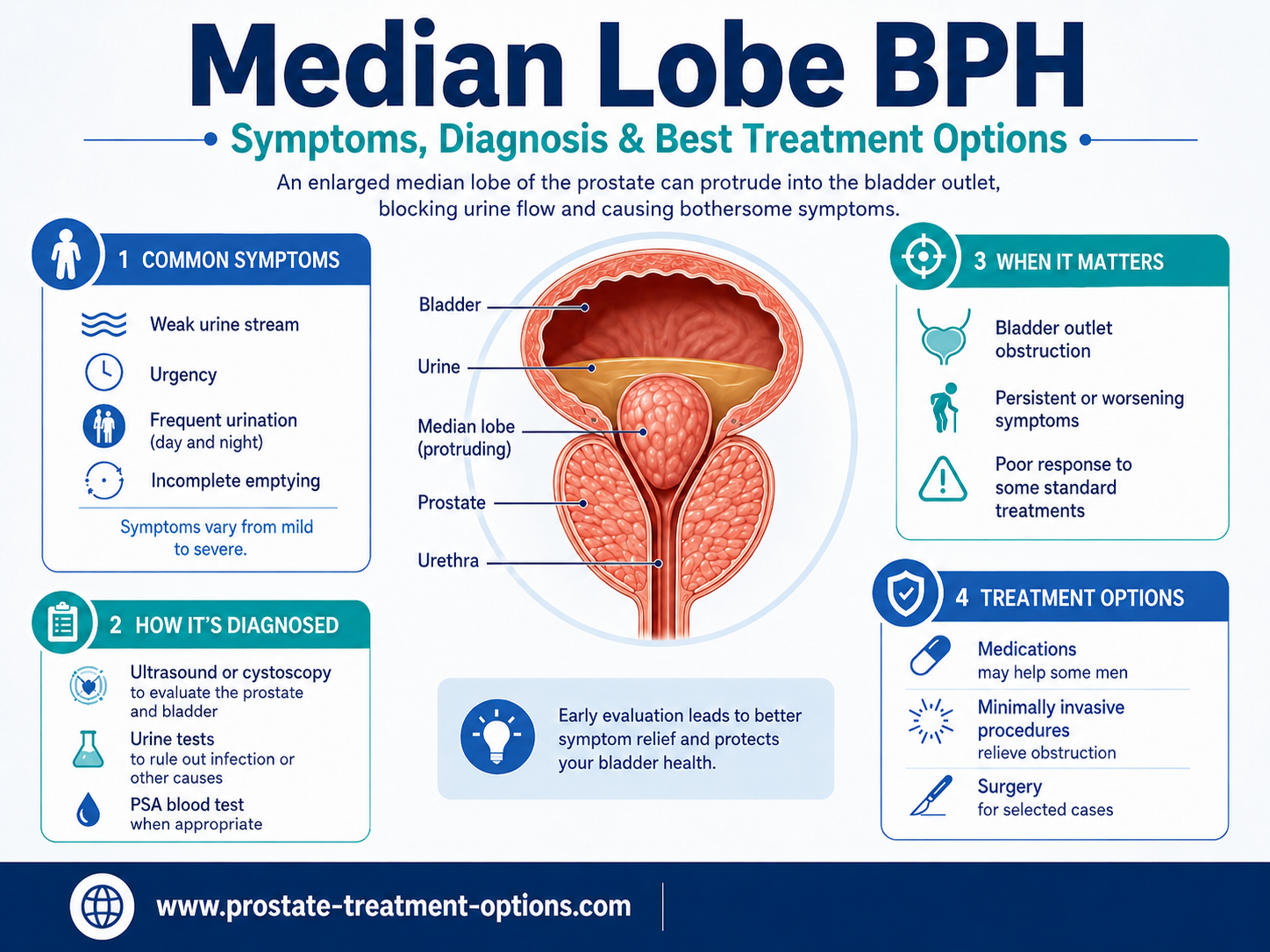
Median lobe BPH means that benign prostate tissue in the central/median portion of the gland enlarges upward toward the bladder neck and may protrude into the bladder. This can create a ball-valve type obstruction, making it difficult for the bladder to empty even when the total prostate volume is not extremely large.
Symptoms are the same lower urinary tract symptoms seen with other forms of BPH: weak stream, hesitancy, straining, incomplete emptying, urgency, frequency, nocturia and sometimes urinary retention. The median lobe is usually identified with ultrasound, transrectal ultrasound or cystoscopy. Intravesical prostatic protrusion (IPP) can be measured on ultrasound and can help estimate the likelihood of bladder outlet obstruction.
Median-lobe anatomy matters most when choosing a procedure. HoLEP, TURP, Aquablation and Rezūm can treat an obstructing median lobe. GreenLight laser vaporization can also be used in experienced hands. UroLift is more complicated: studies show that selected obstructive median lobes can be treated, but the EAU 2026 guideline still recommends PUL/UroLift only for prostates under 70 mL without a middle lobe because guideline-level long-term evidence for median-lobe treatment remains limited.
What Is Median Lobe BPH?
The prostate sits directly below the bladder and surrounds the first portion of the urethra. BPH can enlarge different parts of the gland.
In some men, tissue near the median or middle lobe grows upward into the bladder outlet. When that tissue protrudes into the bladder, doctors may describe it as intravesical prostatic protrusion (IPP).
The important issue is not the word “lobe” itself. What matters clinically is whether this tissue is obstructing the bladder outlet.
Why Can a Median Lobe Cause Significant Obstruction?
A protruding median lobe can act like a flap or ball valve at the bladder neck. During urination, bladder pressure may push the protruding tissue toward the outlet rather than opening it. This helps explain why some men with only a moderately enlarged prostate can still have severe obstruction.
Median-lobe enlargement is still benign prostatic hyperplasia. It does not mean prostate cancer, and BPH does not turn into prostate cancer.
For the broader condition, see Enlarged Prostate (BPH): Causes, Symptoms & Treatment.
What Symptoms Can Median Lobe BPH Cause?
There is no unique symptom that proves a median lobe is present. Symptoms overlap with ordinary BPH and other causes of male LUTS.
Voiding Symptoms
- weak urinary stream;
- difficulty starting;
- intermittent flow;
- straining;
- longer time to urinate;
- dribbling;
- feeling incompletely empty.
Storage Symptoms
- urgency;
- frequent urination;
- nocturia;
- urgency leakage in some men;
- small frequent voids when emptying is poor.
More advanced obstruction can contribute to:
- high post-void residual urine;
- acute urinary retention;
- recurrent urinary infection in some patients;
- bladder stones;
- bladder wall changes from chronic obstruction;
- and, in severe prolonged cases, kidney problems from urinary obstruction.
However, symptoms alone cannot tell you whether the median lobe—or even the prostate—is the main cause. Bladder overactivity, weak bladder muscle, urethral stricture, infection and neurological disease can produce similar complaints.
See Enlarged Prostate Symptoms: LUTS, Warning Signs & When to Seek Help.
How Is Median Lobe BPH Diagnosed?
A standard BPH evaluation begins with symptoms and bladder function rather than imaging alone.
Depending on the situation, your clinician may use:
- medical and medication history;
- International Prostate Symptom Score (IPSS);
- urinalysis;
- PSA when appropriate;
- post-void residual (PVR);
- uroflowmetry;
- ultrasound or transrectal ultrasound (TRUS);
- cystoscopy when anatomy needs direct inspection;
- and selected urodynamic testing when it is uncertain whether poor flow is due to obstruction or weak bladder contraction.
Ultrasound and TRUS
EAU guidance states that prostate size and shape can be assessed using transabdominal ultrasound or TRUS. Identifying a median lobe can directly affect procedural selection because some minimally invasive techniques have anatomical restrictions.
TRUS can define overall prostate volume, median-lobe prominence, prostate configuration and anatomy relevant to procedural planning.
Cystoscopy
A flexible cystoscope allows the urologist to look through the urethra and directly inspect the bladder neck and prostate channel. It can show an obstructing median lobe, lateral-lobe obstruction, urethral stricture, bladder stones and bladder changes associated with chronic obstruction.
Cystoscopy is not required for every man with BPH, but it can be particularly useful when choosing a procedure whose success depends on anatomy.
What Is Intravesical Prostatic Protrusion (IPP)?
IPP measures how far prostate tissue protrudes upward into the bladder.
EAU describes ultrasound measurement from the tip of the protruding median prostate tissue to the bladder neck in the midsagittal plane, usually with a moderately filled bladder.
| IPP Grade | Protrusion Into Bladder | What It Suggests |
|---|---|---|
| Grade I | 0–4.9 mm | Small protrusion |
| Grade II | 5–10 mm | Moderate protrusion |
| Grade III | >10 mm | Marked protrusion; higher probability of bladder outlet obstruction |
Does IPP Prove That the Bladder Is Obstructed?
No. IPP is useful, but it is not perfect.
A 2026 systematic review and meta-analysis of 10 studies involving 1,253 men found that IPP was associated with urodynamically confirmed bladder outlet obstruction. Thresholds around 10–12 mm produced approximately 71% sensitivity and 75.5% specificity.
That means a pronounced IPP makes obstruction more likely, but the measurement cannot diagnose or exclude obstruction with certainty in every man.
Prostate Shape Can Matter as Much as Prostate Size
A 45 mL prostate with a strongly protruding median lobe can sometimes obstruct the bladder more than a much larger gland whose tissue expands mainly outward. Treatment decisions should therefore consider volume + anatomy + symptoms + bladder function, not volume alone.
When diagnostic certainty is essential—for example, if poor flow might come from a weak bladder rather than obstruction—pressure-flow urodynamics remains the reference functional test.
Do BPH Medications Work When There Is a Median Lobe?
They can, depending on symptom severity, prostate size and how fixed the obstruction has become.
Alpha Blockers
Medicines such as tamsulosin, alfuzosin and silodosin relax smooth muscle around the prostate and bladder outlet. They can improve symptoms relatively quickly.
However, alpha blockers do not remove the median lobe, do not shrink the prostate and do not prevent long-term urinary retention or BPH surgery.
Men with marked intravesical protrusion may have a more mechanical form of obstruction and may obtain less complete relief from medication alone.
Finasteride and Dutasteride
5-alpha-reductase inhibitors can gradually reduce total prostate volume and lower the risk of BPH progression, retention and surgery in appropriately enlarged glands. They do not selectively shrink only the median lobe, and improvement takes months.
Combination Therapy
For men with bothersome symptoms, demonstrable enlargement and progression risk, an alpha blocker plus finasteride or dutasteride may provide faster symptom relief plus longer-term disease modification.
Tadalafil
Tadalafil 5 mg daily can improve LUTS, particularly when erectile dysfunction is also present. It does not remove a median lobe or substantially shrink the prostate.
If symptoms remain bothersome despite appropriate medication—or complications develop—the anatomy becomes more important in deciding whether a procedure should directly treat the protruding tissue.
Which BPH Procedures Work for an Enlarged Median Lobe?
A 2026 systematic review specifically examined endoscopic treatment of BPH with an enlarged median lobe. Seventeen studies were included, evaluating HoLEP, Rezūm, GreenLight vaporization, Aquablation, UroLift and TURP.
Across the available studies, all of these modalities produced meaningful urinary symptom improvement in appropriately selected men with median-lobe enlargement.
But there was a major limitation: studies defined “median lobe” differently and reported sexual, functional and retreatment outcomes inconsistently. Therefore, the review could not establish a single procedure as universally best.
HoLEP
HoLEP is one of the strongest options when durable removal of obstructing adenoma is the priority. During HoLEP, the obstructing adenoma—including median-lobe tissue—is separated from the prostate capsule and removed through the urethra.
Advantages include strong symptom and flow improvement, low retreatment rates, effectiveness across a broad range of prostate sizes and ability to treat substantial median-lobe obstruction.
The main sexual tradeoff is that dry/retrograde ejaculation is very common, although erectile function is usually preserved.
Modified median-lobe-only HoLEP has been studied as an ejaculation-preserving approach. EAU cites one study reporting maintenance of antegrade ejaculation in 88%, but the one-year reintervention rate was 14.5%. This should therefore not be confused with standard full-gland HoLEP durability.
TURP
TURP can directly resect a protruding median lobe and remains a highly effective reference treatment, particularly for moderate-size glands. It offers strong relief of obstruction, good improvement in urinary flow and durable symptom improvement.
Potential tradeoffs include bleeding, temporary urinary irritation, urethral scar tissue and a high likelihood of dry/retrograde ejaculation.
Aquablation
Aquablation uses ultrasound-guided robotic waterjet tissue removal. Its treatment plan can include both lateral and median-lobe tissue.
Aquablation is attractive when a patient wants strong symptom and flow improvement, treatment of anatomically complex BPH and a better chance of preserving ejaculation than traditional TURP.
Clinical studies include men with prostate volumes from approximately 30 mL to 150 mL, and contemporary real-world data also support effectiveness across varied anatomy and size.
Rezūm / Water-Vapor Therapy
Rezūm can specifically treat a median lobe. EAU describes one to two steam injections into the median lobe depending on prostate anatomy and size.
Potential advantages include office/outpatient treatment in many centers, good preservation of erectile and ejaculatory function and ability to treat selected median-lobe obstruction.
Improvement is gradual because treated tissue must shrink after thermal ablation. Temporary swelling can cause urgency, burning, weak flow or catheter dependence during early recovery.
GreenLight Laser Vaporization
GreenLight photoselective vaporization can remove obstructing tissue, including median-lobe tissue, in appropriately selected men. It can be particularly useful when bleeding risk is an important consideration. Procedure suitability depends on gland size, anatomy, anticoagulation status and surgeon experience.
Simple Prostatectomy
For a very large prostate, open or robotic simple prostatectomy can remove the obstructing adenoma including median-lobe tissue. This is a more invasive operation and is generally reserved for very large glands or situations where another technique is unsuitable.
Median Lobe BPH Treatment Comparison
| Treatment | Can Treat Median Lobe? | Symptom / Flow Effect | Ejaculation | Key Tradeoff |
|---|---|---|---|---|
| Alpha blocker | Does not remove it | Moderate symptom relief | May be affected, depending on drug | Fast and non-invasive, but no shrinkage/progression prevention |
| Finasteride / dutasteride | Can gradually shrink enlarged prostate tissue | Gradual | Sexual adverse effects possible | Slow onset; useful mainly with demonstrable enlargement/progression risk |
| Rezūm | Yes | Moderate; gradual | Usually preserved | Temporary swelling/catheter; improvement takes time |
| Aquablation | Yes | Strong | Often better preserved than TURP | Bleeding/catheter/anesthesia; availability |
| HoLEP | Yes | Very strong | Dry ejaculation very common with standard HoLEP | Highly durable but sexual tradeoff |
| TURP | Yes | Strong | Dry/retrograde ejaculation common | Established and durable; more invasive than office MISTs |
| GreenLight PVP | Yes, selected cases | Strong/moderate-to-strong | Ejaculation may change | Technique/anatomy/operator dependent |
| UroLift / PUL | Possible in selected obstructive median lobes, but guideline-dependent | Moderate | Usually preserved | EAU 2026 still recommends PUL only with no middle lobe |
| TUIP | No—generally not suitable | Useful only in selected small prostates | More favorable than TURP | EAU recommends only for <30 mL prostates without a middle lobe |
| iTIND | Not recommended for significant median lobe | — | — | 2026 median-lobe systematic review found significant median lobes consistently excluded |
Can UroLift Be Used With a Median Lobe?
This question requires a careful answer because the evidence and guideline recommendations do not line up perfectly.
Evidence That It Can Work
The MedLift study specifically evaluated PUL/UroLift in men with obstructive middle lobes. The study reported substantial improvements in symptom scores, quality of life and urinary flow through 12 months, with preservation of sexual function.
Additional real-world analyses have also reported favorable outcomes in selected men with obstructive median lobes.
Why EAU 2026 Is Still More Restrictive
Despite those studies, the EAU 2026 guideline states that data for obstructed/protruding middle lobes remain limited and gives a strong recommendation to offer PUL to men who want ejaculation preservation only when the prostate is under 70 mL and has no middle lobe.
What This Means for a Patient
A median lobe does not make UroLift technically impossible in every healthcare system, but it makes patient selection more specialized. If UroLift is proposed for a median lobe, ask whether the treatment is consistent with the local device indication, local guideline practice, your exact anatomy and the urologist’s experience with obstructive median lobes.
Also remember that PUL generally provides less improvement in flow than TURP and carries a higher long-term retreatment risk.
What About iTIND and TUIP?
TUIP
EAU recommends transurethral incision of the prostate for moderate-to-severe LUTS when the prostate is under 30 mL and there is no middle lobe. Therefore, an obstructing median lobe generally pushes treatment away from TUIP.
iTIND
The 2026 systematic review of median-lobe treatments found that iTIND studies consistently excluded patients with significant median lobes. That means iTIND should not be assumed to be an appropriate solution for meaningful median-lobe obstruction.
Which Median Lobe Treatment Best Preserves Ejaculation?
There is no single answer for every prostate.
If ejaculation preservation is a high priority, options worth discussing include:
- Rezūm — good ejaculation preservation and the median lobe can be directly treated;
- Aquablation — strong tissue removal with a more favorable ejaculation profile than TURP in trials;
- UroLift — excellent ejaculation preservation, but median-lobe eligibility is guideline- and anatomy-dependent;
- selected modified/median-lobe-only enucleation approaches — promising in specialist hands but with less-established durability than standard HoLEP.
If the priority is instead maximum durability and relief of strong obstruction, standard HoLEP or TURP may be more attractive, accepting that dry ejaculation is common.
Read BPH Treatment Side Effects: Medications, UroLift, Rezūm, TURP, HoLEP & More.
Does a Median Lobe Automatically Mean You Need Surgery?
No.
Treatment depends on how bothersome symptoms are, whether bladder emptying is impaired, PVR and flow rate, prostate size, degree of intravesical protrusion, bladder muscle strength, complications, response to medication and patient preferences.
A man with mild symptoms and no complication may be monitored. Another man with significant IPP, repeated retention and poor flow may benefit from directly removing or ablating the obstructing tissue.
The existence of a median lobe is therefore a treatment-selection factor, not an automatic surgical indication.
Does Median Lobe BPH Increase the Risk of Prostate Cancer?
No evidence shows that having a median lobe enlargement turns BPH into cancer or makes BPH itself a prostate-cancer precursor.
BPH and prostate cancer can exist in the same man, particularly because both become more common with age, but they are different conditions.
PSA should be interpreted according to age, prostate volume, medication use and cancer-risk context. A median lobe does not make PSA diagnostic of cancer.
See PSA Test for Prostate Cancer: Levels, Results & Screening.
When Median Lobe BPH Needs Prompt Medical Attention
Seek prompt medical care if you:
- cannot urinate at all;
- have a painful, full lower abdomen and cannot empty your bladder;
- have urinary symptoms together with fever or chills;
- develop visible or heavy blood in the urine;
- have recurrent urinary infections;
- develop worsening kidney function or hydronephrosis attributed to obstruction;
- or experience rapidly worsening urinary symptoms.
Acute urinary retention may require immediate bladder drainage with a catheter. Do not try to manage a blocked bladder by simply restricting fluids.
Dr. Albana’s Note
When a patient is told that he has a “median lobe,” I would not want him to assume that this automatically means a large prostate or that surgery is inevitable.
The clinically important question is whether the median tissue is protruding into the bladder and actually obstructing urine flow. A relatively modest total prostate volume can still cause major obstruction when the anatomy creates a ball-valve effect at the bladder neck.
This anatomy matters most when choosing a procedure. Rezūm, Aquablation, TURP and HoLEP can all directly address a median lobe, but their tradeoffs are very different. Rezūm may preserve ejaculation better but improves more gradually. HoLEP is highly durable but dry ejaculation is common. Aquablation provides strong tissue removal with better ejaculation preservation than TURP in many men.
I would also be careful with UroLift. There are encouraging studies showing that selected obstructive median lobes can be treated, but current EAU guidance remains more restrictive and recommends PUL only when there is no middle lobe. That is exactly the type of situation where the patient’s anatomy, the local guideline, device indication and the treating urologist’s experience all matter.
Most importantly, treatment should be based on the combination of symptoms, PVR, flow, prostate anatomy, complications and bladder function—not on one ultrasound measurement alone.
— Dr. Albana Greca, MD, MMedSc, Family Physician / General Practitioner
Frequently Asked Questions About Median Lobe BPH
Is median lobe BPH more serious than ordinary BPH?
Not automatically, but a protruding median lobe can create significant bladder-outlet obstruction even when the total prostate is not very large. Severity depends on symptoms, flow, residual urine, bladder function and complications.
Can a median lobe cause urinary retention?
Yes. Marked intravesical protrusion can contribute to bladder-outlet obstruction and acute urinary retention. However, retention can also result from other prostate, bladder, medication or neurological factors.
Can ultrasound detect a median lobe?
Yes. Transabdominal ultrasound and especially TRUS can assess prostate shape and identify intravesical protrusion. Cystoscopy can directly visualize the obstructing anatomy when needed.
What does 10 mm intravesical prostatic protrusion mean?
EAU classifies protrusion greater than 10 mm as Grade III IPP. It is associated with a higher likelihood of bladder-outlet obstruction, but IPP alone cannot prove obstruction in every patient.
Can Rezūm treat a median lobe?
Yes. Water-vapor therapy can include targeted injections into the median lobe. It is particularly attractive when preserving ejaculation is a priority, although improvement is gradual and temporary catheterization may be necessary.
Can HoLEP remove a median lobe?
Yes. HoLEP can enucleate obstructing median-lobe and lateral-lobe adenoma and is a highly durable option across prostate sizes. Standard HoLEP commonly causes dry/retrograde ejaculation.
Can UroLift treat a median lobe?
Selected obstructive median lobes have been successfully treated in studies such as MedLift, but EAU 2026 still recommends PUL/UroLift only in men with prostates under 70 mL and no middle lobe because the guideline considers median-lobe evidence limited.
Is Aquablation good for a median lobe?
Aquablation can plan waterjet tissue removal around varied prostate anatomy, including median-lobe tissue. It offers strong symptom/flow improvement and generally preserves ejaculation more often than TURP.
Does median lobe BPH cause prostate cancer?
No. Median-lobe enlargement is a form of benign prostate enlargement. BPH does not turn into prostate cancer, although both conditions can occur independently in the same man.
Related BPH Guides
Medical References
- Alghamlas A, et al. The median lobe scenario. How to tackle this challenge best: systematic review and expert guidance. World J Urol. 2026;44(1):114. PMID 41554936.
- Han Y, et al. Diagnostic accuracy of intravesical prostatic protrusion (IPP) for bladder outlet obstruction using urodynamics as reference standard: a systematic review and meta-analysis. World J Urol. 2026;44(1):539. PMID 42541608.
- European Association of Urology. Guidelines on the Management of Non-neurogenic Male Lower Urinary Tract Symptoms: Diagnostic Evaluation and Disease Management. 2026.
- Goueli R, et al. Management of Lower Urinary Tract Symptoms Attributed to Benign Prostatic Hyperplasia: AUA Guideline (2026) Part III: Procedural/Surgical Management. J Urol. 2026;216(2):161-170. PMID 42095468.
- Rukstalis D, et al. Prostatic Urethral Lift (PUL) for obstructive median lobes: 12-month results of the MedLift Study. Prostate Cancer Prostatic Dis. 2019;22(3):411-419. PMID 30542055.
Medical information notice: A median lobe is an anatomical finding, not a treatment decision by itself. Procedure selection should be based on symptoms, obstruction, prostate volume and shape, bladder function, sexual priorities, complications and the experience of the treating urologist.
Written & medically reviewed by Dr. Albana Greca, MD, MMedSc • Family Physician / General Practitioner • Founder & Lead Medical Author • Last medically reviewed: September 2026