
Quick Answer
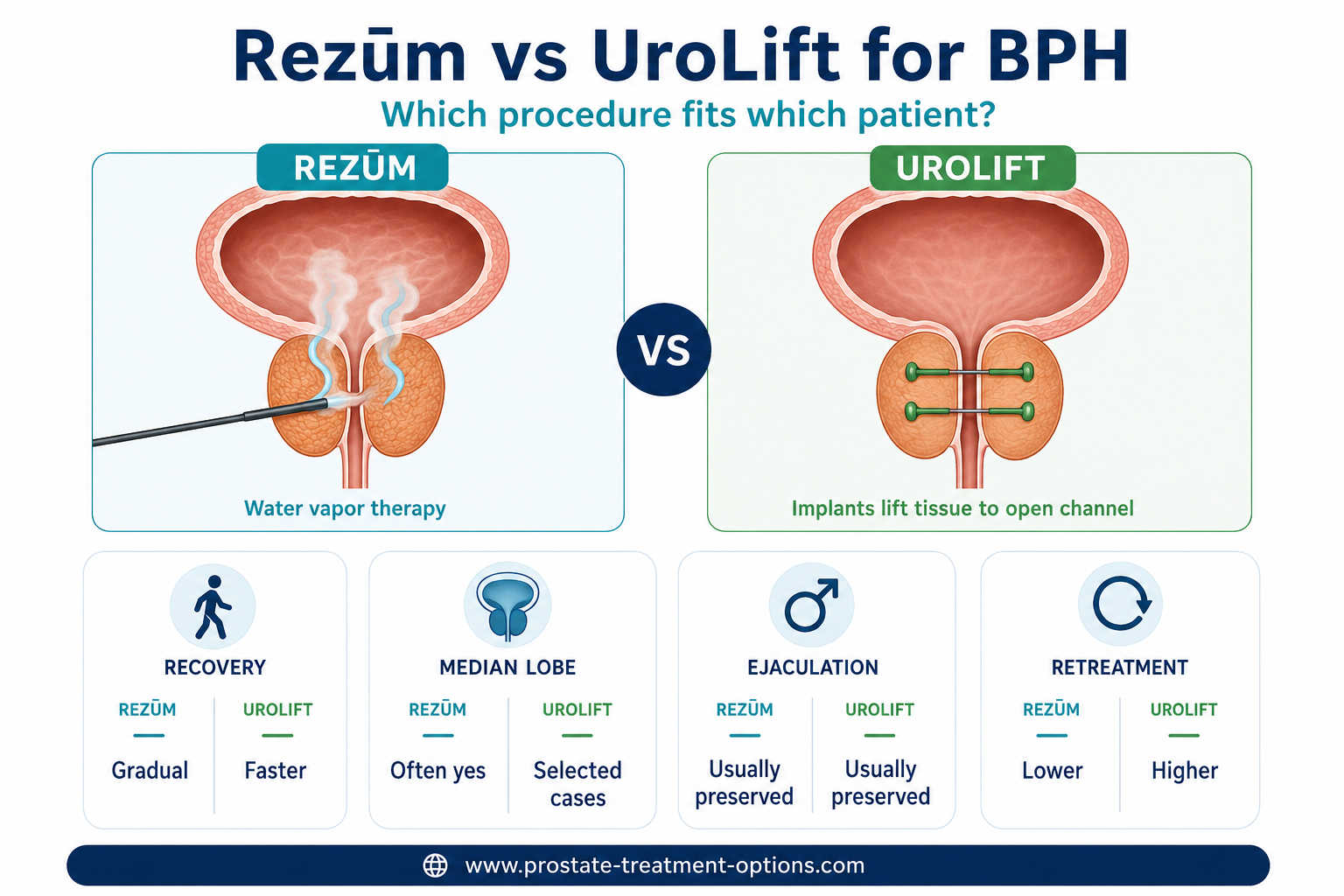
Rezūm and UroLift are both minimally invasive treatments for BPH, but they suit different patients. UroLift mechanically holds prostate tissue away from the urethra, so symptom improvement is often faster and ejaculation is usually preserved. Rezūm injects water vapor into prostate tissue, which then shrinks gradually over weeks to months.
Rezūm is generally more flexible when anatomy includes a median lobe, because the median lobe can be directly treated with steam injections. UroLift has encouraging median-lobe studies, but EAU 2026 still recommends PUL/UroLift for men with prostates under 70 mL and no middle lobe.
Durability also differs. In pivotal five-year data, Rezūm had a 4.4% surgical retreatment rate, whereas the L.I.F.T. UroLift trial reported 13.6% surgical retreatment at five years. Recent real-world analyses also tend to show more reintervention after UroLift than Rezūm.
What Are Rezūm and UroLift?
Rezūm and UroLift are usually grouped as minimally invasive surgical therapies (MISTs) for men with bothersome lower urinary tract symptoms caused by benign prostatic hyperplasia.
They are designed to improve the urinary channel without the amount of tissue removal associated with operations such as HoLEP or TURP.
Rezūm
Rezūm is a water-vapor thermal therapy. Steam is delivered through a needle into targeted prostate tissue.
The thermal energy causes controlled cell death. Over the following weeks and months, the body reabsorbs the treated tissue and the urinary channel becomes less obstructed.
UroLift
UroLift, or prostatic urethral lift (PUL), does not heat or remove prostate tissue.
Small permanent implants are placed through the urethra to retract obstructing prostate lobes and hold the urinary channel open.
The Core Difference
Rezūm changes the prostate tissue and waits for it to shrink. UroLift mechanically opens the channel immediately. That difference explains much of the contrast in early recovery, catheter use and speed of symptom improvement.
Rezūm vs UroLift: Quick Comparison
| Question | Rezūm | UroLift |
|---|---|---|
| How it works | Water vapor causes targeted tissue necrosis and gradual shrinkage | Implants retract prostate tissue away from the urethra |
| Speed of improvement | Gradual over weeks to months | Usually faster, often within days to weeks |
| Median lobe | Can be directly treated | Selected studies support use, but EAU 2026 still recommends no middle lobe |
| Ejaculation | Usually preserved | Usually preserved; one of its strongest advantages |
| Catheter after procedure | More commonly required because of swelling | Often not required or needed only briefly |
| Early urinary irritation | Common during tissue inflammation/swelling | Usually milder and more transient |
| Five-year pivotal surgical retreatment | 4.4% | 13.6% |
| Prostate-size guideline context | Evidence extends across broader sizes, though evidence quality varies | EAU recommendation: <70 mL, no middle lobe |
| Main advantage | Broader anatomical flexibility and good durability | Very rapid recovery and excellent sexual-function preservation |
| Main tradeoff | Slower improvement and more temporary swelling/catheter use | Higher retreatment probability and stricter anatomy selection |
How Rezūm and UroLift Work
Rezūm: Controlled Thermal Ablation
EAU describes Rezūm as convective water-vapor energy treatment. Radiofrequency energy produces steam, which disperses through prostate tissue and releases stored thermal energy when it condenses.
The treated cells die and the prostate subsequently remodels and shrinks.
EAU notes that treatment typically involves:
- one to three injections into each lateral lobe;
- and one to two injections into a median lobe when required by the anatomy.
UroLift: Mechanical Retraction
UroLift uses implants placed through the urethra to pull obstructing lateral prostate tissue away from the lumen.
There is:
- no tissue cutting;
- no tissue vaporization;
- no delayed tissue resorption;
- and generally less postoperative swelling than after a thermal procedure.
This helps explain why UroLift patients often recover faster.
Which Gives Better BPH Symptom Relief?
Both improve symptoms, urine flow and quality of life in appropriately selected patients.
Head-to-head evidence, although more limited than the evidence for each treatment individually, tends to suggest somewhat greater symptom improvement with Rezūm.
A three-year comparative study found that Rezūm produced a larger reduction in IPSS than UroLift at 24 and 36 months. Early maximum-flow improvement also favored Rezūm, although the difference was no longer significant from 12 to 36 months.
A separate prospective two-year comparison likewise found meaningful improvements with both treatments.
Neither Procedure Matches Tissue-Removing Surgery for Maximum De-Obstruction
Men with severe obstruction, very large residual urine, repeated retention or complications may obtain stronger objective improvement from procedures such as TURP, HoLEP or Aquablation. A minimally invasive procedure should not be selected solely because recovery sounds easier.
For the complete procedural landscape, see BPH Surgery & Procedures.
Which Has the Faster Recovery?
UroLift generally has the faster early recovery.
Because it opens the prostate mechanically rather than producing thermal tissue injury, there is less need to wait for swelling and dead tissue to resolve.
Patients may still experience:
- burning with urination;
- urgency;
- frequency;
- pelvic discomfort;
- and blood in the urine.
But these effects are generally transient.
Rezūm Recovery
Rezūm deliberately creates inflammation and tissue necrosis, so symptoms may temporarily worsen before improving.
Common early experiences include:
- dysuria;
- urgency and frequency;
- weak stream during swelling;
- hematuria;
- pelvic discomfort;
- and temporary urinary retention.
Patients should expect improvement to be gradual rather than immediate.
Rezūm vs UroLift: Which Is More Likely to Need a Catheter?
Temporary catheterization is generally more common after Rezūm.
The reason is postoperative swelling. The prostate can become temporarily more obstructive before the treated tissue shrinks.
Catheter duration varies according to:
- prostate size;
- median-lobe treatment;
- baseline urinary retention;
- amount of tissue treated;
- and the treating urologist’s protocol.
UroLift often avoids prolonged catheterization because there is less swelling and the implants create an immediate mechanical opening.
However, neither procedure guarantees that a catheter will never be required.
If you already have substantial incomplete emptying, review your post-void residual (PVR) and bladder function before choosing a minimally invasive procedure.
Rezūm vs UroLift for a Median Lobe
This is one of the most important anatomical differences.
Rezūm
EAU specifically describes treatment of the median lobe with one or two water-vapor injections when appropriate.
A 2026 systematic review of median-lobe BPH included Rezūm among the procedures producing favorable urinary outcomes in men with enlarged median lobes.
UroLift
The answer is more nuanced.
The MedLift study showed that selected obstructive median lobes can be treated successfully with PUL, with meaningful improvements in symptoms, flow and quality of life while preserving sexual function.
Real-world studies have also supported technically successful median-lobe treatment.
However, current EAU 2026 guidance states that long-term evidence in protruding middle lobes remains limited and recommends PUL/UroLift to men who:
- want preservation of ejaculatory function;
- have a prostate under 70 mL;
- and have no middle lobe.
Practical Interpretation
If you have an obstructing median lobe, Rezūm is usually easier to justify within current EAU guidance. If UroLift is proposed, ask specifically about the local device indication, the urologist’s median-lobe experience and why PUL is preferred over alternatives.
Read Median Lobe BPH: Symptoms, Diagnosis & Best Treatment Options.
Which Better Preserves Ejaculation and Erections?
Both have favorable sexual-function profiles.
UroLift
Ejaculation preservation is one of UroLift’s most established advantages.
The five-year L.I.F.T. study reported stable sexual function without new sustained erectile or ejaculatory dysfunction.
EAU therefore specifically recommends PUL for appropriately selected men who prioritize ejaculatory preservation.
Rezūm
Rezūm also preserves erectile and ejaculatory function in most patients.
EAU cites a comparative study in which 98% maintained antegrade ejaculation at 12 months.
Direct comparative evidence has sometimes shown somewhat better ejaculatory-function scores after UroLift, but both perform much more favorably in this area than standard TURP or HoLEP.
See BPH Treatment Side Effects for the broader sexual-function comparison.
Which Is More Durable: Rezūm or UroLift?
Available evidence generally favors Rezūm for durability.
Rezūm
EAU reports a 4.4% surgical retreatment rate at five years in the pivotal Rezūm follow-up.
That figure refers to surgical reintervention. When restarting medication is also counted as treatment failure, reported rates are higher.
UroLift
The L.I.F.T. trial reported 13.6% surgical retreatment over five years.
EAU also cites a systematic review estimating surgical reintervention around 6% per year across heterogeneous PUL studies, while emphasizing that retreatment is higher than after TURP.
Direct Head-to-Head Data
A three-year comparison found surgical retreatment of approximately 4.4% after Rezūm versus 10.7% after UroLift.
A large 2025 propensity-matched database analysis similarly found lower cumulative reintervention after Rezūm:
- 5 years: approximately 6.8% Rezūm;
- versus approximately 10.9% UroLift.
Another nationwide 2026 real-world analysis reported higher absolute five-year retreatment estimates for both—about 14% for Rezūm and 16% for PUL—illustrating how results vary by population and how retreatment is defined.
Why Do Retreatment Percentages Vary So Much?
Clinical trials use carefully selected patients and specific retreatment definitions. Real-world datasets include broader anatomy, different surgeon experience, medication restarting and variable follow-up. Use retreatment figures to understand relative durability—not as a guarantee of your individual outcome.
What Prostate Size Is Best for Rezūm or UroLift?
UroLift
EAU’s 2026 recommendation is relatively specific:
prostate <70 mL and no middle lobe.
Evidence for larger glands exists, but effectiveness and durability are less established.
Rezūm
The pivotal randomized trial centered on moderate-size glands, but subsequent studies and systematic reviews have reported favorable outcomes in:
- smaller glands;
- prostates above 80 mL;
- median-lobe disease;
- and men in urinary retention.
EAU notes encouraging data in prostates above 80 mL, even up to about 150 mL, but also emphasizes the need for stronger comparative trials.
Large glands therefore require individualized discussion rather than assuming Rezūm is automatically equivalent to HoLEP or TURP.
If you are starting with a scan report, see Normal Prostate Size by Age: What Do 30, 40, 50 and 80 cc Mean?.
Rezūm or UroLift: Which Procedure Fits Which Patient?
Rezūm May Fit Better If:
- you have an obstructing median lobe;
- durability is a stronger priority;
- you accept slower improvement;
- you can tolerate temporary catheterization;
- you want to preserve ejaculation;
- your anatomy is less suitable for PUL.
UroLift May Fit Better If:
- you strongly prioritize the quickest recovery;
- ejaculation preservation is a major goal;
- your prostate is under 70 mL;
- you do not have a significant middle lobe under current EAU selection;
- you want to avoid thermal tissue injury;
- you accept a higher chance of future retreatment.
Neither May Be Ideal If:
- you have recurrent/refractory urinary retention;
- kidney impairment or hydronephrosis is caused by BPH obstruction;
- you have recurrent bladder stones or infections from poor emptying;
- your bladder is severely decompensated;
- you need maximum durable de-obstruction from a very large gland.
In those situations, a more definitive procedure may be more appropriate.
Dr. Albana’s Note
Rezūm and UroLift are often presented as similar “quick” BPH procedures, but I would explain to patients that they solve obstruction in very different ways.
UroLift gives an immediate mechanical opening and therefore often has the easier early recovery. It is particularly attractive when preserving ejaculation is a major priority and the prostate anatomy fits the procedure.
Rezūm requires more patience. Swelling can temporarily make symptoms worse, and a catheter is more likely. But the treated tissue then shrinks, and the procedure can directly treat a median lobe. Current evidence also generally favors Rezūm when long-term retreatment is compared with UroLift.
I would pay particular attention to the median lobe. Published UroLift studies are encouraging, but EAU 2026 remains conservative and recommends PUL only when there is no middle lobe. That should be discussed openly rather than hidden behind the broad statement that “UroLift can treat BPH.”
Finally, neither procedure should be chosen merely because it is minimally invasive. A patient with severe retention, hydronephrosis, a very large obstructing gland or markedly impaired bladder emptying may need a more definitive operation.
— Dr. Albana Greca, MD, MMedSc, Family Physician / General Practitioner
Frequently Asked Questions About Rezūm vs UroLift
Which is better, Rezūm or UroLift?
Neither is universally better. UroLift usually offers faster recovery and excellent ejaculation preservation, while Rezūm can treat a broader range of anatomy, including median lobes, and generally has lower reported retreatment rates.
Which works faster?
UroLift usually provides faster early improvement because it mechanically opens the urethral channel. Rezūm improves more gradually as treated tissue shrinks.
Which is more likely to need a catheter?
Rezūm. Thermal swelling can temporarily worsen obstruction. UroLift often requires little or no catheterization, although individual cases vary.
Which better preserves ejaculation?
Both generally preserve ejaculation. UroLift has especially strong long-term sexual-function data and is specifically recommended by EAU for selected men prioritizing ejaculation preservation.
Can Rezūm treat a median lobe?
Yes. EAU specifically describes water-vapor injections into the median lobe according to anatomy.
Can UroLift treat a median lobe?
Selected studies such as MedLift show that it can be technically effective, but EAU 2026 still recommends PUL only for prostates under 70 mL without a middle lobe because long-term evidence is considered limited.
Which has the lower retreatment rate?
Available trial and comparative evidence generally favors Rezūm. Pivotal five-year surgical retreatment was 4.4% after Rezūm versus 13.6% in the UroLift L.I.F.T. trial, although real-world estimates vary.
Can either procedure cause erectile dysfunction?
New persistent erectile dysfunction is uncommon after both treatments. Their sexual-function profiles are substantially more favorable than standard tissue-removing surgery.
Which is better for a large prostate?
Rezūm has published data in glands above 80 mL, whereas EAU limits its strong UroLift recommendation to prostates under 70 mL. For very large or strongly obstructing glands, HoLEP or another definitive procedure may offer more reliable de-obstruction.
Can I stop BPH medication after Rezūm or UroLift?
Some patients are able to reduce or stop medication after successful treatment, but this should be decided with the prescriber. Real-world studies show that medication may be restarted in a proportion of patients after either procedure.
Related BPH Procedure Guides
Medical References
- European Association of Urology. Guidelines on the Management of Non-neurogenic Male Lower Urinary Tract Symptoms: Disease Management. 2026. Water-vapor therapy can include median-lobe injections; five-year Rezūm surgical retreatment 4.4%. PUL recommendation: prostate <70 mL and no middle lobe, with higher retreatment than TURP.
- Roehrborn CG, et al. Five-year results of the prospective randomized controlled prostatic urethral L.I.F.T. study. Can J Urol. 2017. Surgical retreatment 13.6% over five years with preservation of erectile and ejaculatory function. PMID 28646935.
- Rukstalis D, et al. Prostatic Urethral Lift for obstructive median lobes: 12-month results of the MedLift Study. Prostate Cancer Prostatic Dis. 2019. PMID 30542055.
- McVary KT, et al. Rezūm Water Vapor Thermal Therapy for LUTS associated with BPH: long-term randomized study follow-up. Five-year durability data.
- Prostatic urethral lift versus convective water vapor ablation for minimally invasive treatment of BPH: comparison of 3-year clinical outcomes. PMID 34657655.
- Comparison of Durability Between Rezum Water Vapor Therapy and UroLift in Treating BPH: A Multicenter Propensity Score-Matched Analysis. 2025. PMID 40125525.
- Five-year Retreatment and Medication Restart Rates Following BPH Treatments: A Nationwide Real-world Analysis Using Epic Cosmos. 2026. PMID 41558957.
Medical information notice: Rezūm and UroLift outcomes depend on prostate size and shape, median-lobe anatomy, bladder function, baseline retention, surgeon experience and how retreatment is defined. Discuss individualized suitability with a urologist who evaluates the prostate anatomy before treatment.
Written & medically reviewed by Dr. Albana Greca, MD, MMedSc • Family Physician / General Practitioner • Founder & Lead Medical Author • Last medically reviewed: September 2026