
Quick Answer
Yes. An enlarged prostate can contribute to recurrent urinary tract infections when it causes bladder-outlet obstruction and leaves significant urine behind after urination. Residual urine can make it easier for bacteria to persist and can make infections harder to eliminate completely.
However, BPH does not directly “cause bacteria.” Recurrent UTI in a man can also be related to chronic bacterial prostatitis, bladder or kidney stones, a urinary catheter, urethral stricture, diabetes, neurological bladder dysfunction or another urinary-tract abnormality.
Current EAU guidance lists benign prostatic obstruction, significant post-void residual, urinary obstruction, stones and catheters among factors that can complicate UTI treatment. Recurrent UTIs caused by BPH/BPO are also a compelling indication to consider definitive prostate treatment rather than repeatedly treating infection without correcting the emptying problem.
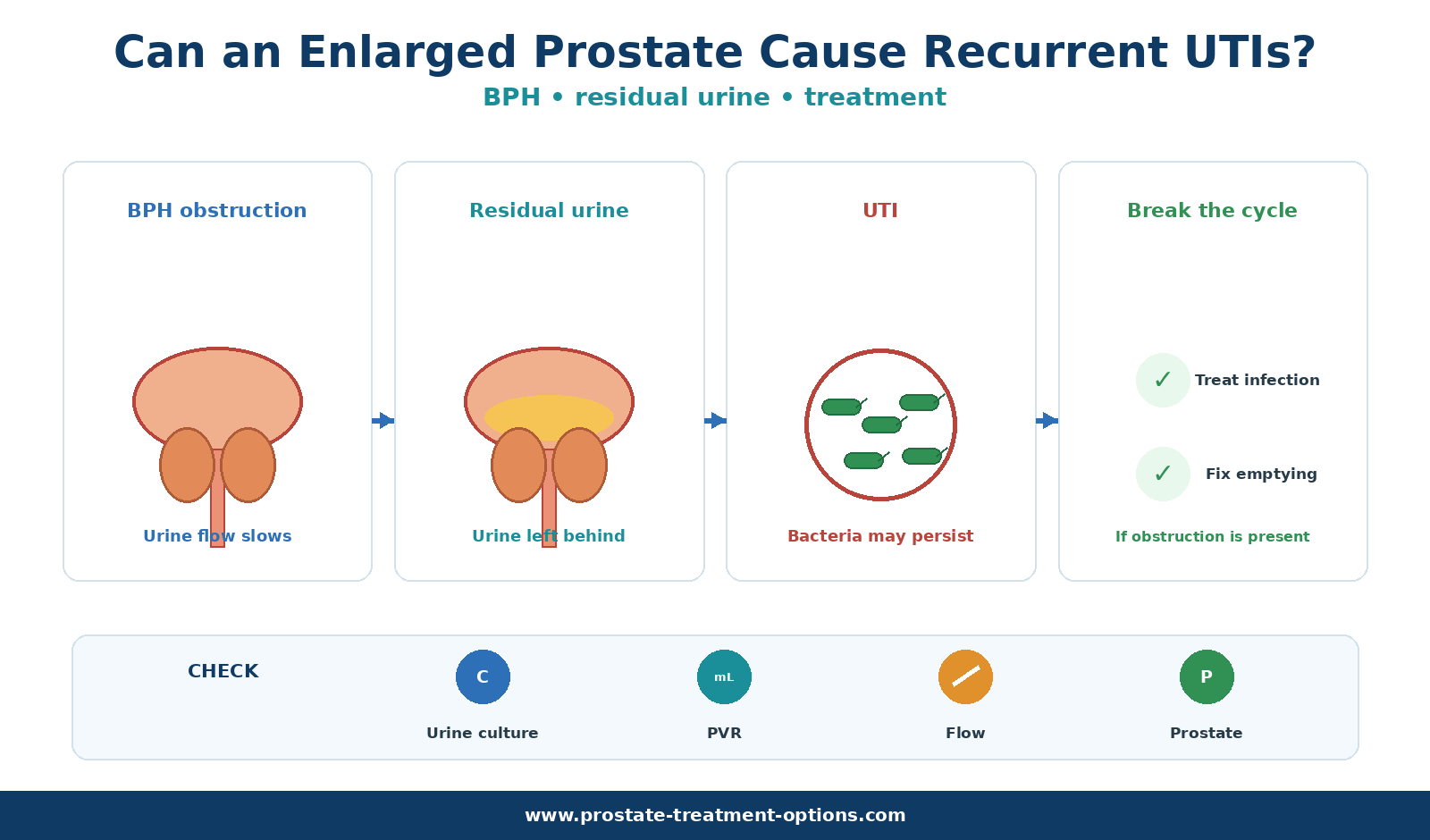
How Can an Enlarged Prostate Lead to Recurrent UTIs?
The prostate surrounds the urethra just below the bladder.
When benign prostatic enlargement narrows the bladder outlet, the bladder may not empty completely.
This can create a cycle:
- the enlarged prostate increases resistance to urine flow;
- urine remains in the bladder after voiding;
- bacteria may persist in the retained urine or urinary tract;
- the infection is treated;
- but if poor emptying continues, another infection may occur.
NIDDK includes urinary tract infections among the recognized complications of BPH.
The AUA BPH guideline similarly explains that recurrent UTIs associated with BPH are generally thought to result from incomplete bladder emptying and persistently elevated PVR.
BPH Is a Risk Factor—Not the Bacterium
BPH changes urinary mechanics. It does not create bacteria by itself. The clinical question is whether the prostate is causing enough obstruction and residual urine to make infection more likely or harder to clear.
What Counts as a Recurrent UTI?
A commonly used definition is:
- 2 or more UTIs within 6 months; or
- 3 or more UTIs within 12 months.
A recurrence can represent:
- relapse: the same organism returns because infection was not fully eradicated or persists in a reservoir such as the prostate;
- reinfection: a new infection occurs, potentially with a different organism.
In men, recurrent infection deserves more attention than a single uncomplicated episode because an anatomical or functional cause is more likely to need investigation.
NICE recommends specialist advice for men with recurrent UTI so the underlying reason for recurrence can be identified and treated.
What Symptoms Suggest a UTI in a Man With BPH?
Symptoms may include:
- burning or pain during urination;
- new or suddenly worse urgency;
- new or suddenly worse frequency;
- cloudy or strong-smelling urine;
- blood in the urine;
- suprapubic discomfort;
- worsening difficulty emptying the bladder.
These symptoms can overlap with BPH itself.
That is why a man who has chronic frequency and urgency should not automatically be given antibiotics every time those symptoms fluctuate.
Symptoms Suggesting a More Serious Infection
Fever, chills, flank pain, vomiting, marked weakness or systemic illness can indicate a systemic UTI, kidney infection or acute bacterial prostatitis and require prompt medical assessment.
Seek Urgent Care If:
- you have fever/chills and feel significantly unwell;
- you develop severe flank or back pain;
- you become confused, faint or very weak;
- you have heavy blood or clots in the urine;
- you cannot urinate at all;
- or symptoms worsen rapidly despite treatment.
Complete inability to urinate may be acute urinary retention and generally requires urgent bladder drainage.
What Else Can Cause Recurrent UTIs in Men?
An enlarged prostate is only one possible explanation.
Urinary-Tract Causes
- BPH/bladder-outlet obstruction;
- high residual urine;
- bladder stones;
- kidney or ureter stones;
- urethral stricture;
- bladder diverticula;
- indwelling catheter;
- recent instrumentation.
Prostate / Bladder / Medical Causes
- chronic bacterial prostatitis;
- weak bladder/detrusor underactivity;
- neurological bladder dysfunction;
- diabetes;
- immunocompromised state;
- other structural urinary abnormalities.
EAU Urological Infections guidance specifically lists prostatic involvement, significant PVR, urinary obstruction, stones, catheters and anatomical/functional urinary-tract abnormalities among factors associated with more difficult UTI courses or treatment failure.
For stones, see BPH and Bladder Stones.
How Important Is Post-Void Residual Urine?
Post-void residual (PVR) is the amount of urine left in the bladder after urination.
A high PVR can create favorable conditions for recurrent infection because urine remains in the urinary tract rather than being regularly flushed out.
EAU Urological Infections guidance identifies significant post-void residual as a UTI risk factor and states that significant residual urine should be treated optimally when recurrent infection is being managed.
Does Any PVR Above 50 or 100 mL Cause UTIs?
No.
There is no single PVR threshold at which infection becomes inevitable.
EAU male-LUTS guidance also emphasizes that high PVR does not automatically prove BPH obstruction. It can arise from:
- bladder-outlet obstruction;
- detrusor underactivity;
- or both.
Therefore, treatment should not be based on one residual number alone.
See Post-Void Residual (PVR): How Much Urine Left in the Bladder Is Too Much?.
High PVR + Recurrent UTI Deserves More Attention Than High PVR Alone
A residual measurement becomes more clinically important when it is persistent and accompanied by recurrent infection, retention, stones, hydronephrosis or other complications.
How Are Recurrent UTIs Evaluated in a Man With BPH?
The aim is to confirm that infection is actually present and determine why it keeps recurring.
Urinalysis
Urinalysis can identify:
- white blood cells;
- nitrites;
- blood;
- protein;
- glucose;
- and other abnormalities.
Urine Culture
Culture identifies the organism and antibiotic susceptibility.
This becomes particularly valuable when infections:
- keep returning;
- do not respond as expected;
- occur after recent antibiotic use;
- or may represent relapse with the same organism.
PVR
A bladder scan after urination evaluates incomplete emptying.
Uroflowmetry
Urinary flow testing provides information about weak or abnormal flow, although a low flow cannot by itself distinguish BPH obstruction from a weak bladder.
Prostate Size and Anatomy
Ultrasound, cystoscopy or other imaging can identify:
- prostate enlargement;
- a protruding median lobe;
- bladder stones;
- diverticula;
- and other structural abnormalities.
Kidney / Upper-Tract Assessment
Recurrent infection, chronic retention or concern about obstruction may justify renal-function testing and upper-tract imaging.
NICE specifically includes recurrent UTI among reasons to consider serum creatinine/eGFR and specialist urinary-tract imaging in men with LUTS.
For the overall investigation pathway, see Prostate & Urinary Tests.
Could Recurrent “UTIs” Actually Be Chronic Bacterial Prostatitis?
Yes.
This is an important possibility in men.
The prostate can act as a reservoir for bacteria. A patient may improve after a short antibiotic course and then develop another infection with the same or a similar organism.
Chronic bacterial prostatitis may produce:
- recurrent culture-positive urinary infection;
- pelvic or perineal discomfort;
- painful ejaculation in some men;
- urinary frequency or urgency;
- and periods when symptoms are mild or absent between episodes.
Treatment differs from ordinary bladder cystitis because antibiotic penetration into the prostate matters and treatment courses may be longer.
Do not repeatedly label recurrent bacterial prostatitis as “BPH infection.”
See Prostate Infection and Prostatitis Treatment.
How Are UTIs Treated When BPH Is Present?
The active infection is treated with an appropriate antimicrobial strategy based on:
- urine culture and susceptibility when available;
- whether infection is localized or systemic;
- whether prostatitis is suspected;
- kidney function;
- previous antibiotic exposure;
- local resistance patterns;
- and medication allergies/interactions.
There is no single “best BPH UTI antibiotic.”
An antibiotic treats the infection. It does not correct bladder-outlet obstruction.
Why Can Infection Return After Antibiotics?
Possible explanations include:
- the organism was resistant;
- the infection involved the prostate;
- a stone or foreign body remains;
- the bladder continues to retain substantial urine;
- or the episode is a new reinfection.
EAU emphasizes that anatomical or functional urinary-tract abnormalities and obstruction should be addressed because antimicrobials alone may be insufficient.
Avoid Repeated Unverified Antibiotic Courses
Chronic BPH urgency, frequency and nocturia can mimic infection symptoms. Repeated antibiotics without confirming infection can expose patients to adverse effects and antimicrobial resistance while delaying diagnosis of the real cause.
What About Bacteria in the Urine Without Symptoms?
Bacteria can sometimes be found on urine culture without symptoms of infection.
This is called asymptomatic bacteriuria.
It should not automatically be treated as a symptomatic UTI simply because BPH is present.
Treatment decisions depend on the clinical context, including whether an invasive urological procedure is planned and other specific risk situations.
The key point is to distinguish:
- symptomatic urinary infection;
- asymptomatic bacteriuria;
- and noninfectious BPH symptoms.
Can BPH Medicines Reduce the Risk of Another UTI?
BPH medicines do not function as antibiotics, but they can improve the urinary mechanics that contribute to infection risk in selected men.
Alpha Blockers
Medicines such as tamsulosin can:
- reduce bladder-outlet resistance;
- improve urinary symptoms relatively quickly;
- and sometimes improve bladder emptying.
However, alpha blockers do not shrink the prostate and do not prevent BPH progression, acute retention or surgery.
Finasteride or Dutasteride
In men with demonstrably enlarged prostates, 5-alpha-reductase inhibitors can:
- reduce prostate volume over time;
- lower the risk of acute urinary retention;
- and reduce future BPH surgery risk.
These disease-modifying effects can be valuable in a man whose recurrent infections occur in the context of significant enlargement and poor emptying.
They do not cure an active UTI.
When Do Recurrent UTIs Lead to BPH Surgery?
This is where recurrent UTI changes the BPH treatment discussion.
EAU 2026 states that surgery is usually required when patients with BPO have experienced:
- recurrent or refractory urinary retention;
- recurrent UTIs;
- bladder stones or diverticula;
- treatment-resistant BPH hematuria;
- upper urinary-tract dilation due to BPO with or without renal insufficiency.
AUA BPH guidance likewise recommends surgery for recurrent UTIs when BPH is considered the cause.
Why Can Surgery Reduce Recurrence?
If infection is being promoted by obstruction and persistent residual urine, de-obstructive surgery can improve emptying.
AUA notes that surgical elimination of obstruction, when bladder contractility is adequate, should allow much more complete emptying and thereby decrease future infection risk.
Does One UTI Mean You Need Surgery?
No.
One isolated infection is very different from recurrent culture-confirmed infections associated with poor emptying.
Before surgery, clinicians should confirm that:
- the infections are genuine;
- other causes such as chronic bacterial prostatitis or stones have been considered;
- the prostate is actually contributing to obstruction;
- and bladder function is adequate enough that reducing outlet resistance is likely to help.
If it is unclear whether the problem is BPH obstruction or weak bladder contractility, see Weak Bladder or Enlarged Prostate?.
Which Procedure?
The choice depends on prostate size, anatomy and patient priorities.
Options may include:
- HoLEP;
- TURP;
- Aquablation;
- other laser procedures;
- or simple prostatectomy for selected very large glands.
When recurrent infection is a complication of significant obstruction, the priority is dependable bladder emptying rather than simply choosing the least invasive procedure.
What If the Bladder Is Weak Rather Than Obstructed?
A high PVR and recurrent infections can also occur when the bladder muscle is too weak to empty well.
In that situation, prostate surgery may not solve the emptying problem if there is little true outlet obstruction.
Management may include:
- treating reversible causes;
- timed/double voiding in selected patients;
- intermittent catheterization when needed for reliable drainage;
- and selective urodynamic assessment if the mechanism remains uncertain.
EAU recurrent-infection guidance explicitly states that significant residual urine should be treated optimally, including intermittent catheterization when judged appropriate.
How Can Recurrent UTIs Be Reduced in Men With BPH?
Prevention depends on correcting the specific risk factor rather than relying only on repeated antibiotics.
Improve Bladder Emptying
This may involve:
- alpha-blocker treatment;
- 5-alpha-reductase inhibitor treatment in an enlarged gland;
- definitive BPH surgery when obstruction is clinically important;
- or catheter-based strategies if bladder contractility is poor.
Treat Stones or Other Structural Problems
A bladder or urinary stone can act as a persistent nidus for infection.
Review Catheter Use
Indwelling urinary catheters substantially change infection risk and should be used only when clinically necessary.
Manage Diabetes and Other Medical Risk Factors
Poor glycemic control and other comorbidities can increase the complexity of urinary infection.
Use Antibiotic Prophylaxis Selectively
Long-term preventive antibiotics may be considered in selected men with recurrent UTI, but NICE recommends specialist advice and attention to further investigation and the risk of antimicrobial resistance.
Prophylactic antibiotics should not become a substitute for correcting significant urinary obstruction or another treatable structural cause.
Dr. Albana’s Note
If a man with an enlarged prostate keeps getting UTIs, I would not think only about which antibiotic to prescribe next.
I would first confirm that these are true infections with appropriate urine testing. Then I would ask why bacteria keep returning.
A persistent post-void residual is an important clue because stagnant urine can make recurrent infection more likely. But a high residual does not automatically mean the prostate is responsible; a weak bladder can create the same finding.
I would also consider chronic bacterial prostatitis, especially when infections recur with the same organism, as well as stones, strictures, catheters and diabetes.
If the man has confirmed BPH obstruction, substantial residual urine and repeated UTIs, then the treatment goal changes. Continuing antibiotics without addressing the obstruction may only treat each episode temporarily. Current EAU and AUA guidance both recognize recurrent BPH-related UTIs as a strong reason to consider definitive prostate surgery.
So the practical strategy is: treat the current infection, identify why it recurred, and correct the emptying problem when one is present.
— Dr. Albana Greca, MD, MMedSc, Family Physician / General Practitioner
Frequently Asked Questions About BPH and Recurrent UTIs
Can an enlarged prostate cause repeated UTIs?
It can contribute when BPH causes bladder-outlet obstruction and significant residual urine. BPH does not create bacteria directly, so other causes of recurrent infection still need consideration.
How much residual urine causes a UTI?
There is no universal PVR cutoff at which infection occurs. Risk increases in the context of significant persistent residual urine, but PVR must be interpreted with symptoms, bladder function and other complications.
Does recurrent UTI mean I need prostate surgery?
Not every recurrent UTI is caused by BPH. If recurrent infections are attributable to benign prostatic obstruction, current EAU and AUA guidance considers this a compelling indication for surgery.
Can tamsulosin prevent UTIs?
Tamsulosin is not an antibiotic. It may improve bladder emptying by reducing outlet resistance, which may help when obstruction contributes to infection risk, but it does not directly prevent bacterial infection.
Can finasteride prevent UTIs?
Not directly. Finasteride can shrink an enlarged prostate over months and reduce BPH progression. In a man whose infections are associated with obstruction and poor emptying, improving the underlying BPH may be part of prevention.
Could repeated UTIs actually be prostatitis?
Yes. Chronic bacterial prostatitis can act as a bacterial reservoir and cause recurrent culture-positive urinary infections in men.
Should recurrent UTIs in men be investigated?
Yes. NICE recommends specialist advice for men with recurrent UTI because an underlying anatomical, prostate or bladder cause may need investigation and treatment.
Can bladder stones cause recurrent UTIs?
Yes. Stones and poor bladder emptying can promote recurrent infection. A bladder stone should trigger investigation of the cause, including possible BPH obstruction.
Can a weak bladder cause recurrent UTIs?
It can contribute if detrusor underactivity leaves significant residual urine. This is why high PVR does not automatically prove BPH obstruction.
When is a UTI an emergency?
Fever/chills with systemic illness, severe flank pain, vomiting, confusion, inability to urinate, severe weakness or rapidly worsening symptoms require prompt medical evaluation.
Related BPH Complication Guides
Medical References
- European Association of Urology. Guidelines on Urological Infections. 2026. Prostatic involvement, significant PVR, urinary obstruction, stones, catheters and anatomical/functional urinary-tract abnormalities are important UTI risk factors; underlying urological risk factors and significant residual urine should be addressed.
- European Association of Urology. Guidelines on the Management of Non-neurogenic Male Lower Urinary Tract Symptoms: Disease Management. 2026. Recurrent UTIs associated with BPO are among the compelling indications for surgery.
- American Urological Association. Benign Prostatic Hyperplasia Guideline. Recurrent UTIs attributable to BPH are an indication for surgery; incomplete emptying and elevated PVR are considered important mechanisms.
- National Institute of Diabetes and Digestive and Kidney Diseases. Enlarged Prostate (Benign Prostatic Hyperplasia). UTIs are among recognized BPH complications.
- National Institute for Health and Care Excellence. Urinary tract infection (recurrent): antimicrobial prescribing. Men with recurrent UTI should be referred or specialist advice sought to investigate the underlying cause and guide prevention.
Medical information notice: Recurrent urinary symptoms do not always mean recurrent bacterial infection. Culture-confirmed infection, residual urine, prostate/bladder anatomy, chronic bacterial prostatitis, stones, catheters and other risk factors may all need assessment. Antibiotic choice and duration must be individualized.
Written & medically reviewed by Dr. Albana Greca, MD, MMedSc • Family Physician / General Practitioner • Founder & Lead Medical Author • Last medically reviewed: September 2026