
Quick Answer
Yes, an enlarged prostate can cause blood in the urine. BPH can increase the number and fragility of blood vessels within the prostate, and those vessels may bleed into the urinary tract. The bleeding may be microscopic or visible as pink, red or tea-colored urine.
However, blood in the urine should not simply be blamed on BPH. Urinary infection, stones, kidney disease, bladder cancer, kidney cancer, upper-tract urothelial cancer and other causes can also produce hematuria. This is especially important when the blood is visible, recurrent, associated with clots, or occurs in an older man or someone with a smoking history.
If a urologic evaluation excludes other important causes and the bleeding is judged to come from the prostate, treatment may include a 5-alpha-reductase inhibitor such as finasteride in selected men. Current EAU guidance also lists treatment-resistant visible hematuria due to BPH/BPE as a compelling indication for surgical treatment.
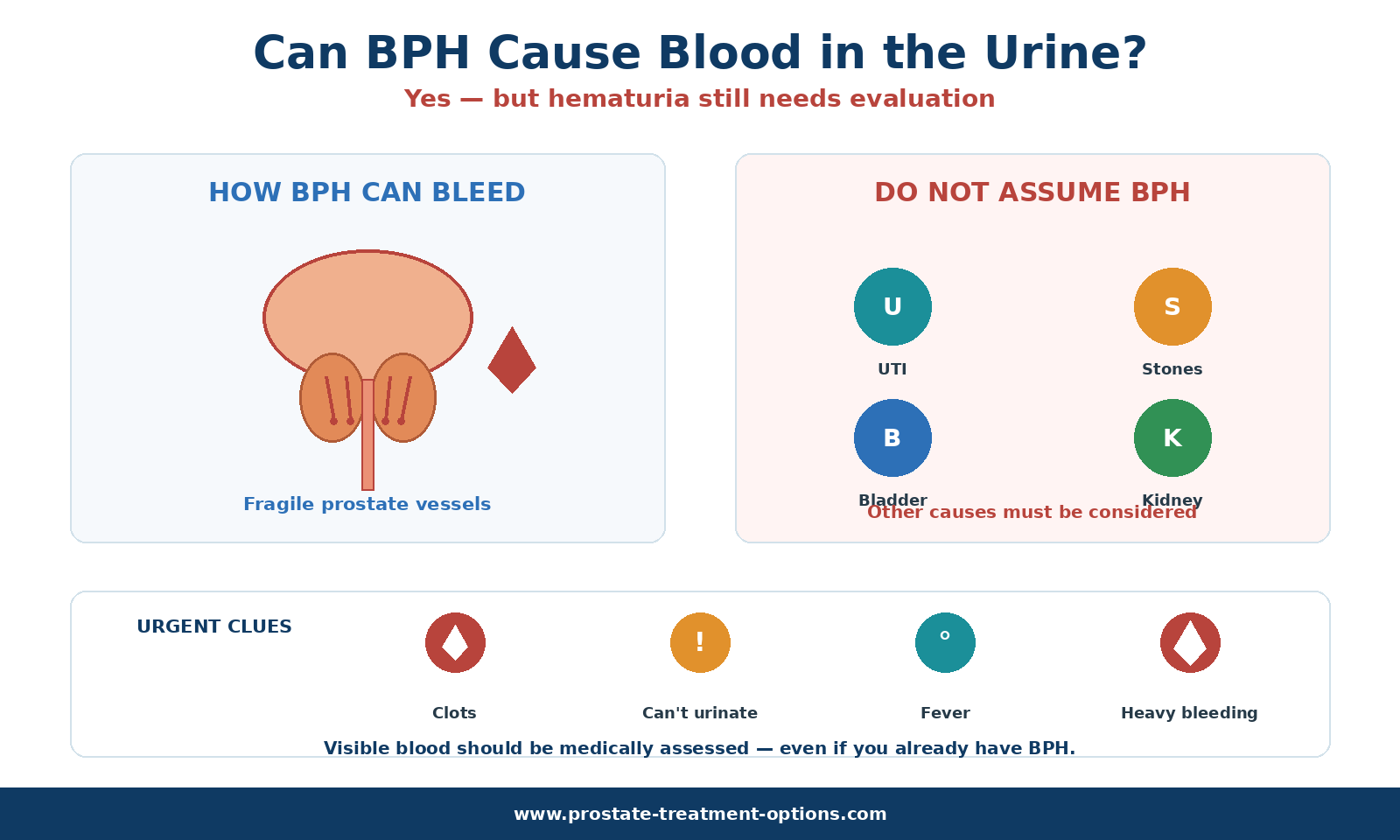
How Can BPH Cause Blood in the Urine?
The prostate sits immediately below the bladder and surrounds the first part of the urethra.
As benign prostatic hyperplasia (BPH) develops, the gland increases in volume and may also develop increased vascularity.
Some of these small blood vessels can be fragile and bleed.
The result may be:
- microscopic blood detected on urinalysis;
- pink or red urine;
- intermittent episodes of visible blood;
- or, less commonly, heavier bleeding with clots.
Why Does Finasteride Sometimes Reduce Prostatic Bleeding?
One proposed mechanism is reduced prostatic vascularity.
Older AUA guideline evidence notes that finasteride suppresses prostatic vascular endothelial growth factor (VEGF) and that recurrent bleeding presumed to be prostatic can decrease with finasteride after other causes have been excluded.
EAU 2026 similarly notes that finasteride may reduce blood loss during transurethral prostate surgery, probably through effects on prostatic vascularisation, although perioperative evidence is mixed.
BPH Can Bleed—but That Diagnosis Comes After Evaluation
The important sequence is: hematuria → evaluate the urinary tract → exclude important alternative causes → then attribute bleeding to BPH if the evidence supports it. Starting treatment for “prostate bleeding” without an appropriate evaluation can delay diagnosis of another urinary-tract condition.
Visible Blood vs Microscopic Blood in the Urine
Visible or Gross Hematuria
Visible hematuria means the urine itself looks:
- pink;
- red;
- brown-red;
- or sometimes tea/cola-colored.
Clots may also appear.
A history of gross hematuria is considered an important malignancy-risk feature in AUA hematuria guidance.
Microscopic Hematuria
Microscopic hematuria means red blood cells are detected on laboratory examination even though the urine looks normal.
The 2025 AUA/SUFU guideline defines microhematuria as more than 3 red blood cells per high-power field on microscopic examination of a properly collected urine specimen.
A positive dipstick alone does not establish the diagnosis. It should be confirmed with microscopy.
Do Not Use the Color of the Urine to Judge the Cause
A small amount of blood can make urine look dramatic, while significant microscopic hematuria may be invisible. The appearance alone cannot distinguish BPH bleeding from stones, infection or cancer.
What Else Can Cause Blood in the Urine?
Hematuria has a wide differential diagnosis.
Urinary Tract Causes
- urinary tract infection;
- bladder or kidney stones;
- BPH/prostatic bleeding;
- prostatitis;
- urethral injury or instrumentation;
- bladder tumors;
- upper urinary tract urothelial tumors;
- kidney tumors.
Kidney / Medical Causes
- glomerular kidney disease;
- certain inherited kidney disorders;
- trauma;
- vigorous exercise in selected cases;
- anticoagulant or antiplatelet therapy revealing an underlying source of bleeding;
- other less common systemic causes.
Age, smoking history, degree and persistence of hematuria, previous gross hematuria and certain occupational or treatment exposures affect cancer risk.
The key message for this BPH site is simple:
an enlarged prostate does not protect a patient from having a bladder, kidney or urinary-tract cancer at the same time.
When Is Blood in the Urine an Emergency?
Hematuria deserves medical assessment, but some presentations require urgent care.
Seek Urgent Medical Help If You Have:
- heavy visible bleeding;
- large blood clots;
- inability to urinate;
- painful bladder distension;
- fever or chills;
- severe flank pain;
- dizziness, weakness or fainting;
- markedly reduced urine output;
- or bleeding that is rapidly worsening.
Blood clots can block the bladder outlet and cause acute urinary retention, which may require urgent catheter drainage and clot management.
How Is Blood in the Urine Evaluated?
The correct work-up depends on whether the blood is visible or microscopic, whether there is infection, the patient’s age, smoking history, kidney function and other risk factors.
Urinalysis and Microscopy
Urinalysis can identify:
- red blood cells;
- white blood cells;
- nitrites or other infection clues;
- protein;
- glucose;
- and other abnormalities.
Urine Culture
If infection is suspected, a urine culture can help identify the organism and guide antibiotic treatment.
Kidney Function
Serum creatinine/eGFR may be checked, especially when kidney disease or upper-tract obstruction is possible.
Cystoscopy
Cystoscopy allows the urologist to look directly inside the urethra and bladder.
This is particularly important because bladder tumors may not be reliably excluded by ultrasound alone.
AUA hematuria guidance emphasizes cystoscopy in patients whose risk category warrants bladder evaluation.
Upper Urinary Tract Imaging
Depending on risk, imaging may include:
- renal/bladder ultrasound;
- CT urography;
- MR urography;
- or another tailored imaging approach.
In AUA microhematuria guidance, intermediate-risk patients typically undergo cystoscopy plus renal ultrasound, while high-risk patients undergo cystoscopy plus axial upper-tract imaging, commonly CT urography when appropriate.
What If the Blood Is Caused by a Urinary Infection?
A urinary tract infection can cause:
- blood in the urine;
- burning;
- frequency;
- urgency;
- pelvic discomfort;
- fever in more serious infection.
When hematuria is attributed to UTI, current AUA/SUFU guidance recommends repeating urinalysis after treatment to make sure the blood has resolved.
If hematuria persists after the infection has been treated, it should not simply continue to be blamed on the infection.
For prostate infection and inflammation, see Prostate Infection and Prostatitis Treatment.
What If You Take a Blood Thinner?
Anticoagulants and antiplatelet drugs can make bleeding more noticeable or more prolonged.
However, blood-thinning medication does not automatically explain away hematuria.
AUA guidance recommends evaluating patients with microhematuria who take anticoagulant or antiplatelet medication using the same risk-based approach as patients who are not taking these drugs.
That is because anticoagulants can uncover bleeding from:
- BPH;
- stones;
- infection;
- bladder tumors;
- kidney tumors;
- or another lesion.
Do Not Stop a Blood Thinner on Your Own
If you develop hematuria while taking warfarin, apixaban, rivaroxaban, dabigatran, aspirin, clopidogrel or another antithrombotic medication, contact the prescribing clinician/urologist. Stopping these medicines without medical advice can create serious stroke or cardiovascular risk.
Can Finasteride Treat Blood in the Urine From BPH?
It can be considered when the bleeding is genuinely believed to come from the prostate and other important causes have been excluded.
Historical AUA guideline evidence supports finasteride as an option for refractory hematuria presumed to result from prostatic bleeding.
This fits with its biological effect on:
- prostate size;
- dihydrotestosterone;
- and prostatic vascularity.
Finasteride is not an emergency drug for heavy active bleeding. Its effect develops over time.
What About Dutasteride?
Dutasteride is also a 5-alpha-reductase inhibitor and has similar long-term BPH effects on prostate shrinkage and disease progression.
However, the older guideline evidence specifically supporting treatment of refractory prostatic hematuria was stronger for finasteride, while dutasteride was inferred to have a similar biological effect rather than being as extensively studied for this exact indication.
For the broader comparison, see Finasteride vs Dutasteride for BPH.
Will an Alpha Blocker Stop BPH Bleeding?
Alpha blockers such as tamsulosin improve urinary symptoms by relaxing smooth muscle at the prostate and bladder outlet.
They do not directly reduce prostate vascularity or shrink the gland.
Therefore, they are not the main medication used specifically to prevent recurrent prostatic bleeding.
They may still be appropriate when the patient also has bothersome obstructive urinary symptoms.
When Does BPH-Related Hematuria Lead to Surgery?
Current EAU guidance lists treatment-resistant macroscopic hematuria due to BPH/BPE among the compelling indications for surgical treatment.
This means surgery may be considered when:
- other causes of bleeding have been adequately evaluated;
- the prostate is judged to be the source;
- bleeding is recurrent or clinically important;
- medical treatment has not controlled it;
- or bleeding occurs alongside other significant BPH complications.
Which Procedures Can Be Used?
The best procedure depends on prostate size, anatomy, bleeding risk and surgeon expertise.
Potential options include:
- HoLEP;
- bipolar TURP;
- laser vaporization;
- Aquablation in selected patients;
- and simple prostatectomy for selected very large glands.
For patients in whom bleeding risk is particularly important, laser techniques such as HoLEP may be attractive because of their strong hemostatic profile.
Does Blood in the Urine Mean Prostate Cancer?
No.
Hematuria can occur for many benign and malignant reasons.
It is not a specific prostate-cancer symptom and should not be used alone to diagnose or exclude prostate cancer.
The bigger concern with visible or persistent hematuria is that the entire urinary tract may need evaluation—including the bladder and upper urinary tract—not just the prostate.
If prostate cancer risk is also being assessed, PSA, examination, MRI and biopsy decisions follow a separate diagnostic pathway.
See PSA Testing and Prostate Tests.
Dr. Albana’s Note
If a man with known BPH tells me that his urine suddenly turned red, I would not reassure him that “it is just the prostate” without further evaluation.
BPH can certainly cause bleeding. The prostate becomes more vascular as it enlarges, and fragile vessels can bleed. But visible blood can also be the first sign of a urinary infection, a stone or a bladder or kidney tumor.
I would pay particular attention to age, smoking history, whether the blood is visible or microscopic, whether it is recurring, whether there are clots, pain, fever or retention, and whether the patient takes anticoagulants.
Once other important causes have been excluded and the urologist is confident the prostate is responsible, finasteride can be useful for recurrent prostatic bleeding in selected men. If bleeding continues despite appropriate medical management, current EAU guidance considers treatment-resistant visible BPH bleeding a legitimate reason to move toward surgery.
My main message is therefore straightforward: BPH can cause hematuria, but hematuria deserves its own evaluation.
— Dr. Albana Greca, MD, MMedSc, Family Physician / General Practitioner
Frequently Asked Questions About BPH and Blood in the Urine
Can BPH cause visible blood in the urine?
Yes. Enlarged prostate tissue can develop fragile blood vessels that bleed into the urinary tract. However, visible hematuria should be medically evaluated before it is attributed to BPH.
Can BPH cause microscopic hematuria?
Yes, but microscopic hematuria also has many other causes. Current guidelines use risk-based evaluation rather than assuming BPH is responsible.
Is blood in the urine from BPH dangerous?
Prostatic bleeding itself may be mild, but hematuria can also indicate infection, stones, cancer or significant bleeding. Clots can obstruct the bladder and cause acute retention.
Does hematuria mean bladder cancer?
No, but bladder cancer is an important diagnosis that clinicians try not to miss, especially in older adults, smokers and patients with visible or persistent hematuria.
Can finasteride stop prostate bleeding?
It can reduce recurrent prostatic bleeding in selected men after other causes have been excluded. It is not a substitute for hematuria evaluation and does not act quickly enough for an acute heavy-bleeding emergency.
Does tamsulosin stop blood in the urine?
Tamsulosin helps urinary flow and symptoms but does not directly shrink prostate vascularity. It is not the main treatment specifically for recurrent prostatic bleeding.
Should I stop aspirin or apixaban if I see blood in my urine?
Not on your own. Contact the prescribing clinician. Hematuria should still be evaluated, while interruption of antiplatelet or anticoagulant therapy requires individualized medical decision-making.
What if I see blood clots and cannot urinate?
Seek urgent care. Clot retention can obstruct the bladder and may require catheterization, irrigation or other urgent urologic treatment.
Can a UTI cause blood in the urine?
Yes. If hematuria is attributed to UTI, current AUA guidance recommends repeating urinalysis after treatment to confirm that the blood has resolved.
When does BPH bleeding require surgery?
EAU guidance considers treatment-resistant visible hematuria caused by BPH/BPE a compelling indication for surgery after other important causes of bleeding have been excluded.
Related BPH & Hematuria Guides
Medical References
- American Urological Association / Society of Urodynamics, Female Pelvic Medicine & Urogenital Reconstruction. Microhematuria: AUA/SUFU Guideline, 2020; amended 2025. Microhematuria is defined by microscopic RBC count, not dipstick alone; evaluation is risk-based and includes cystoscopy and upper-tract imaging according to malignancy risk.
- European Association of Urology. Guidelines on the Management of Non-neurogenic Male Lower Urinary Tract Symptoms: Disease Management. 2026. Treatment-resistant macroscopic hematuria due to BPH/BPE is a compelling indication for surgery.
- AUA BPH guideline evidence on 5-alpha-reductase inhibitors for presumed prostatic bleeding. Finasteride can reduce recurrent hematuria after other causes have been excluded.
- National Institute of Diabetes and Digestive and Kidney Diseases. Patient guidance identifying hematuria as a symptom requiring medical assessment because serious urinary-tract causes may be present.
Medical information notice: Hematuria should not be self-diagnosed as BPH bleeding. Visible blood, persistent microscopic blood, clots, infection symptoms, urinary retention or kidney-related symptoms warrant appropriate medical evaluation.
Written & medically reviewed by Dr. Albana Greca, MD, MMedSc • Family Physician / General Practitioner • Founder & Lead Medical Author • Last medically reviewed: September 2026