
Quick Answer
Aquablation and HoLEP are both highly effective procedures for urinary obstruction caused by BPH. Both can produce major improvements in urinary symptoms, flow and bladder emptying.
The main tradeoff is different: Aquablation is much better at preserving antegrade ejaculation, while HoLEP generally provides more complete tissue removal, stronger objective de-obstruction and exceptionally durable results. Current EAU 2026 guidance strongly recommends Aquablation as an alternative to TURP for prostates around 30–80 mL, especially when ejaculation preservation matters, while HoLEP is strongly recommended as an alternative to TURP or open prostatectomy and is effectively usable across a much wider prostate-size range in experienced hands.
Bleeding also deserves nuance. Older Aquablation studies—especially in larger prostates—reported more bleeding and transfusions. Modern hemostasis techniques have substantially improved that safety profile, but comparative evidence still generally favors HoLEP for blood-loss control.
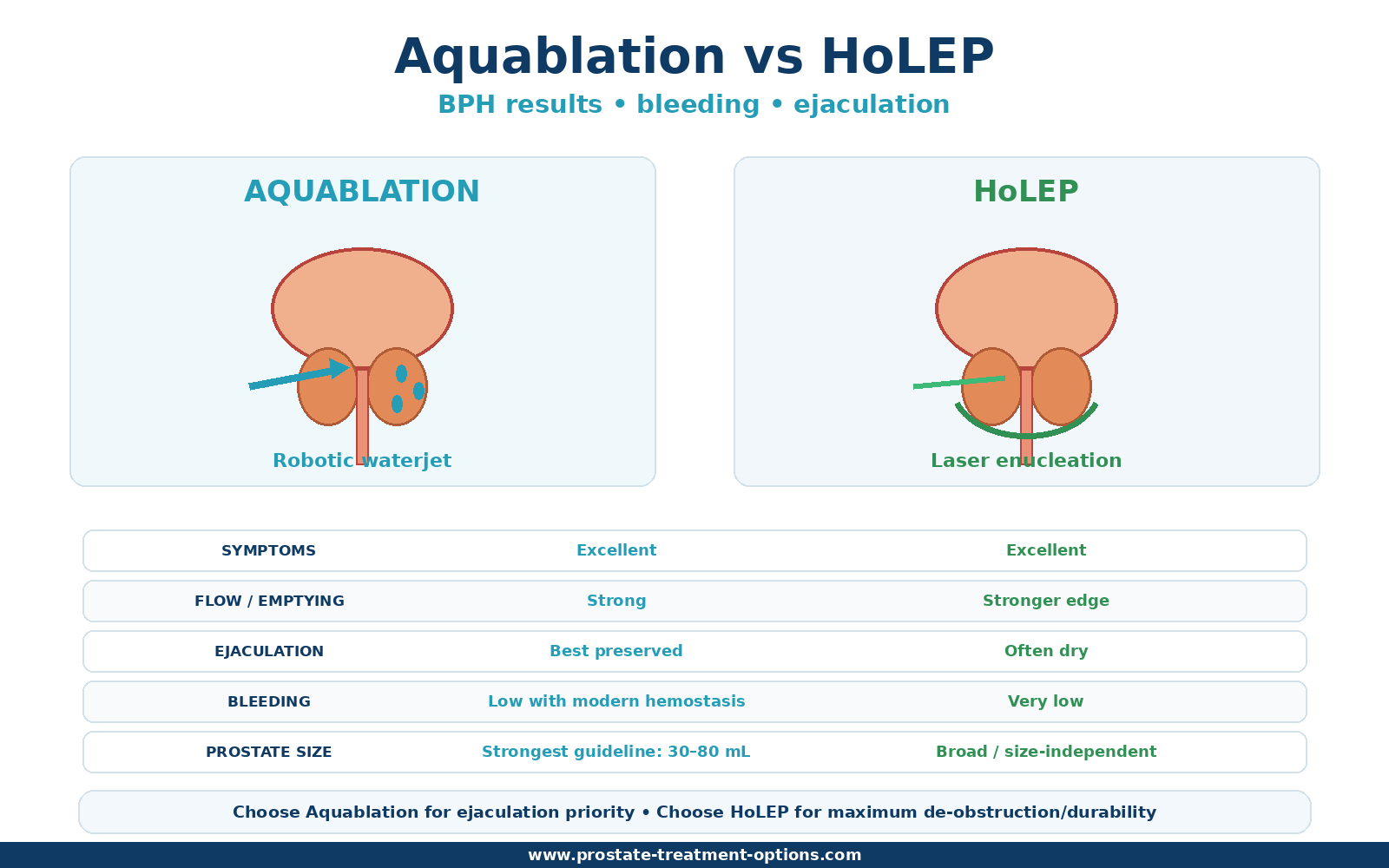
What Are Aquablation and HoLEP?
Aquablation
Aquablation is a robotically assisted, image-guided waterjet treatment for BPH.
The surgeon maps the prostate under real-time transrectal ultrasound guidance. A high-velocity saline jet then removes targeted prostate tissue without using heat for the tissue ablation itself.
After the waterjet treatment, bleeding control is achieved using techniques such as:
- balloon catheter traction;
- focal cautery;
- diathermy;
- or selected low-powered laser/coagulation methods.
HoLEP
HoLEP means holmium laser enucleation of the prostate.
A holmium laser separates the obstructing BPH adenoma from the prostate capsule. The tissue is pushed into the bladder, mechanically morcellated and removed.
This is an anatomical enucleation procedure, meaning the surgeon can remove a very large proportion of the obstructing adenoma.
For comparison with another standard operation, see HoLEP vs TURP for BPH.
Aquablation vs HoLEP: Quick Comparison
| Question | Aquablation | HoLEP |
|---|---|---|
| Symptom relief | Excellent | Excellent |
| Urinary flow improvement | Strong | Often stronger objective improvement |
| PVR reduction | Strong | Often stronger in comparative meta-analysis |
| Amount of tissue removed | Targeted resection | More complete anatomical enucleation |
| Antegrade ejaculation | Usually much better preserved | Dry/retrograde ejaculation very common after standard HoLEP |
| Erectile function | Usually preserved | Usually preserved |
| Blood loss | Improved substantially with modern hemostasis; still a key consideration | Very favorable bleeding profile |
| Catheter / hospital stay | Usually short | Usually short |
| Strongest guideline size range | EAU: 30–80 mL; evidence also exists for 80–150 mL | Broad / effectively size-independent in experienced hands |
| Long-term durability | Good five-year data; direct long-term comparison with HoLEP still limited | Excellent, with very low retreatment rates |
Aquablation vs HoLEP: Which Gives Better BPH Results?
Both procedures produce major improvements in urinary symptoms.
EAU 2026 cites a network meta-analysis comparing Aquablation and HoLEP across 23 studies. It found that:
- IPSS improvement was broadly similar;
- quality-of-life improvement was broadly similar;
- HoLEP had a greater improvement in maximum urinary flow;
- HoLEP also produced a greater reduction in PVR.
The difference is therefore more obvious in objective de-obstruction than in how much better patients report feeling.
Direct Prospective Comparison
A 2025 prospective multicenter study of 150 men directly compared Aquablation with HoLEP in prostates between 30 and 120 mL.
At six months, both procedures significantly improved:
- IPSS;
- quality of life;
- Qmax;
- and PVR.
There were no statistically significant differences between the groups in those main functional outcomes at six months.
However, HoLEP produced a much smaller postoperative prostate volume and a larger reduction in PSA, which reflects more complete tissue removal.
What Does “More Complete Tissue Removal” Mean?
It does not automatically mean the patient will feel dramatically better. Aquablation can produce excellent symptom relief without removing as much tissue. But more complete adenoma removal helps explain HoLEP’s strong objective flow results and very low long-term recurrence/retreatment profile.
Which Improves Urine Flow and Bladder Emptying More?
Both procedures improve urine flow substantially.
The EAU-cited network meta-analysis found that HoLEP produced an approximately 3.2 mL/s greater improvement in Qmax and about 23 mL greater reduction in PVR than Aquablation.
That does not mean Aquablation produces weak flow results.
Pooled Aquablation studies show large improvements in Qmax and meaningful reductions in PVR across a wide range of prostate sizes.
A 2025 pooled analysis of 528 Aquablation patients found mean Qmax increasing from about 8 mL/s before treatment to around 20.5 mL/s at 12 months, with substantial PVR reduction.
If poor emptying is one of your main concerns, review Post-Void Residual (PVR): How Much Urine Left in the Bladder Is Too Much?.
Aquablation vs HoLEP: Which Better Preserves Ejaculation?
Aquablation has the clear advantage.
This is probably the most important difference for many sexually active men.
Aquablation
The WATER randomized trial found substantially less anejaculation after Aquablation than TURP.
EAU reports preservation of antegrade ejaculation in approximately:
- 90% of men in the smaller-prostate WATER cohort;
- 81% in the larger-prostate WATER II cohort.
In the 2025 direct Aquablation-vs-HoLEP multicenter study, ejaculatory dysfunction occurred in approximately:
- 6.6% after Aquablation;
- 89.3% after HoLEP.
That is a very large difference.
HoLEP
Standard HoLEP commonly produces dry or retrograde ejaculation because the surgery changes bladder-neck/prostate anatomy and removes a large amount of adenoma.
Erection and orgasm can remain intact even when external semen is greatly reduced or absent.
If Future Fertility Matters, Discuss It Before Surgery
Dry ejaculation can substantially reduce natural fertility. Aquablation may be much more attractive when preserving antegrade ejaculation is a major priority, but no procedure guarantees normal ejaculation or future fertility.
What About Erectile Function?
Both procedures generally preserve erectile function well.
Aquablation’s sexual-function advantage is mainly ejaculation preservation, not a dramatic superiority in erectile function.
HoLEP also usually preserves erections despite its high rate of dry ejaculation.
This distinction matters:
erection ≠ ejaculation ≠ orgasm.
For a wider comparison of sexual effects across BPH treatments, see BPH Treatment Side Effects.
Which Has Less Bleeding: Aquablation or HoLEP?
HoLEP generally has the stronger bleeding-control profile.
Laser enucleation cuts and coagulates efficiently, and comparative evidence consistently shows low hemoglobin loss and transfusion risk.
Aquablation’s Bleeding Story Has Changed
It would be inaccurate to use only early Aquablation trials to describe current bleeding risk.
Early WATER II experience in prostates 80–150 mL reported notable bleeding-related complications and transfusions.
However, hemostasis techniques evolved substantially.
A multicenter analysis of more than 2,000 Aquablation procedures using focal bladder-neck cautery reported:
- transfusion in about 0.8%;
- return to the operating room for bleeding control in about 0.6%.
A larger 2025 real-world analysis covering more than 70,000 procedures reported a combined rate of transfusion or return to theatre for bleeding control of about 0.2%, although the data source has important limitations and should not be interpreted as a randomized comparison.
Direct Aquablation vs HoLEP
The 2025 multicenter comparison found:
- a larger postoperative hemoglobin drop after Aquablation;
- but the same measured transfusion rate in both groups (1.3%).
Therefore the practical interpretation is:
modern Aquablation bleeding control is much better than early experience suggested, but HoLEP remains particularly attractive when minimizing blood loss is a major priority.
Which Has the Easier Recovery?
Both are transurethral procedures and typically allow relatively short hospital stays.
Aquablation
EAU notes that catheter removal before day two is commonly achievable.
Aquablation’s actual tissue-removal phase can be very fast because the robotic waterjet performs the mapped resection in minutes.
In the 2025 direct comparison, waterjet tissue-removal time was much shorter than HoLEP enucleation time, although total operation time was not significantly different.
HoLEP
HoLEP generally has short catheterization and hospitalization and is well known for rapid recovery despite removing a large amount of tissue.
Temporary postoperative symptoms may include:
- burning;
- urgency;
- frequency;
- blood in the urine;
- and temporary stress urinary leakage.
Which Is Faster Overall?
There is not enough high-quality direct evidence to promise that one procedure will always produce faster return to normal activity.
Aquablation can have a short procedure and early catheter removal. HoLEP has an excellent perioperative recovery profile. Center-specific protocols and surgeon experience strongly influence the actual hospital and recovery timeline.
Aquablation vs HoLEP by Prostate Size
Aquablation: Strongest Guideline Evidence at 30–80 mL
EAU 2026 gives a strong recommendation to offer Aquablation to men with moderate-to-severe LUTS/BPO and prostate volume around 30–80 mL as an alternative to TURP, particularly when ejaculation preservation is important.
What About 80–150 mL?
WATER II specifically studied prostates from 80–150 mL.
Five-year follow-up showed sustained improvements in:
- IPSS;
- Qmax;
- PVR;
- and quality of life.
EAU therefore states that Aquablation is feasible above 80 mL but that more randomized evidence is still needed before the larger-gland evidence reaches the same level as the 30–80 mL indication.
HoLEP: Broad Size Range
HoLEP is effectively a size-independent operation in experienced hands.
It can treat:
- moderate-size prostates;
- 80–100 mL glands;
- very large glands that historically might have required open simple prostatectomy.
This is one of HoLEP’s strongest practical advantages.
To interpret your ultrasound measurement first, see Normal Prostate Size by Age: What Do 30, 40, 50 and 80 cc Mean?.
Which Has the Lower Retreatment Risk?
Both procedures appear durable, but HoLEP has the more mature long-term record and generally the stronger case for minimum retreatment.
Aquablation
EAU reports:
- five-year surgical retreatment of about 5.1% in the WATER 30–80 mL trial;
- about 3% in WATER II large prostates.
Pooled WATER/WATER II follow-up reports surgical retreatment-free survival above 94% at five years.
HoLEP
HoLEP has repeatedly shown very low reoperation rates because the obstructing adenoma is anatomically enucleated.
EAU notes significantly lower retreatment after HoLEP than bipolar TURP in a randomized trial involving glands above 80 mL.
Direct Aquablation vs HoLEP
The network meta-analysis suggested lower retreatment with HoLEP, but confidence in that indirect comparison was low.
EAU therefore makes an important statement: long-term durability of Aquablation directly against enucleation remains to be established.
Practical Interpretation
Aquablation already has respectable five-year durability. HoLEP has an even longer and stronger history of durable de-obstruction. If minimizing the lifetime probability of another BPH operation is your highest priority, HoLEP currently has the stronger evidence base.
What If You Have a Median Lobe?
Both procedures can treat obstructing median-lobe tissue.
Aquablation
The treatment map is created under ultrasound guidance, allowing the surgeon to target obstructing anatomy while planning areas to preserve near the ejaculatory structures.
HoLEP
HoLEP can directly enucleate the median lobe along with lateral-lobe adenoma.
In terms of pure obstruction relief, HoLEP is extremely effective for median-lobe BPH.
If ejaculation preservation is important, however, Aquablation can offer an important advantage over standard complete HoLEP.
See Median Lobe BPH: Symptoms, Diagnosis & Best Treatment Options.
What About Temporary Urinary Incontinence?
Temporary stress urinary leakage can occur after HoLEP.
The EAU-cited network meta-analysis suggested a higher risk of incontinence with HoLEP than Aquablation, but the estimate had very low certainty and a very wide confidence interval.
A propensity-matched 2025 comparison likewise observed transient incontinence more often after HoLEP, but the difference was not statistically significant.
Persistent severe incontinence is much less common than temporary postoperative leakage.
Aquablation five-year datasets report low de novo incontinence rates.
The patient’s baseline bladder function, sphincter function, prostate size and surgeon technique all matter.
Aquablation or HoLEP: Which Procedure Fits Which Patient?
Aquablation May Fit Better If:
- preserving ejaculation is a major priority;
- you want strong surgical-level symptom relief;
- your prostate is in the strongest guideline range of 30–80 mL;
- or you have a larger gland and are being treated at a center experienced with large-gland Aquablation;
- you accept that direct long-term durability versus HoLEP is still being established.
HoLEP May Fit Better If:
- maximum de-obstruction is the priority;
- your prostate is very large;
- you want the lowest practical chance of BPH regrowth/retreatment;
- bleeding minimization is especially important;
- you accept a very high likelihood of dry/retrograde ejaculation;
- an experienced HoLEP surgeon is available.
Surgeon and Center Experience Matter
This is important for both procedures.
HoLEP has a recognized learning curve. EAU specifically highlights surgeon experience as a major determinant of complications.
Aquablation relies on accurate imaging, treatment mapping and modern hemostasis technique. Outcomes can therefore vary by center experience as well.
Your Bladder Matters Too
A technically successful prostate procedure cannot guarantee normal emptying if the bladder muscle is severely underactive.
If PVR is high or chronic retention is present, the urologist may need to determine whether obstruction, weak detrusor function or both are responsible.
When the Decision Is About More Than Symptoms
If BPH causes:
- recurrent or refractory urinary retention;
- hydronephrosis;
- kidney impairment from obstruction;
- recurrent urinary infection;
- bladder stones;
- or severe symptoms despite appropriate treatment,
the priority shifts toward reliable relief of obstruction rather than simply choosing the procedure with the easiest recovery or best ejaculation profile.
See BPH and Kidney Damage and Acute Urinary Retention From BPH.
Dr. Albana’s Note
If a patient asks me whether Aquablation is “better” than HoLEP, I would first ask what outcome matters most to him.
For pure obstruction relief and long-term durability, HoLEP is exceptionally strong. It removes a large amount of adenoma, works across very large prostate sizes and has a very favorable bleeding profile.
Aquablation’s major advantage is different: it can deliver strong symptom relief while preserving antegrade ejaculation in a much higher proportion of men. That can be a decisive benefit for sexually active patients who consider dry ejaculation an important quality-of-life issue.
I would also avoid using old Aquablation bleeding figures without context. Early large-gland experience showed significant bleeding, but contemporary hemostasis methods have reduced transfusion and reoperation substantially.
At the same time, I would not tell a patient that Aquablation has already matched HoLEP’s lifetime durability. Aquablation now has good five-year data, but direct long-term comparison with enucleation is still developing.
So my summary would be: Aquablation is particularly compelling when preserving ejaculation matters; HoLEP is particularly compelling when maximum tissue removal, size flexibility and durability matter most.
— Dr. Albana Greca, MD, MMedSc, Family Physician / General Practitioner
Frequently Asked Questions About Aquablation vs HoLEP
Which works better, Aquablation or HoLEP?
Both provide excellent symptom relief. Comparative meta-analysis suggests HoLEP has an edge in objective measures such as Qmax and PVR, while patient-reported IPSS and quality-of-life improvements are broadly similar.
Which better preserves ejaculation?
Aquablation by a large margin. Modern studies report much higher antegrade-ejaculation preservation than standard HoLEP.
Which causes less bleeding?
HoLEP generally has the stronger bleeding-control profile. Modern Aquablation bleeding rates have improved considerably with better hemostasis techniques.
Which is better for a very large prostate?
HoLEP has the strongest established size-independent role. Aquablation has encouraging five-year evidence in 80–150 mL prostates, but EAU says additional randomized evidence is still needed for large glands.
Can Aquablation treat a 100 cc prostate?
Yes, it has published evidence in the 80–150 mL range. The strongest current EAU recommendation remains 30–80 mL, with larger-gland treatment best considered at experienced centers.
Can HoLEP preserve ejaculation?
Standard HoLEP commonly causes dry or retrograde ejaculation. Modified ejaculation-sparing techniques exist but are specialist approaches and may trade some completeness/durability for ejaculation preservation.
Which has the lower retreatment rate?
HoLEP has the more mature evidence for extremely low retreatment. Aquablation has good five-year retreatment rates, but direct long-term durability versus HoLEP remains less certain.
Which has faster recovery?
Both usually have short catheterization and hospital stays. Aquablation has a very fast waterjet tissue-removal phase, while HoLEP also has a favorable recovery profile. Direct evidence does not support promising one procedure will always produce faster full recovery.
Which is better if I am on blood thinners?
HoLEP has a very strong hemostatic profile, but anticoagulant/antiplatelet management must be individualized. Do not stop blood-thinning medication without the prescribing clinician and urologist coordinating the plan.
Can either procedure treat a median lobe?
Yes. Both can directly treat obstructing median-lobe anatomy.
Related BPH Surgery Guides
Medical References
- European Association of Urology. Guidelines on the Management of Non-neurogenic Male Lower Urinary Tract Symptoms: Disease Management. 2026. Strong recommendation for Aquablation at 30–80 mL, particularly when ejaculation preservation is a priority; feasibility data for >80 mL; HoLEP strongly recommended as an alternative to TURP/open prostatectomy.
- Bhatia A, et al. Comparing outcomes of Aquablation versus holmium laser enucleation of prostate in the treatment of benign prostatic hyperplasia: A network meta-analysis. BJUI Compass. 2024. PMID 39744077.
- Quintas JJ, et al. Aquablation vs. holmium laser enucleation of the prostate for benign prostatic hyperplasia: a 150-patient prospective comparative multicenter study. 2025. PMID 39932697.
- Aquablation versus HoLEP: Propensity score matching analysis of functional outcomes and ejaculation preservation. 2025. PMID 40897661.
- Siqueira MHB, et al. Outcomes of aquablation: pooled analysis from the WATER, WATER II, OPEN WATER, FRANCAIS WATER, and JAPAN PMS studies. 2025. PMID 41148264.
- Aquablation for BPH: real-world prostate size relevance and bleeding events across 6 years. 2025. PMID 41399106.
- Complication Profile and Safety Outcomes of Aquablation in the Management of BPH. 2025 systematic review. PMID 41470078.
Medical information notice: Aquablation and HoLEP outcomes depend on prostate size and anatomy, bladder function, anticoagulant use, surgeon/center experience and individual priorities such as ejaculation preservation. Comparative evidence continues to evolve.
Written & medically reviewed by Dr. Albana Greca, MD, MMedSc • Family Physician / General Practitioner • Founder & Lead Medical Author • Last medically reviewed: September 2026