
Quick Answer
Urgency, frequency and nocturia do not automatically mean BPH. These are bladder-storage symptoms and are also the hallmark symptoms of overactive bladder (OAB).
BPH or benign prostatic obstruction becomes more likely when urgency occurs together with weak stream, hesitancy, straining, intermittency or incomplete emptying. OAB is more likely when urgency is the dominant symptom, often with frequent small voids and sometimes urgency urinary incontinence, while urinary flow and bladder emptying are relatively preserved.
Importantly, BPH and OAB can occur together. Long-standing bladder-outlet obstruction may contribute to bladder overactivity, and some men continue to have urgency even after prostate obstruction has been treated. The most useful evaluation usually combines symptom history, urinalysis, a 3-day bladder diary, post-void residual (PVR) and urinary flow rather than trying to diagnose the cause from urgency alone.
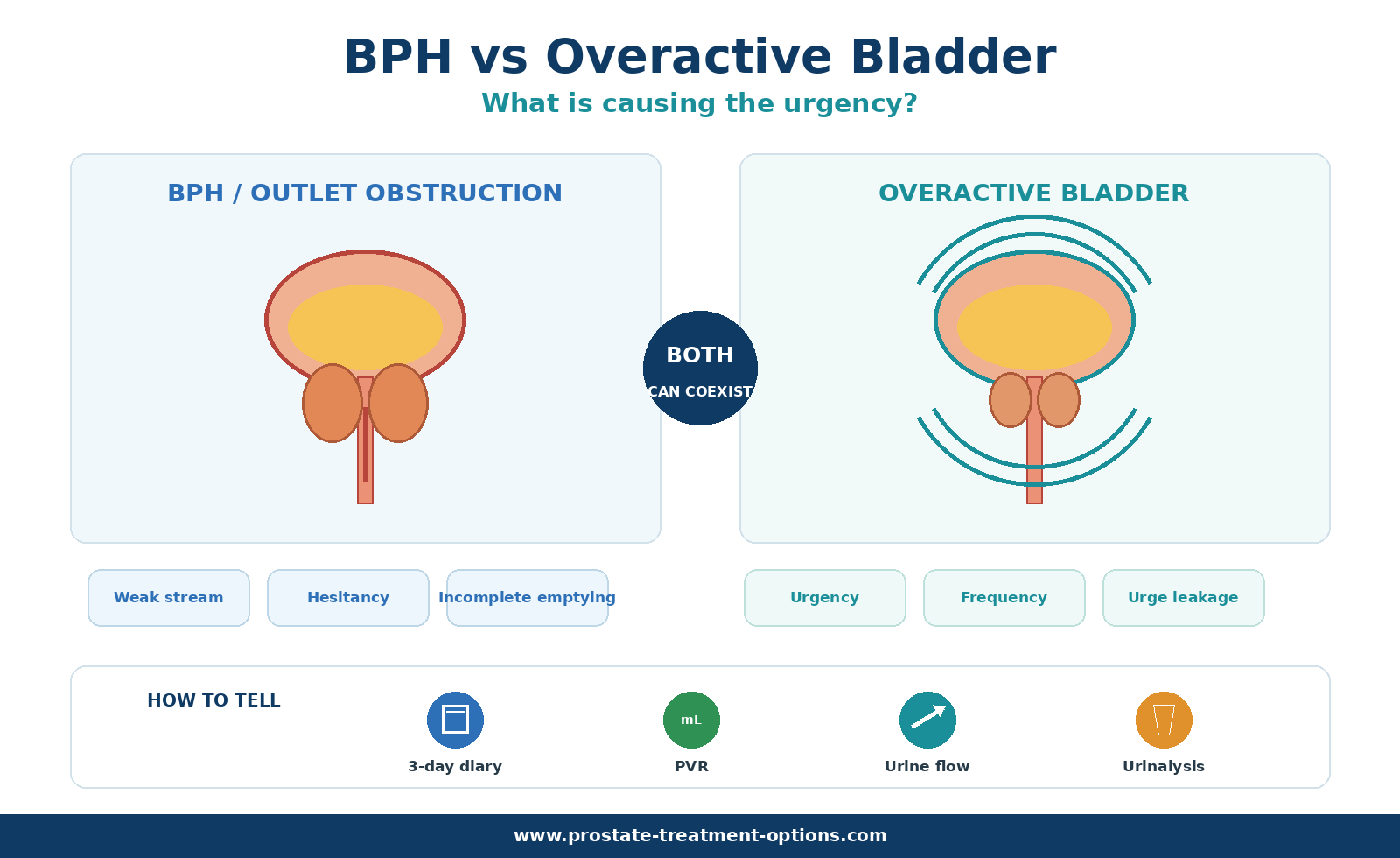
BPH vs Overactive Bladder: What Is the Main Difference?
BPH is a prostate condition. OAB is a bladder-symptom syndrome.
BPH / Benign Prostatic Obstruction
Benign prostatic hyperplasia is enlargement of benign prostate tissue. It may narrow the bladder outlet and increase resistance to urinary flow.
However, having a large prostate does not automatically mean it is causing obstruction, and having urinary symptoms does not automatically prove BPH.
When prostate enlargement actually obstructs urine flow, clinicians often use the term benign prostatic obstruction (BPO).
Overactive Bladder
The AUA/SUFU guideline defines OAB as urinary urgency, usually accompanied by frequency and nocturia, with or without urgency urinary incontinence, when UTI or other obvious pathology does not explain the symptoms.
The key word is urgency: a sudden compelling need to urinate that is difficult to defer.
Why Men Commonly Confuse the Two
BPH can cause both voiding symptoms and storage symptoms. OAB mainly produces storage symptoms. Therefore urgency, frequency and nocturia sit in the overlap between the two conditions and cannot identify the cause by themselves.
Which Symptoms Point More Toward BPH and Which Toward OAB?
| Symptom / Finding | More Suggestive of BPH / Outlet Obstruction | More Suggestive of OAB |
|---|---|---|
| Urgency | Can occur, especially with secondary bladder overactivity | Core symptom |
| Frequency | Common | Very common |
| Nocturia | Common but nonspecific | Common but nonspecific |
| Urgency urinary leakage | Can occur | Strong OAB clue |
| Weak stream | Strong obstruction clue | Not a defining OAB feature |
| Hesitancy | Supports voiding obstruction | Not typical of isolated OAB |
| Straining to void | Supports obstruction or weak bladder function | Not typical of isolated OAB |
| Interrupted stream | Supports voiding dysfunction | Not typical of isolated OAB |
| Incomplete emptying | Important clue, though it can also reflect weak bladder muscle | Not a defining feature |
| Elevated PVR | May support obstruction or detrusor underactivity | Pure OAB usually has relatively preserved emptying |
No Single Symptom Diagnoses BPH Obstruction
EAU 2026 notes that individual symptoms and symptom questionnaires cannot reliably diagnose bladder-outlet obstruction compared with urodynamic pressure-flow testing. Symptoms help identify the pattern; objective tests help explain the mechanism.
Can You Have BPH and Overactive Bladder at the Same Time?
Yes—and this is common enough that current guidelines treat BPH + OAB as a specific clinical problem.
There are several possible patterns:
Obstruction First
The prostate narrows the outlet. The bladder works harder for years and can develop detrusor overactivity, producing urgency and frequency.
Independent OAB + BPH
A man may have an enlarged prostate that is only mildly obstructive plus a separate overactive-bladder syndrome.
OAB Persists After BPH Treatment
Opening the prostate channel can improve urgency, but bladder overactivity may not disappear immediately—or at all.
Weak Bladder + Storage Symptoms
Incomplete emptying from detrusor underactivity can itself cause frequency and urgency, further complicating the picture.
This is why treating every urgency complaint with more prostate medication can fail.
How Do Doctors Tell BPH From Overactive Bladder?
The initial evaluation is usually straightforward but systematic.
1. Detailed Symptom History
The clinician separates symptoms into:
- storage symptoms: urgency, frequency, nocturia and urgency leakage;
- voiding symptoms: weak stream, hesitancy, straining and intermittency;
- post-micturition symptoms: incomplete emptying and dribbling.
Medication use, diabetes, neurological conditions, constipation, sleep apnea, fluid intake and diuretics should also be reviewed because all can alter urinary symptoms.
2. Urinalysis
EAU strongly recommends urinalysis in men with LUTS.
This helps identify conditions that can mimic or worsen OAB/BPH symptoms, including:
- urinary infection;
- blood in the urine;
- glycosuria / diabetes;
- and other urinary abnormalities.
3. PVR
PVR shows whether the bladder is emptying adequately.
4. Uroflowmetry
Urinary flow measurement helps identify a weak or abnormal stream.
5. Prostate Evaluation
DRE, ultrasound or other imaging can assess prostate volume and anatomy when relevant.
A protruding median lobe can cause substantial obstruction even when the overall prostate is not extremely large.
6. Advanced Testing Only When Needed
AUA/SUFU states that urodynamics, cystoscopy and urinary-tract imaging are not routinely required for uncomplicated initial OAB evaluation.
They become useful when there is diagnostic uncertainty, obstructive voiding symptoms, elevated PVR, recurrent infections, hematuria, neurological disease or failure of standard treatment.
Why a 3-Day Bladder Diary Is So Useful
A bladder diary can be one of the most useful low-tech tests for urgency and frequency.
EAU strongly recommends a bladder diary for male LUTS—particularly nocturia—and recommends recording for at least three days.
Record:
- time of each urination;
- amount voided;
- fluid intake;
- urgency;
- leakage;
- night-time voids;
- and relevant circumstances such as caffeine or diuretic timing.
What Pattern Suggests OAB?
A diary showing repeated small-volume voids triggered by strong urgency, sometimes with leakage, supports an OAB-type storage pattern.
What Else Can the Diary Reveal?
It can identify:
- excessive total fluid intake;
- heavy caffeine use;
- nocturnal polyuria;
- very high urine production from diabetes or medications;
- and habits that mimic bladder disease.
Nocturia deserves particular caution because it may result from sleep apnea, leg edema, heart disease, nocturnal polyuria and other systemic problems rather than the prostate or OAB alone.
What Does PVR Tell You About BPH vs OAB?
PVR is especially important when a man has urgency plus weak flow or incomplete emptying.
A low PVR makes severe retention less likely, although it does not rule out BPH obstruction.
A high PVR means the bladder is not emptying well, but it still does not prove BPH because it can result from:
- bladder-outlet obstruction;
- detrusor underactivity;
- neurological disease;
- medications;
- or a combination.
EAU specifically states that PVR is not necessarily associated with obstruction and that no universal PVR threshold alone determines BPH treatment.
See Post-Void Residual (PVR): How Much Urine Left in the Bladder Is Too Much?.
What Does Urinary Flow Tell You?
Uroflowmetry measures the rate and pattern of urination.
A persistently low Qmax can raise suspicion for:
- bladder-outlet obstruction;
- or a weak bladder muscle.
It cannot reliably distinguish the two by itself.
EAU notes that uroflowmetry should ideally be performed with a voided/bladder volume above about 150 mL and may need to be repeated because the result varies from void to void.
A Useful Combination
Urgency + normal/strong flow + low PVR makes isolated OAB more plausible. Urgency + weak flow + high PVR raises more concern for obstruction or weak bladder emptying. Neither pattern is a final diagnosis by itself.
If BPH Is the Main Problem, How Is It Treated?
If the evaluation suggests that outlet obstruction and prostate enlargement are driving the symptoms, treatment is directed toward BPH.
Alpha Blockers
Tamsulosin, alfuzosin and related drugs relax smooth muscle at the bladder outlet and can improve symptoms relatively quickly.
They can improve both voiding and some storage symptoms, but they do not shrink the prostate or prevent progression.
Finasteride or Dutasteride
For men with demonstrably enlarged prostates and progression risk, 5-alpha-reductase inhibitors can shrink the gland and lower future risk of acute urinary retention and BPH surgery.
See Finasteride vs Dutasteride for BPH.
Tadalafil
Tadalafil 5 mg daily can improve LUTS and erectile dysfunction when appropriate.
See Tadalafil vs Tamsulosin for BPH.
Procedures or Surgery
When symptoms remain severe or complications develop, options include Rezūm, UroLift, Aquablation, TURP, HoLEP and other procedures selected according to anatomy and clinical priorities.
If Overactive Bladder Is the Main Problem, How Is It Treated?
Bladder Training
AUA/SUFU strongly recommends bladder training for OAB.
This involves gradually increasing the interval between voids and using urge-suppression strategies rather than immediately rushing to the bathroom with every sensation.
Fluid, Caffeine and Lifestyle Review
EAU recommends behavioral modification including:
- moderating caffeine and alcohol;
- adjusting fluid timing when appropriate;
- addressing constipation;
- reviewing diuretics and other contributing medications;
- and using bladder-training strategies.
Antimuscarinic Medicines
Medicines such as solifenacin, tolterodine, trospium and others can reduce:
- urgency;
- urgency urinary incontinence;
- and daytime frequency.
EAU strongly recommends antimuscarinics for men whose moderate-to-severe LUTS are mainly storage symptoms.
However, these medicines can increase residual urine, so bladder emptying matters.
EAU advises not using antimuscarinic OAB medication when PVR is above 150 mL and recommends reassessing PVR during therapy.
Beta-3 Agonists
Mirabegron and, in some regions, vibegron are alternatives that relax the detrusor during bladder filling.
EAU strongly recommends beta-3 agonists for moderate-to-severe storage LUTS.
Mirabegron can increase blood pressure and is contraindicated in severe uncontrolled hypertension. Blood pressure should be checked before and during treatment.
What If You Have Both BPH and OAB?
This is where treatment often needs to target both the outlet and the bladder.
AUA/SUFU specifically states that men with BPH and bothersome OAB may be offered:
- an antimuscarinic alone;
- a beta-3 agonist alone;
- or an alpha blocker combined with an antimuscarinic or beta-3 agonist.
EAU similarly supports:
- alpha blocker + antimuscarinic when storage symptoms persist;
- alpha blocker + beta-3 agonist for persistent OAB symptoms;
- with attention to PVR and retention risk.
Example
A man may have:
- weak stream that improves after tamsulosin;
- but persistent urgency and frequency despite better flow.
That pattern suggests residual storage/OAB symptoms rather than simply “not enough prostate medicine.”
A clinician may then consider adding an OAB-directed medicine after checking bladder emptying.
Do Not Add an Antimuscarinic Without Considering PVR
In men with poor emptying, suppressing bladder contractions can worsen residual urine. This is why current EAU guidance uses a PVR above 150 mL as a cautionary threshold against antimuscarinic therapy.
Will BPH Surgery Cure Overactive Bladder Symptoms?
Sometimes—but not always.
If obstruction is driving detrusor overactivity, relieving the obstruction can improve:
- urgency;
- frequency;
- nocturia;
- and urgency incontinence.
AUA/SUFU notes that men with OAB-predominant LUTS and BPH can show improvement in symptoms and detrusor overactivity after procedures such as TURP, HoLEP or prostate photovaporization.
However, some men have persistent OAB after surgery, and a smaller group may develop new or temporarily worsened urgency after a procedure.
Why Can Urgency Persist After the Obstruction Is Gone?
Possibilities include:
- long-standing bladder remodeling;
- persistent detrusor overactivity;
- age-related bladder changes;
- neurological or metabolic factors;
- or a bladder disorder that was present independently of BPH.
Therefore, persistent urgency after a technically successful HoLEP or TURP does not automatically mean the prostate operation failed.
Other Conditions That Can Mimic BPH or OAB
Urgency and frequency have a broad differential diagnosis.
Important alternatives include:
- urinary tract infection;
- prostatitis;
- bladder stones;
- bladder cancer or other causes of hematuria;
- diabetes / glycosuria;
- excessive fluid or caffeine intake;
- diuretics;
- sleep apnea and nocturnal polyuria;
- neurological disease;
- interstitial cystitis / bladder pain syndrome when pain is prominent;
- urethral stricture;
- and detrusor underactivity.
Burning, fever, pelvic pain or blood in the urine deserves evaluation rather than being labeled “just BPH” or “just OAB.”
When Urgency Needs Prompt Medical Assessment
Seek prompt care if urgency/frequency occurs with:
- complete inability to urinate;
- painful bladder distension;
- fever or chills;
- visible blood or blood clots;
- new flank pain;
- rapidly worsening kidney function;
- new leg weakness/numbness or loss of bowel/bladder control.
Sudden inability to urinate can be acute urinary retention and usually requires urgent bladder drainage.
Dr. Albana’s Note
When a man tells me, “I have urgency, so my prostate must be worse,” I would not make that assumption.
Urgency is fundamentally a storage symptom. The first question is whether there are also signs that the bladder outlet is obstructed—weak flow, hesitancy, straining, incomplete emptying, elevated PVR or a significant median lobe.
If the stream is reasonably strong, PVR is low and urgency dominates the picture, overactive bladder becomes more likely. A three-day bladder diary can be surprisingly informative because it shows whether the patient is making frequent small voids, producing excessive urine overall or mainly producing too much urine at night.
I would also remember that BPH and OAB often overlap. Improving prostate obstruction may help urgency, but it does not guarantee the bladder will immediately behave normally again.
The practical aim is therefore not to choose the label “BPH” or “OAB” too early. It is to identify which component is actually driving the patient’s symptoms so we treat the outlet, the bladder—or both.
— Dr. Albana Greca, MD, MMedSc, Family Physician / General Practitioner
Frequently Asked Questions About BPH vs Overactive Bladder
Can BPH cause urgency?
Yes. Bladder-outlet obstruction can contribute to detrusor overactivity and storage symptoms such as urgency and frequency. But urgency alone does not prove BPH.
What is the main symptom of overactive bladder?
Urgency is the defining symptom. It is usually accompanied by frequency and nocturia, with or without urgency urinary incontinence.
Does weak urine flow happen with OAB?
Weak flow is not a defining feature of isolated OAB. It raises concern for outlet obstruction, weak bladder contraction or another voiding disorder.
Can I have BPH and OAB together?
Yes. Current AUA/SUFU and EAU guidance specifically addresses men with both BPH and bothersome OAB symptoms.
Can tamsulosin help urgency?
It can improve some storage symptoms when bladder-outlet obstruction is contributing. If urgency persists despite improved flow, additional OAB-directed treatment may be needed.
Can an OAB medicine cause urinary retention in men with BPH?
Antimuscarinics can increase PVR. Acute retention is uncommon in properly selected men with low baseline residuals, but EAU advises against antimuscarinic therapy when PVR exceeds 150 mL.
Does mirabegron help men with BPH and urgency?
Yes, beta-3 agonists can improve storage symptoms. EAU supports beta-3 agonists for moderate-to-severe storage LUTS and allows add-on therapy when urgency persists despite an alpha blocker.
Will TURP or HoLEP cure urgency?
They can improve urgency when obstruction is an important driver, but OAB symptoms may persist or occasionally worsen temporarily after surgery.
How do I know whether I empty my bladder properly?
A post-void residual bladder scan measures urine left after voiding. Uroflowmetry can add information about urinary flow.
What is the best home test for urgency?
A three-day bladder diary is very useful. Record fluid intake, timing and volume of each urination, urgency, leakage and night-time voids, then review the pattern with a clinician.
Related BPH & Bladder Guides
Medical References
- European Association of Urology. Guidelines on the Management of Non-neurogenic Male Lower Urinary Tract Symptoms: Diagnostic Evaluation and Disease Management. 2026. Urinalysis, validated symptom scores, PVR and uroflowmetry are key elements of male LUTS assessment; at least a 3-day bladder diary is recommended. Antimuscarinics and beta-3 agonists are guideline-supported for storage symptoms.
- American Urological Association / Society of Urodynamics, Female Pelvic Medicine & Urogenital Reconstruction. AUA/SUFU Guideline on the Diagnosis and Treatment of Idiopathic Overactive Bladder. J Urol. 2024. OAB is defined by urgency, usually with frequency/nocturia, with or without urgency urinary incontinence, after excluding UTI or other obvious pathology.
- AUA/SUFU OAB Guideline Statement 32–33. Men with BPH and bothersome OAB may receive OAB-directed pharmacotherapy or combination treatment with an alpha blocker plus antimuscarinic or beta-3 agonist, with appropriate attention to bladder emptying.
- National Institute of Diabetes and Digestive and Kidney Diseases (NIDDK). Bladder Control Problems. Urgency incontinence is leakage associated with a strong urge to urinate; bladder symptoms may overlap with frequency, nocturia and emptying problems.
Medical information notice: Urgency and frequency are symptoms, not diagnoses. BPH, OAB, urinary infection, diabetes, medications, neurological disease, nocturnal polyuria and other conditions can overlap. Treatment should be based on the underlying mechanism and bladder-emptying assessment rather than symptom labels alone.
Written & medically reviewed by Dr. Albana Greca, MD, MMedSc • Family Physician / General Practitioner • Founder & Lead Medical Author • Last medically reviewed: September 2026