
Quick Answer
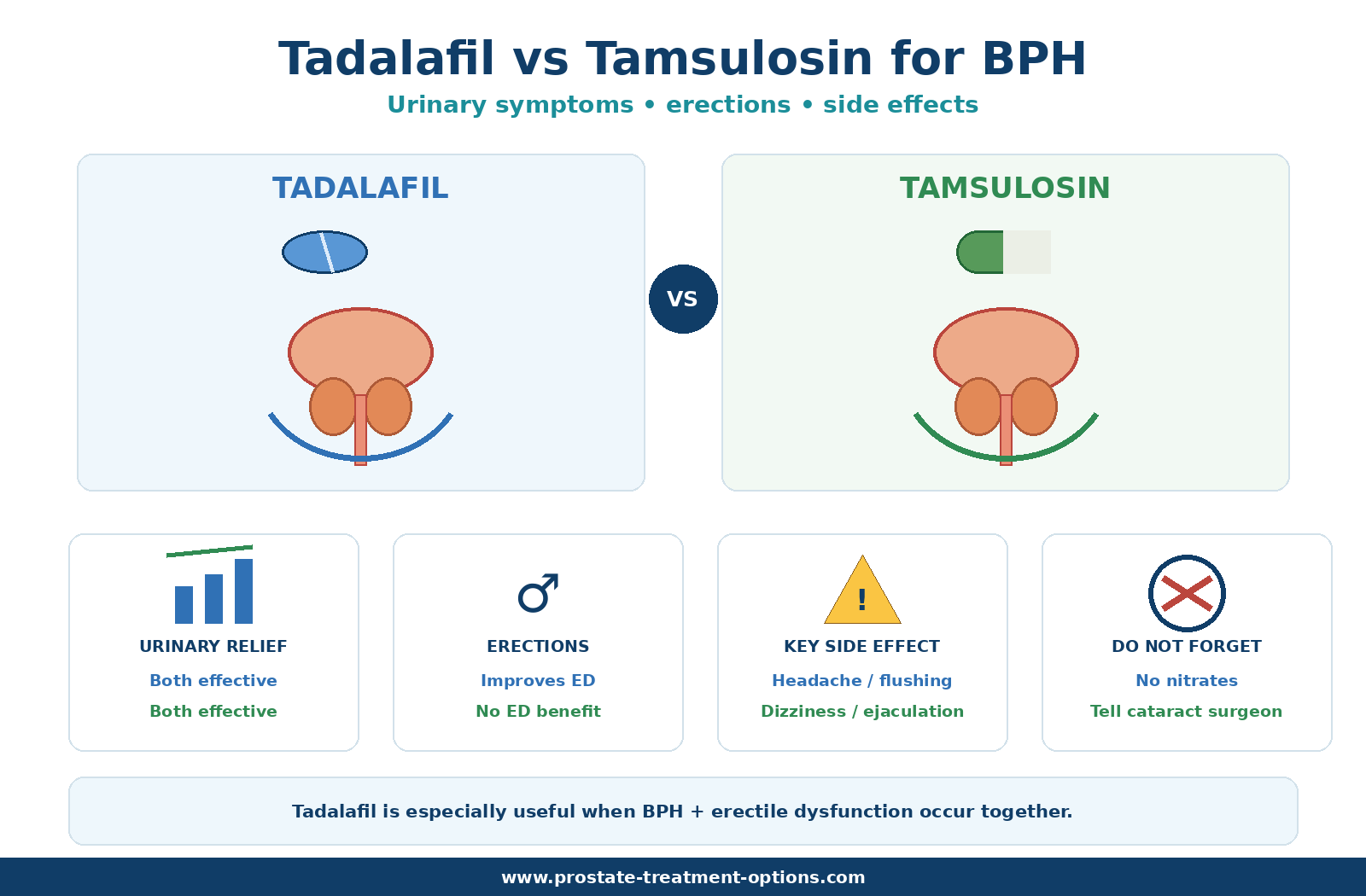
Tadalafil 5 mg once daily and tamsulosin are both effective treatments for bothersome urinary symptoms associated with BPH. Direct randomized-trial meta-analysis has found no significant overall difference between tadalafil and tamsulosin in total IPSS, storage symptoms, voiding symptoms, quality of life, maximum urinary flow or post-void residual.
The major difference is sexual function. Tadalafil can improve erectile dysfunction as well as urinary symptoms, while tamsulosin does not treat erectile dysfunction and is more likely to cause ejaculatory problems. Tamsulosin is a fast-acting alpha blocker and is particularly established for improving urinary flow; tadalafil improves symptom scores but usually has a smaller or inconsistent effect on Qmax.
Neither medicine shrinks the prostate or prevents BPH progression, acute urinary retention or future BPH surgery. If prostate enlargement and progression risk are important, a 5-alpha-reductase inhibitor such as finasteride or dutasteride may need to be considered separately.
What Are Tadalafil and Tamsulosin?
Tadalafil
Tadalafil is a phosphodiesterase type 5 inhibitor (PDE5 inhibitor). It is widely known as an erectile-dysfunction medicine, but tadalafil 5 mg once daily is also licensed for male lower urinary tract symptoms/BPH.
EAU 2026 notes that tadalafil is currently the only PDE5 inhibitor officially licensed for male LUTS.
It increases cyclic GMP signaling and reduces smooth-muscle tone in parts of the lower urinary tract. The exact mechanism by which it improves BPH symptoms is not completely understood.
Tamsulosin
Tamsulosin is an alpha-1 adrenergic receptor blocker. A common BPH dose is 0.4 mg once daily, although formulation and prescribing instructions can vary by country.
It reduces alpha-adrenergic smooth-muscle tone around the prostate and bladder outlet, allowing urine to pass more easily.
Tamsulosin does not remove prostate tissue and does not directly reduce prostate volume.
For the full medication overview, see BPH Medications: Drugs for Enlarged Prostate and How They Work.
Tadalafil vs Tamsulosin: Quick Comparison
| Question | Tadalafil 5 mg Daily | Tamsulosin |
|---|---|---|
| Drug class | PDE5 inhibitor | Alpha-1 blocker |
| BPH symptom relief | Effective | Effective |
| Direct comparison of IPSS | No significant overall difference in meta-analysis of randomized trials | |
| Urine flow (Qmax) | Usually little or inconsistent improvement | More established improvement in Qmax |
| Erectile dysfunction | Improves erections | Does not treat ED |
| Ejaculation | Usually not impaired | Ejaculatory dysfunction is a recognized adverse effect |
| Speed | Benefit can appear within the first weeks | Rapid onset; alpha-blocker effects can begin within days |
| Prostate shrinkage | No meaningful shrinkage | No shrinkage |
| Prevents retention/surgery? | No established disease-progression prevention | No |
| Major safety issue | Never use with nitrates | Dizziness/orthostasis; cataract-surgery IFIS; ejaculation changes |
Which Is Better for BPH Urinary Symptoms?
Direct comparisons suggest that both are reasonable symptom-relief medicines.
A meta-analysis of seven randomized controlled trials involving 1,601 men found no statistically significant difference between tadalafil and tamsulosin for:
- total IPSS;
- voiding symptom score;
- storage symptom score;
- quality of life;
- maximum urinary flow;
- or post-void residual urine.
The important exception was erectile function, which favored tadalafil.
EAU 2026 similarly reports that PDE5 inhibitors and alpha blockers show no significant difference in IPSS in comparative meta-analysis.
What Does This Mean in Practice?
If your main problem is bothersome LUTS and you also have erectile dysfunction, tadalafil can address both with one daily medicine. If erections are not a concern and the priority is straightforward rapid urinary symptom relief, tamsulosin remains a very established first-line option.
Which Improves Urine Flow More?
Alpha blockers have the stronger guideline track record for improving maximum urine flow.
EAU reports that alpha blockers typically:
- reduce IPSS by approximately 30–40% in controlled studies;
- and increase Qmax by approximately 20–25%.
Tadalafil clearly improves urinary symptom scores, but its effect on objective flow is less consistent.
EAU notes that in most tadalafil/PDE5-inhibitor trials, Qmax did not differ significantly from placebo, although some pooled analyses have shown a small improvement.
This is an important distinction:
feeling better is not exactly the same as producing a much stronger urinary flow.
If you have a very weak stream, large post-void residual or suspected significant obstruction, your clinician should evaluate the underlying mechanism rather than simply switch medicines based on symptom scores.
Tadalafil vs Tamsulosin for Erectile Dysfunction
This comparison strongly favors tadalafil.
Tadalafil is an established treatment for erectile dysfunction. In men who have both ED and LUTS/BPH, EAU specifically notes that daily tadalafil can improve both urinary symptoms and erectile function.
In a randomized placebo-controlled trial comparing tadalafil with tamsulosin, both improved LUTS, but only tadalafil significantly improved erectile-function scores.
The direct meta-analysis likewise found significantly better International Index of Erectile Function results with tadalafil.
Does Tamsulosin Cause Erectile Dysfunction?
Alpha blockers generally do not have a major adverse effect on erectile function or libido.
Tamsulosin’s better-known sexual adverse effect involves ejaculation rather than erections.
Which Is Better for Ejaculation?
Tadalafil generally has the more favorable profile.
EAU reports that ejaculatory dysfunction occurs significantly more often with alpha blockers than placebo, particularly with highly selective agents such as tamsulosin and silodosin.
The ejaculation problem may involve:
- little or no semen;
- ejaculation failure;
- reduced ejaculate;
- or other ejaculatory changes.
It is often loosely called “retrograde ejaculation,” although modern evidence suggests that reduced or absent seminal emission explains many cases.
This does not necessarily mean loss of orgasm or erectile ability.
For a broader sexual-effects comparison, see BPH Treatment Side Effects.
Which Works Faster: Tadalafil or Tamsulosin?
Tamsulosin belongs to the faster-acting BPH medication class.
EAU describes alpha blockers as first-line medications partly because of their rapid onset. Significant benefit can occur within hours to days, although the full effect takes several weeks.
Tadalafil can also improve symptoms relatively early. In a major randomized comparison, both tadalafil and tamsulosin showed statistically significant IPSS improvement versus placebo as early as one week.
Therefore, it would be misleading to say tadalafil always takes months to work. It does not.
The main practical difference is that tamsulosin is specifically optimized for alpha-blockade at the lower urinary tract, whereas tadalafil provides the added erectile-function benefit.
Tadalafil vs Tamsulosin Side Effects
Tadalafil Side Effects
- headache;
- flushing;
- indigestion;
- nasal congestion;
- back pain;
- muscle aches;
- lightheadedness or low blood pressure in susceptible patients.
Tamsulosin Side Effects
- dizziness;
- orthostatic symptoms;
- fatigue/asthenia;
- nasal congestion/rhinitis;
- ejaculatory dysfunction;
- rare fainting;
- intraoperative floppy iris syndrome during cataract surgery.
Tamsulosin tends to cause less vascular blood-pressure lowering than older, less selective alpha blockers such as doxazosin or terazosin, but dizziness and orthostatic effects remain clinically important.
U.S. prescribing data for tamsulosin 0.4 mg report dizziness in about 15% of men in two controlled studies, compared with about 10% on placebo. Abnormal ejaculation was reported in about 8.4% on 0.4 mg versus 0.2% on placebo in those studies.
Individual risk can be very different from trial averages.
Tadalafil and Nitrates: The Most Important Safety Rule
Tadalafil must not be used with nitrates.
This includes medications such as nitroglycerin used for angina.
The combination can cause a dangerous drop in blood pressure.
Tadalafil is also contraindicated with soluble guanylate cyclase stimulators such as riociguat.
EAU also lists several cardiovascular situations in which tadalafil is contraindicated or inappropriate, including certain recent myocardial infarctions or strokes, unstable angina, uncontrolled arrhythmias, severe hypotension and other unstable cardiovascular conditions.
Chest Pain After Taking Tadalafil
Do not self-administer nitrate medication after tadalafil. If you develop chest pain or a cardiovascular emergency after using tadalafil, seek urgent medical care and tell the medical team when the last tadalafil dose was taken.
Tamsulosin and Cataract Surgery
Tamsulosin is strongly associated with intraoperative floppy iris syndrome (IFIS).
This can complicate cataract surgery.
EAU states that ophthalmologists should be informed about current or previous alpha-blocker use before cataract surgery.
U.S. prescribing information similarly warns that IFIS has occurred in patients currently taking or previously exposed to tamsulosin.
Planning Cataract Surgery?
Tell the ophthalmologist if you take or have previously taken tamsulosin. Do not simply stop the medicine on your own, because stopping shortly before surgery has not been proven to eliminate IFIS risk.
Do Tadalafil or Tamsulosin Shrink the Prostate?
No.
Neither medicine significantly reduces prostate volume.
Tamsulosin relaxes smooth muscle.
Tadalafil changes smooth-muscle signaling and other lower-urinary-tract pathways.
Neither produces the disease-modifying gland shrinkage seen with finasteride or dutasteride.
EAU explicitly notes that alpha blockers do not reduce prostate size or prevent acute urinary retention.
For tadalafil, long-term data on prostate-size reduction and disease progression are limited, and EAU reports no evidence that it prevents progression.
If your prostate is clearly enlarged and you are at increased risk of progression, see Finasteride vs Dutasteride for BPH and Normal Prostate Size by Age.
Can Tadalafil and Tamsulosin Be Taken Together?
Sometimes specialists prescribe an alpha blocker together with a PDE5 inhibitor, but this needs careful interpretation because guidance differs.
EAU 2026 gives a weak recommendation for alpha-blocker + PDE5-inhibitor combination therapy in men with bothersome LUTS, particularly when improving erectile function is also important. EAU notes that the additional improvement in IPSS is statistically significant but modest.
Recent randomized-trial meta-analyses also report better IPSS, Qmax and erectile-function outcomes with tadalafil plus tamsulosin than with tamsulosin alone, but with more adverse effects.
Important U.S. Label Difference
Current U.S. tadalafil prescribing information states that tadalafil is not recommended in combination with alpha blockers specifically for the treatment of BPH because of additive blood-pressure lowering and because the combination has not been considered adequately established for that indication in the label.
Do Not Combine Them Yourself
Tadalafil and tamsulosin can both lower blood pressure. The combination should be considered only by a clinician who knows your blood pressure, cardiovascular history and other medications.
Tadalafil or Tamsulosin: Which One Fits Which Patient?
Tadalafil May Fit Better If:
- you have BPH symptoms plus erectile dysfunction;
- you want one daily medicine targeting both problems;
- ejaculatory preservation is important;
- you do not take nitrates or riociguat;
- your cardiovascular status makes PDE5-inhibitor therapy appropriate.
Tamsulosin May Fit Better If:
- your main priority is urinary symptom relief;
- erectile dysfunction is not a treatment goal;
- you want a well-established rapid-onset alpha blocker;
- you can tolerate the possibility of ejaculation changes;
- cataract surgery is not imminent or the ophthalmologist is informed.
What Else Should Influence the Choice?
- blood pressure;
- cardiovascular disease;
- current nitrates or antihypertensive drugs;
- erectile dysfunction;
- importance of ejaculation;
- planned cataract surgery;
- prostate size;
- PVR and urinary retention history;
- and whether long-term progression prevention is needed.
If symptoms are severe despite medication or there are complications, the discussion may need to shift from medicines to other BPH treatment options.
Dr. Albana’s Note
If a patient has both urinary symptoms and erectile dysfunction, tadalafil is a particularly attractive option because one daily medicine may improve both problems.
If erections are normal and the main goal is simply to improve urinary symptoms quickly, tamsulosin remains a very reasonable and familiar first-line medicine.
I would also explain that neither medicine solves every BPH problem. Neither shrinks a large prostate or prevents progression in the way finasteride or dutasteride can. A patient with a very enlarged prostate, repeated urinary retention or a high progression risk may need a different strategy.
The side-effect priorities are also different. With tadalafil, I would focus on nitrates, cardiovascular status, headache, flushing and blood-pressure interactions. With tamsulosin, I would ask about dizziness, ejaculation and upcoming cataract surgery.
Finally, I would not advise patients to combine tadalafil and tamsulosin on their own. Combination therapy can improve symptoms in selected men, but blood-pressure effects and other adverse events increase, and prescribing guidance differs between Europe and the U.S.
— Dr. Albana Greca, MD, MMedSc, Family Physician / General Practitioner
Frequently Asked Questions About Tadalafil vs Tamsulosin
Is tadalafil as effective as tamsulosin for BPH?
For overall urinary symptom scores, randomized-trial meta-analysis has found broadly similar effectiveness. Tamsulosin has a more established effect on urinary flow, while tadalafil provides the additional benefit of treating erectile dysfunction.
Which is better for erections?
Tadalafil. It is an established erectile-dysfunction treatment. Tamsulosin does not treat ED.
Which is better for ejaculation?
Tadalafil generally has the more favorable profile. Tamsulosin can reduce or alter ejaculation in some men.
Which works faster?
Tamsulosin has a rapid alpha-blocker onset and may begin helping within days. Tadalafil can also improve BPH symptoms relatively early, with significant benefit seen by one week in some trials.
Does tadalafil increase urine flow?
It may produce a small improvement, but in most trials the increase in Qmax has been less consistent than its improvement in symptom scores. Tamsulosin has a stronger established flow-rate effect.
Does tamsulosin cause erectile dysfunction?
Not usually. Its better-known sexual side effect is ejaculatory dysfunction rather than loss of erections.
Can tadalafil be taken with nitroglycerin?
No. Nitrates and tadalafil must not be combined because severe hypotension can occur.
Can tadalafil and tamsulosin be taken together?
Selected clinicians use the combination, and EAU gives a weak recommendation in bothersome LUTS, especially when erectile function is also a priority. However, adverse effects increase and current U.S. tadalafil labeling does not recommend the combination specifically for BPH. Do not combine them without medical supervision.
Which medicine shrinks the prostate?
Neither. Finasteride and dutasteride are the main prescription BPH medicines that reduce prostate volume over time.
Which is better for a very large prostate?
Neither tadalafil nor tamsulosin changes prostate size substantially. A large gland with progression risk may need a 5-alpha-reductase inhibitor, combination therapy or a procedure depending on symptoms and complications.
Related BPH Medication Guides
Medical References
- European Association of Urology. Guidelines on the Management of Non-neurogenic Male Lower Urinary Tract Symptoms: Disease Management. 2026. Alpha blockers are effective with rapid onset; tamsulosin is associated with ejaculatory dysfunction and IFIS. Tadalafil 5 mg once daily improves LUTS and erectile function but has limited effect on Qmax and no established disease-progression benefit.
- Goueli R, et al. Management of Lower Urinary Tract Symptoms Attributed to Benign Prostatic Hyperplasia: AUA Guideline (2026) Part II: Medical Management. J Urol. 2026;216(2):152-160. PMID 42095477.
- Guo B, et al. Comparative Effectiveness of Tadalafil versus Tamsulosin in Treating Lower Urinary Tract Symptoms Suggestive of Benign Prostate Hyperplasia: A Meta-Analysis of Randomized Controlled Trials. 2020. PMID 32327621.
- Oelke M, et al. Monotherapy with tadalafil or tamsulosin similarly improved lower urinary tract symptoms suggestive of BPH in an international randomized placebo-controlled trial. Eur Urol. 2012. PMID 22297243.
- Liu J, et al. Comparison of Monotherapies and Combination Therapy of Tamsulosin and Tadalafil for LUTS/BPH with or without ED: A Meta-Analysis. Urol Int. 2024. PMID 38081154.
- Tamsulosin plus Tadalafil compared with Tamsulosin alone for BPH in patients with or without erectile dysfunction: meta-analysis and meta-regression of randomized controlled trials. 2025. PMID 40349279.
- DailyMed prescribing information: tadalafil and tamsulosin hydrochloride. Nitrate contraindication, alpha-blocker blood-pressure interactions, orthostasis, ejaculation effects and intraoperative floppy iris syndrome.
Medical information notice: Tadalafil and tamsulosin are prescription medicines. Treatment should account for blood pressure, cardiovascular status, nitrate/riociguat use, cataract plans, sexual priorities, prostate size, PVR, other medications and the possibility that urinary symptoms are not caused by BPH alone.
Written & medically reviewed by Dr. Albana Greca, MD, MMedSc • Family Physician / General Practitioner • Founder & Lead Medical Author • Last medically reviewed: September 2026