
Quick Answer
A healthy younger adult prostate is often around 20–30 cc (mL), but prostate volume tends to increase with age and there is no single “normal prostate size” for every age. Population studies show substantial variation between men, ethnic groups and measurement methods.
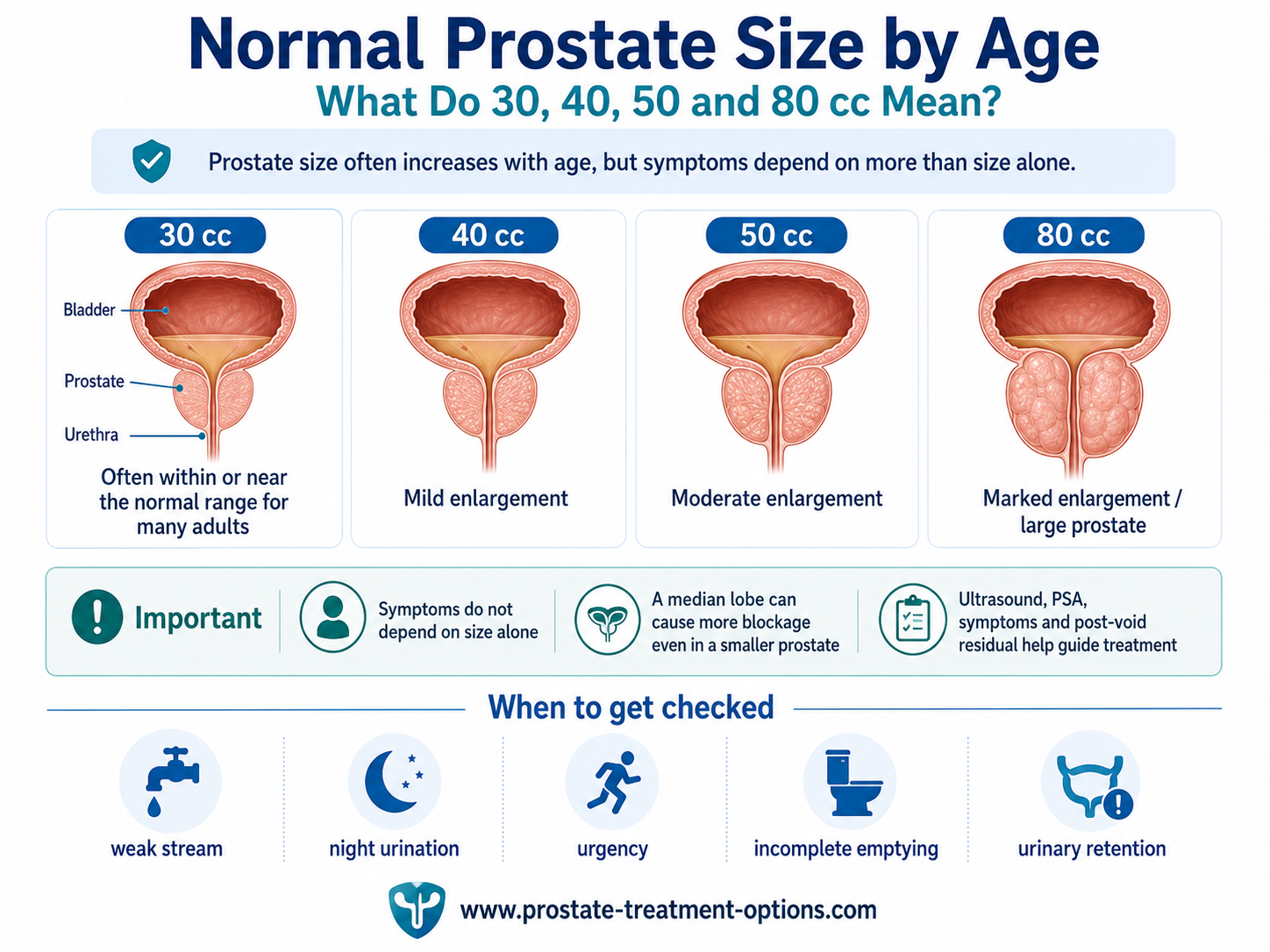
As a practical clinical guide, 30 cc is near the point where many guidelines begin to regard the gland as demonstrably enlarged; 40 cc is a commonly used threshold for increased BPH progression risk; 50 cc is clearly enlarged compared with most younger-adult reference values; and 80 cc is a large prostate that can materially influence which BPH procedures are suitable.
However, prostate size alone does not determine how severe your urinary symptoms are or whether you need surgery. A 40 cc prostate with an obstructing median lobe can sometimes cause more obstruction than a much larger gland that grows mainly outward.
What Is a Normal Prostate Size?
The prostate is often described as being approximately the size of a walnut in a younger adult man, but that comparison is only a rough visual guide.
Ultrasound and MRI measure prostate volume in milliliters (mL) or cubic centimeters (cc).
Are cc and mL the Same?
Yes for volume: 1 cc = 1 mL. Prostate weight in grams is also numerically close to prostate volume because prostate tissue has a specific gravity near 1, so urologists often use cc, mL and grams approximately interchangeably when discussing prostate size. They are not literally identical physical units, but the difference is usually unimportant for routine BPH decision-making.
A modern European study of healthy fertile men with a mean age of about 36 years found an average prostate volume of approximately 25 mL, with a reference range of about 15–35 mL.
That is useful for understanding younger adults, but it should not be turned into a rule that every prostate above 35 cc is abnormal or requires treatment. Prostates naturally tend to enlarge with aging, and BPH becomes increasingly common later in life.
Normal Prostate Size by Age: What Research Actually Shows
There is no universally accepted age-by-age prostate-volume chart that applies to every man.
Published reference studies differ because of:
- ethnicity and population;
- body size and metabolic health;
- whether men with urinary symptoms were excluded;
- transabdominal ultrasound vs TRUS vs MRI;
- measurement technique;
- and whether BPH was already present.
Still, several studies show a consistent pattern: prostate volume is usually in the low-to-mid 20s in younger adults and increases progressively with age.
| Age | Population Evidence | Practical Interpretation |
|---|---|---|
| 20s | Healthy fertile European men: mean about 22 mL in ages 23–30. | A prostate around 20–25 cc is common in a healthy younger adult. |
| 30s | Same study: mean about 25 mL in ages 31–40. | Mid-20 cc volumes are typical in many healthy men. |
| 40s | Same cohort ages 41–53: mean about 27 mL. Other populations show wide variation. | 30 cc can be only mildly enlarged and must be interpreted clinically. |
| 50s–70s | A German community study of 1,763 healthy men aged 50–80 found mean volume rising continuously from about 24 cc to 38 cc across the age range. | Increasing size becomes more common, but many older men still have relatively modest volumes. |
| 60s | One TRUS study of healthy men reported an average around 35.5 cc at ages 60–69; other populations reported lower values. | A value in the 30s may be common, but population and measurement method matter. |
| 70s+ | Community studies show continued average growth, with substantial person-to-person variation. | 40–50+ cc becomes increasingly common, but age alone does not make urinary symptoms “normal.” |
Do Not Use an Age Chart as a Diagnosis
A prostate can be larger than the population average without causing meaningful obstruction, while a smaller prostate can cause severe symptoms because of bladder-neck anatomy, median-lobe protrusion, urethral resistance or bladder dysfunction.
What Does a 30 cc Prostate Mean?
A 30 cc prostate is only modestly larger than the average young-adult prostate.
In BPH management, however, 30 cc is clinically important because modern treatment guidance often uses approximately this size as evidence of demonstrable enlargement.
AUA guidance has used prostate volume greater than about 30 cc, palpable enlargement, or PSA above roughly 1.5 ng/mL as evidence supporting the use of a 5-alpha-reductase inhibitor in an appropriately symptomatic patient.
A 30 cc prostate does not automatically mean:
- you have severe BPH;
- your urinary symptoms come from the prostate;
- you need finasteride;
- you need surgery;
- or you have prostate cancer.
If a 30 cc prostate is accompanied by a significant protruding median lobe, however, the anatomy can still produce meaningful obstruction. That is why prostate shape should be considered alongside volume.
What Does a 40 cc Prostate Mean?
A 40 cc prostate is enlarged compared with typical younger-adult reference values and becomes more clinically relevant in BPH management.
EAU 2026 uses prostate volume above 40 mL as a practical example of increased risk for LUTS/BPH progression when recommending long-term treatment with finasteride or dutasteride.
That does not mean every 40 cc prostate needs medication.
A doctor still considers:
- how bothersome the symptoms are;
- IPSS symptom score;
- urinary flow;
- post-void residual;
- PSA;
- prostate shape;
- median-lobe anatomy;
- previous urinary retention;
- and the patient’s treatment preferences.
If symptoms are mild and bladder emptying is good, monitoring may still be reasonable.
See BPH Treatment: Medications, Procedures, Surgery & How to Choose.
What Does a 50 cc Prostate Mean?
A 50 cc prostate is clearly enlarged relative to the usual volume of a younger healthy prostate.
At this size, the likelihood that BPH contributes to symptoms becomes more relevant, particularly if the man also has:
- weak flow;
- incomplete emptying;
- rising PVR;
- higher PSA consistent with gland enlargement;
- recurrent retention;
- or a protruding median lobe.
But even a 50 cc prostate does not tell you exactly how severe symptoms should be.
Population studies have repeatedly shown that the relationship between prostate volume and symptom severity is only modest. Some men with 50–60 cc glands have few complaints, while others with smaller glands are severely bothered.
A 50 cc gland can often be treated medically if appropriate. If a procedure is preferred or needed, many modern options are technically available in this volume range.
What Does an 80 cc Prostate Mean?
An 80 cc prostate is a large prostate in routine BPH practice.
At this point, volume becomes especially important for procedural planning.
It still does not mean surgery is automatically necessary.
Instead, an 80 cc prostate raises questions such as:
- Are symptoms severe or merely mild?
- Is there true bladder outlet obstruction?
- Is the bladder still contracting well?
- Has urinary retention occurred?
- Are there recurrent infections, bladder stones or kidney consequences?
- Does the prostate have a large median lobe?
- Is long-term medication controlling symptoms adequately?
If procedural treatment is required, large glands often favor techniques that can remove substantial amounts of adenoma efficiently, especially HoLEP or another anatomic endoscopic enucleation technique. Simple prostatectomy can still be appropriate for selected very large glands, particularly where endoscopic enucleation expertise is unavailable.
Other procedures may also be possible depending on anatomy, local expertise and guideline indications.
See BPH Surgery & Procedures for a complete comparison.
Does a Bigger Prostate Mean Worse Urinary Symptoms?
Not necessarily.
This is one of the most important points on this page.
A large community study found only a modest relationship between prostate size and urinary symptom severity. Age, urinary flow and other factors also influenced symptoms.
Why can a smaller prostate cause severe problems?
Median Lobe
A relatively modest gland can protrude into the bladder and create a ball-valve obstruction.
Bladder Neck
Some men have significant resistance at the bladder outlet even without a huge prostate.
Bladder Muscle
A weak detrusor can cause poor emptying even when prostate obstruction is not severe.
Overactive Bladder
Urgency and frequency can persist independently of how large the prostate is.
Conversely, a very large prostate may expand outward and cause surprisingly little obstruction.
That is why BPH evaluation should combine prostate volume with symptoms, flow, residual urine and anatomy rather than using volume alone.
How Is Prostate Size Measured?
Digital Rectal Examination (DRE)
A DRE can tell the clinician whether the gland feels enlarged, firm, asymmetric or nodular, but it is not the most accurate way to calculate volume.
Transabdominal Ultrasound
Ultrasound through the lower abdomen can estimate prostate volume and is convenient when the bladder and residual urine are being assessed at the same time.
Transrectal Ultrasound (TRUS)
EAU notes that TRUS is more accurate than transabdominal ultrasound for prostate-volume measurement. It also provides useful information about prostate shape and median-lobe anatomy.
MRI
Prostate MRI can provide highly detailed volume and anatomical information, particularly when the scan is being performed for prostate-cancer risk assessment. MRI is not required simply to measure every BPH prostate.
How Is Volume Calculated?
Ultrasound and MRI commonly estimate prostate volume using three dimensions:
width × height × length × approximately 0.52
This is an ellipsoid estimate, so the result is not an exact physical measurement of every irregular contour of the gland.
Why Two Scans Can Give Different Numbers
A prostate reported as 46 cc on one scan and 51 cc on another has not necessarily grown dramatically. Differences can result from imaging method, operator technique, where the measurements were placed and the shape of the prostate. Small volume differences should be interpreted cautiously.
What Is the Relationship Between PSA and Prostate Size?
PSA is produced by prostate tissue, so larger benign prostates often produce more PSA.
EAU reports that PSA has useful predictive value for prostate volume. In men with LUTS/BPH, a PSA around 1.5 ng/mL can help predict a prostate volume above 30 mL, although this is not exact.
EAU also reports approximate PSA levels associated with prostate volumes above 40 mL:
| Age Group | Approximate PSA Level Suggesting a Higher Probability of Prostate >40 mL |
|---|---|
| 50s | >1.6 ng/mL |
| 60s | >2.0 ng/mL |
| 70s | >2.3 ng/mL |
These values are not prostate-cancer thresholds and are not a substitute for imaging.
PSA is prostate-specific but not cancer-specific. BPH, inflammation, urinary retention and other factors can raise it.
See PSA Test for Prostate Cancer: Levels, Results, Screening & What Happens Next.
How Does Prostate Size Change BPH Treatment?
Size is particularly important for two decisions:
- whether a prostate-shrinking medication is likely to be useful; and
- which procedure best fits the anatomy.
Medication
Alpha blockers can improve symptoms regardless of prostate size in the short term. They do not shrink the gland or prevent future retention/surgery.
Finasteride and dutasteride work best when the prostate is demonstrably enlarged. EAU recommends 5-alpha-reductase inhibitors for men with moderate-to-severe LUTS and increased progression risk, giving prostate volume above 40 mL as a practical example.
Over two to four years, 5-ARIs can reduce prostate volume by approximately 18–28% and lower the risks of acute urinary retention and BPH-related surgery.
Procedures
Procedure selection uses volume together with anatomy.
| Approximate Size Context | Examples of Treatment Considerations |
|---|---|
| <30 cc | TUIP can be appropriate in selected small prostates without a median lobe. Medications or other MISTs may also be used according to symptoms. |
| 30–80 cc | Many established options can be considered, including TURP, selected UroLift, Rezūm, Aquablation and laser procedures depending on anatomy and priorities. |
| >80 cc | Large-gland procedures such as HoLEP/anatomic enucleation become especially attractive because of efficiency and durability. Other options remain possible in selected patients. |
| Very large prostate | HoLEP or other enucleation techniques can often treat very large glands; simple prostatectomy remains an option in selected patients. |
The exact cutoff should never be used in isolation. A 70 cc gland with a prominent median lobe may need a different procedure than a 70 cc gland without one.
Can You Shrink an Enlarged Prostate?
Yes, but not every BPH treatment shrinks it.
Finasteride and dutasteride can reduce volume gradually over months.
Procedures such as TURP, HoLEP, Aquablation and laser surgery physically remove or destroy obstructing tissue.
Alpha blockers and tadalafil may improve symptoms but do not substantially shrink the prostate.
Herbal supplements have not demonstrated reliable prostate shrinkage comparable with 5-ARIs.
When Does Prostate Size Become Concerning?
The number itself is rarely the main concern.
A 90 cc prostate that empties well and causes little bother may be managed differently from a 45 cc prostate causing repeated retention.
Doctors become more concerned when enlargement is accompanied by:
- recurrent or refractory urinary retention;
- progressively increasing residual urine;
- very weak flow with significant obstruction;
- recurrent urinary infection related to poor emptying;
- bladder stones;
- recurrent BPH-related bleeding;
- hydronephrosis;
- kidney impairment caused by obstruction;
- or severe symptoms despite appropriate treatment.
Those are clinical consequences of BPH—not simply consequences of reaching a particular number of cubic centimeters.
Seek Prompt Medical Attention If You Cannot Urinate
Complete inability to pass urine, especially with a painful full lower abdomen, can be acute urinary retention.
It may require prompt bladder drainage with a catheter.
Also seek medical care for urinary symptoms with fever/chills, substantial blood in the urine, severe flank pain or rapidly worsening symptoms.
Do not attempt to manage acute retention by restricting water.
Dr. Albana’s Note
Patients often focus intensely on one number—“My prostate is 42 cc” or “My scan says 80 cc; is that dangerous?” I would use the volume as one piece of information, not as the diagnosis or treatment decision by itself.
A prostate in the 20–30 cc range is common in younger healthy men, and average volume tends to rise with age. Once the gland reaches 30–40 cc, its size becomes increasingly relevant to BPH progression and medication choice. But it still does not tell us how badly the bladder outlet is obstructed.
I would pay particular attention to anatomy. A 35–40 cc prostate with a protruding median lobe can create major obstruction, while another man’s 70 cc prostate may produce relatively little difficulty. PVR, urinary flow, symptoms and bladder function therefore matter just as much as volume.
At larger volumes—around 80 cc and beyond—the number becomes especially useful for procedure planning. It may favor enucleation techniques such as HoLEP, but even then surgery should not be recommended merely because the prostate crossed a numerical threshold.
Finally, prostate size and PSA are related, but neither proves cancer. PSA must be interpreted using the entire clinical picture.
— Dr. Albana Greca, MD, MMedSc, Family Physician / General Practitioner
Frequently Asked Questions About Prostate Size
What is a normal prostate size in cc?
Many healthy younger adult men have prostate volumes around 20–30 cc. A European study of healthy fertile men found an average around 25 mL and a reference range of approximately 15–35 mL. Volume generally increases with age, so there is no single normal value for every age.
Is a 30 cc prostate enlarged?
It is near the upper end of common younger-adult volumes and is often used clinically as a threshold for demonstrable enlargement. It does not automatically require treatment.
Is a 40 cc prostate large?
It is enlarged relative to typical younger-adult values. EAU uses prostate volume above 40 mL as an example of increased BPH progression risk when considering a 5-alpha-reductase inhibitor.
Is a 50 cc prostate dangerous?
No. It is clearly enlarged, but danger depends on consequences such as retention, poor bladder emptying, stones, infection or kidney obstruction—not the 50 cc number itself.
Does an 80 cc prostate require surgery?
No. An 80 cc prostate is large and influences procedural selection, but surgery depends on symptoms, obstruction, complications, response to medication and patient preference.
Can a small prostate cause severe urinary symptoms?
Yes. Median-lobe protrusion, bladder-neck obstruction, urethral disease, overactive bladder or a weak bladder muscle can produce severe symptoms even when total prostate volume is modest.
Does prostate size predict PSA?
There is a meaningful relationship because benign prostate tissue produces PSA. Larger glands often have higher PSA, but PSA cannot accurately determine prostate size in every individual and cannot distinguish BPH from cancer by itself.
Can prostate size decrease?
Yes. Finasteride and dutasteride can reduce prostate volume by roughly 18–28% over time in men with BPH. Tissue-removing or ablative procedures can reduce the obstructing adenoma more directly.
Is prostate size the same as BPH severity?
No. BPH severity depends on symptoms, obstruction, bladder function and complications as well as anatomy and prostate volume.
Related BPH & Prostate Testing Guides
Medical References
- Goueli R, et al. Management of Lower Urinary Tract Symptoms Attributed to Benign Prostatic Hyperplasia: AUA Guideline (2026) Part I: Presentation and Evaluation. J Urol. 2026;216(2):143-151. PMID 42095481.
- Goueli R, et al. Management of Lower Urinary Tract Symptoms Attributed to Benign Prostatic Hyperplasia: AUA Guideline (2026) Part II: Medical Management. J Urol. 2026;216(2):152-160. PMID 42095477.
- Goueli R, et al. Management of Lower Urinary Tract Symptoms Attributed to Benign Prostatic Hyperplasia: AUA Guideline (2026) Part III: Procedural/Surgical Management. J Urol. 2026;216(2):161-170. PMID 42095468.
- European Association of Urology. Guidelines on the Management of Non-neurogenic Male Lower Urinary Tract Symptoms: Diagnostic Evaluation and Disease Management. 2026.
- Berges R, et al. Age-stratified normal values for prostate volume, PSA, maximum urinary flow rate, IPSS, and other LUTS/BPH indicators in the German male community-dwelling population aged 50 years or older. World J Urol. 2011. PMID 21221974.
- Lotti F, et al. The European Academy of Andrology ultrasound study on healthy, fertile men: Prostate-vesicular transrectal ultrasound reference ranges. Andrology. 2022. PMID 35735741.
- Lee F, et al. / community-based prostate volume literature: age, prostate volume and urinary symptom relationships.
Medical information notice: Prostate volume is only one component of BPH assessment. A treatment decision should consider urinary symptoms, flow, PVR, prostate anatomy, PSA, bladder function, complications, overall health and patient preferences.
Written & medically reviewed by Dr. Albana Greca, MD, MMedSc • Family Physician / General Practitioner • Founder & Lead Medical Author • Last medically reviewed: September 2026