
Quick Answer
A trial without catheter (TWOC) is a planned attempt to remove the urinary catheter after an episode of acute urinary retention and see whether you can urinate adequately on your own.
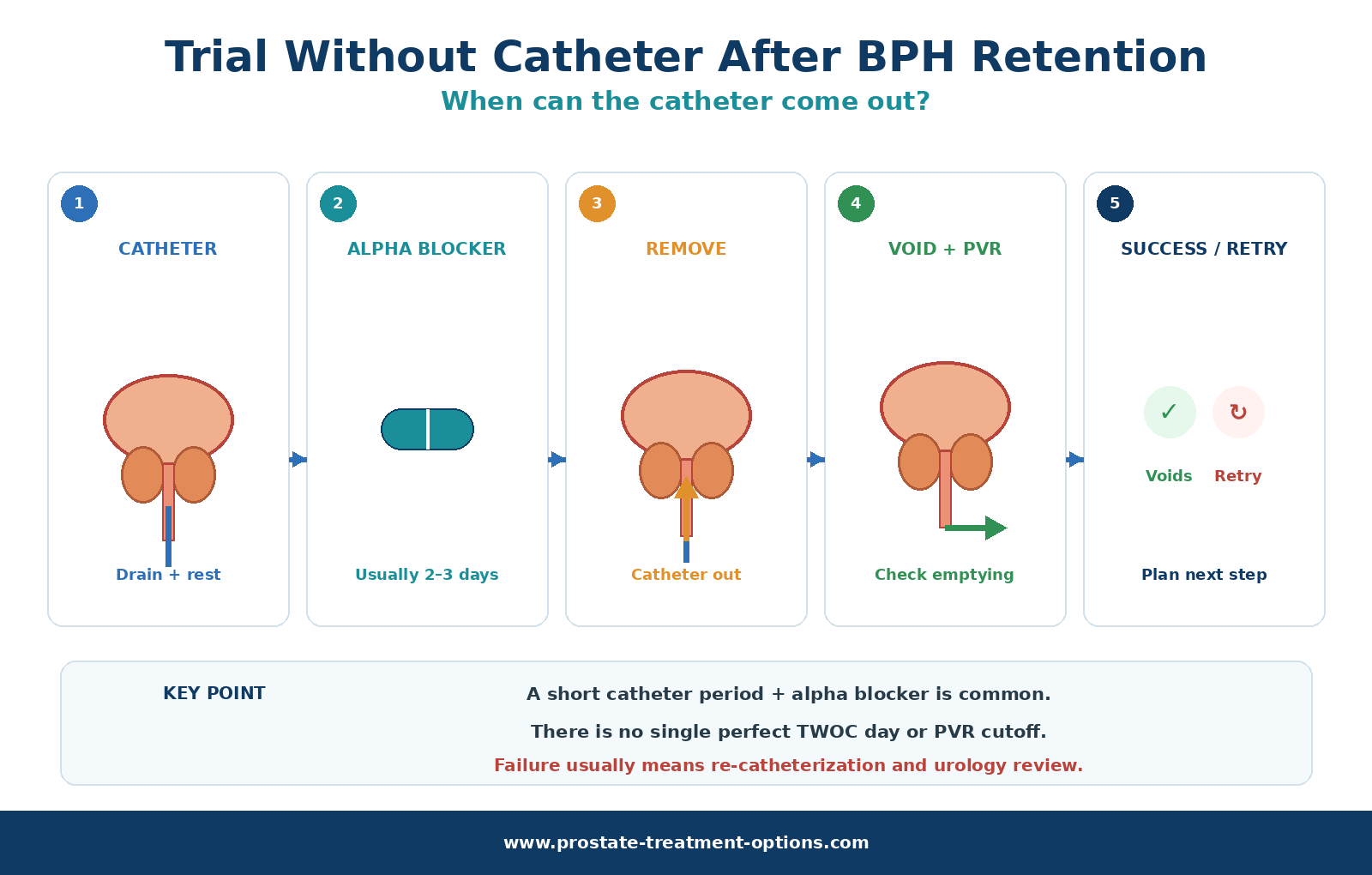
For BPH-related retention, there is no single perfect day when every catheter should come out. Current evidence commonly supports a short catheter period—often around 2–3 days of alpha-blocker treatment before TWOC—with many clinical pathways using roughly 2–5 days overall. A 2025 evidence-based French guideline found that alpha blockers such as tamsulosin, alfuzosin or silodosin given for 2–3 days improve TWOC success, while catheterization beyond about 3–5 days increases catheter-related complications without a clearly proven overall advantage.
A successful TWOC means more than simply passing a little urine. Clinicians may consider whether you can void comfortably, how much urine you pass, your urinary flow and how much post-void residual (PVR) remains. There is no internationally agreed single PVR cutoff that defines TWOC success for every patient.
What Is a Trial Without Catheter?
A TWOC is the planned removal of a urinary catheter after the emergency phase of acute urinary retention from BPH.
The goal is to answer a practical question:
Can the bladder now empty well enough without the catheter?
The catheter initially drains the overfilled bladder. It does not permanently correct the prostate obstruction.
During the catheter period, clinicians may:
- start an alpha blocker;
- review medications that may have contributed to retention;
- treat infection if present;
- check kidney function when indicated;
- assess prostate size and anatomy;
- and decide when it is appropriate to attempt catheter removal.
A TWOC is particularly useful after a first episode of BPH-related retention because many men can resume spontaneous urination and avoid immediate surgery.
When Can the Catheter Come Out After BPH Urinary Retention?
There is no universally proven optimal timing.
A 2024 systematic review including 61 studies compared immediate versus delayed TWOC. It found:
- overall immediate-TWOC success of about 47% across four cohorts;
- overall delayed-TWOC success of about 53% across 52 cohorts;
- but the quality of evidence was low or very low;
- and the authors concluded that the evidence did not clearly favor immediate or delayed TWOC.
The same review notes that common practice is to attempt TWOC roughly 2–7 days after catheterization, while acknowledging that the best timing has not been established.
What Does the Newer 2025 Guideline Recommend?
The 2025 French Urological Association Male LUTS Panel performed a systematic literature review and produced evidence-based recommendations for BPH-related acute urinary retention.
Its practical conclusions were:
- use an alpha blocker for approximately 2–3 days before TWOC;
- keep catheterization relatively short when clinically safe;
- catheter duration below roughly 3–5 days reduces catheter-related complications without clearly compromising TWOC outcomes;
- and individualize the drainage method and timing.
Seven Days Is Not Automatically Better Than Three
A 2024 randomized study comparing silodosin for three versus seven days found TWOC success of 57% versus 68%, but the difference was not statistically significant. Catheter-related complications were much more common in the seven-day group.
That supports the principle that leaving a catheter in longer should have a clinical reason—not simply the assumption that “more days always means a better chance.”
Why Take an Alpha Blocker Before TWOC?
Alpha blockers reduce smooth-muscle tone around the prostate and bladder neck, lowering resistance to urine flow.
Common agents used in studies include:
- tamsulosin 0.4 mg;
- alfuzosin 10 mg;
- silodosin 8 mg.
The 2025 French guideline found that these medications significantly improve TWOC success and that no one agent has been proven clearly superior.
How Much Difference Can an Alpha Blocker Make?
A Cochrane review of randomized trials found that about 60% of men receiving an alpha blocker voided successfully after catheter removal versus about 38% receiving placebo.
In a placebo-controlled tamsulosin trial, approximately 48% of men taking tamsulosin avoided re-catheterization on the TWOC day versus 26% taking placebo.
Other trials of tamsulosin, alfuzosin and silodosin also support this approach.
Alpha Blockers Improve the Chance—They Do Not Guarantee Success
Even with an alpha blocker, a substantial proportion of men fail their first TWOC. The drug relaxes the outlet; it does not remove a large obstructing adenoma, fix a weak bladder muscle or eliminate a significant median lobe.
See BPH Medications for the broader role of alpha blockers.
What Actually Happens During a TWOC?
The exact protocol varies by clinic, but the basic process is similar.
1. The Catheter Is Removed
The catheter is deflated and removed. This may cause brief urethral discomfort.
2. You Drink Normally
You are usually allowed to drink enough fluid to develop a normal desire to urinate. Excessive forced fluid intake is not necessary.
3. You Try to Urinate
The team records whether you can pass urine and may measure the voided volume or urine flow.
4. PVR Is Checked
A bladder scan can measure how much urine remains afterward.
For example, a man who passes 300 mL but retains 350 mL has a different result from a man who passes 300 mL and retains 30 mL.
See Post-Void Residual (PVR): How Much Urine Left in the Bladder Is Too Much?.
5. The Clinician Decides Whether the Catheter Can Stay Out
The decision considers:
- whether spontaneous urination occurred;
- voided volume;
- PVR;
- urinary flow;
- pain or bladder distension;
- kidney function and previous complications;
- and how the patient feels.
What Counts as a Successful TWOC?
This is more complicated than many internet articles suggest.
There is no internationally agreed definition of successful TWOC.
Different studies have used different criteria.
| Study Approach | Example of “Success” | Why It Cannot Be a Universal Rule |
|---|---|---|
| Some alpha-blocker trials | Passing urine without needing re-catheterization | Does not specify exactly how well the bladder emptied. |
| Some clinical studies | Voided volume >100 mL plus PVR <200 mL | A man with a 190 mL residual is very different depending on bladder capacity and symptoms. |
| Other protocols | Lower PVR thresholds plus acceptable flow | Thresholds vary between centers and patient groups. |
The Cochrane review on alpha blockers specifically noted the lack of internationally agreed TWOC outcome measures.
Current EAU guidance also emphasizes that PVR itself has no single validated cutoff that determines BPH treatment.
The Practical Definition
A TWOC is clinically successful when you can urinate adequately, remain comfortable, avoid immediate re-catheterization and empty the bladder sufficiently for your overall clinical situation.
What Makes a TWOC More or Less Likely to Succeed?
No prediction model is perfect, but several factors have repeatedly been associated with the outcome.
Factors That May Reduce Success
- older age;
- larger prostate;
- severe pre-existing LUTS;
- very large retention volume;
- spontaneous rather than clearly precipitated AUR in some datasets;
- large intravesical prostatic protrusion;
- weak bladder contractility.
Factors That May Improve Success
- alpha blocker before removal;
- younger age;
- smaller prostate volume;
- less severe baseline obstruction;
- a reversible trigger that has resolved;
- adequate bladder contractility.
A worldwide survey of more than 6,000 men found that alpha-blocker use nearly doubled the odds of TWOC success. In that study, age ≥70 years, prostate size ≥50 g, severe LUTS and drained volume ≥1,000 mL were associated with lower success.
These are statistical associations—not reasons to tell an individual patient that TWOC “will fail.”
What About a Median Lobe?
A protruding median lobe can create significant ball-valve obstruction even when the total prostate is not extremely large.
If a TWOC repeatedly fails and imaging shows marked intravesical protrusion, the anatomy may influence the decision toward a procedure that directly treats the median lobe.
What Happens If the First TWOC Fails?
If you cannot urinate adequately and the bladder refills, the usual immediate step is to drain the bladder again.
This may mean:
- replacing an indwelling urethral catheter;
- intermittent self-catheterization in selected patients;
- or occasionally a suprapubic catheter if urethral catheterization is unsuitable.
Then the urologist reviews why the trial failed.
Important questions include:
- Is the prostate severely obstructing the bladder outlet?
- Is there a median lobe?
- Is prostate volume large?
- Is there a urethral stricture?
- Is infection present?
- Is the bladder muscle too weak to empty properly?
- Was the retention triggered by a temporary medication or illness?
Failure of one TWOC does not automatically mean emergency surgery, but it increases the need for a clear longer-term plan.
Can You Have a Second Trial Without Catheter?
Yes, in selected men.
Real-world studies show that a second TWOC is commonly attempted after first failure.
In the large Reten-World survey, about 43.5% of men who failed the initial TWOC had another trial, with a second-TWOC success rate of roughly 29.5%.
An older large French survey similarly found that only about one quarter succeeded at a second attempt.
That means a second TWOC can avoid surgery or ongoing catheterization in some men, but the chance of success is generally lower after an initial failure.
When Might Another TWOC Make Sense?
Examples include:
- a first attempt performed very soon after the retention episode;
- a reversible trigger that has now resolved;
- additional time on an alpha blocker;
- no kidney/upper-tract complication requiring definitive relief;
- reasonable bladder function;
- and a urologist who believes another attempt is appropriate.
When Is Repeated TWOC Less Attractive?
Repeated trials become less attractive when:
- retention is recurrent or refractory;
- hydronephrosis or kidney impairment is present;
- there are recurrent infections or bladder stones;
- there is marked mechanical obstruction;
- or repeated catheterization is creating complications.
Should Finasteride or Dutasteride Be Started Before TWOC?
Finasteride and dutasteride do not work fast enough to meaningfully change a TWOC taking place a few days later.
Their benefit develops over months.
However, they may still be added to the longer-term treatment plan when:
- the prostate is demonstrably enlarged;
- BPH progression risk is meaningful;
- and the aim is to reduce future urinary retention and surgery risk.
For the direct comparison, see Finasteride vs Dutasteride for BPH.
When Does Failed TWOC Lead to BPH Surgery?
One failed TWOC does not create an automatic surgical requirement.
But surgery becomes increasingly reasonable when retention is recurrent or refractory.
EAU also lists compelling indications such as:
- upper urinary tract dilation/hydronephrosis caused by BPH obstruction;
- renal insufficiency due to obstruction;
- recurrent urinary infections;
- bladder stones;
- overflow incontinence;
- and recurrent BPH-related bleeding that cannot be controlled medically.
Which Surgery After Retention?
The correct procedure depends on:
- prostate volume;
- median-lobe anatomy;
- bladder function;
- bleeding risk;
- sexual priorities;
- and local surgeon expertise.
Potential options include HoLEP, TURP, Aquablation, laser procedures and, for selected very large glands, simple prostatectomy.
See BPH Surgery & Procedures and HoLEP vs TURP.
What Should You Watch for While Waiting for TWOC?
While the catheter is in place, seek medical advice if:
- urine stops draining and the bladder becomes painful/full;
- the catheter falls out;
- you develop fever or chills;
- there is heavy blood or persistent clots;
- urine is leaking around the catheter with significant pain or poor drainage;
- you develop new flank pain;
- or you feel systemically unwell.
Some mild blood staining, bladder spasms or catheter discomfort can occur, but significant symptoms should not simply be ignored.
Do Not Remove the Catheter Yourself Unless Your Clinical Team Specifically Instructed You How
The retention may recur rapidly. A planned TWOC should include a clear route for reassessment or re-catheterization if the bladder does not empty.
Dr. Albana’s Note
Patients often want one exact answer: “Should my catheter come out after three days or seven?” Current evidence does not support one rigid number for every man.
For uncomplicated BPH-related acute retention, I would usually expect a short period of bladder drainage, an alpha blocker when appropriate, and a planned TWOC rather than leaving a catheter in unnecessarily for a long time.
The 2025 guideline evidence is useful here: two to three days of alpha-blocker therapy improves the chance of successful catheter removal, and prolonged catheterization increases infection and catheter-related complications. That does not mean every catheter must be removed on day three. Kidney function, infection, the amount initially retained, prostate anatomy and the overall clinical condition still matter.
I would also avoid defining success using one PVR number alone. A man who urinates comfortably and empties most of his bladder may be very different from a man who passes a small amount and rapidly becomes painfully full again.
If the first trial fails, I would reassess rather than simply repeat catheter removals indefinitely. A second attempt may be reasonable, but recurrent or refractory retention is a strong reason to discuss definitive treatment.
— Dr. Albana Greca, MD, MMedSc, Family Physician / General Practitioner
Frequently Asked Questions About Trial Without Catheter
What does TWOC mean?
TWOC means trial without catheter. The urinary catheter is removed to test whether you can urinate adequately on your own after an episode of urinary retention.
How many days should a catheter stay in before TWOC?
There is no universal number. Many BPH-related pathways use a short period of roughly 2–5 days, with alpha-blocker therapy for about 2–3 days before removal when appropriate. The exact timing depends on the clinical situation.
Is three days better than seven days?
Not conclusively. Some small studies suggest somewhat higher success after longer catheterization, but systematic review evidence does not establish an optimal timing, and longer catheter use increases infection and catheter-related complications.
Does tamsulosin improve TWOC success?
Yes. Randomized evidence shows that alpha blockers including tamsulosin increase the likelihood of spontaneous urination after catheter removal compared with placebo.
What PVR means a TWOC has failed?
There is no universally agreed single PVR cutoff. Studies use different thresholds, and clinicians interpret PVR together with voided volume, symptoms, flow, bladder capacity and whether re-catheterization is necessary.
What happens if I cannot urinate after the catheter is removed?
You need prompt reassessment. If the bladder is filling and you cannot empty it, it usually needs to be drained again with a catheter.
Can I try TWOC a second time?
Yes, in selected patients. Real-world data suggest around one quarter to one third of men may succeed on a second attempt after first failure, although the likelihood depends on the underlying cause.
Does failed TWOC mean I need TURP?
Not necessarily. The urologist considers whether to attempt another TWOC, continue medication or move to surgery. Recurrent or refractory retention is a stronger surgical indication than one isolated failed attempt.
Can finasteride make TWOC successful after three days?
Finasteride works too slowly to have a meaningful effect over only a few days. Its role is long-term prostate shrinkage and reducing future retention/surgery risk in appropriately enlarged glands.
Can I remove my catheter at home?
Only if your clinical team has specifically arranged and instructed a home TWOC protocol with a clear plan for what to do if you cannot urinate. Otherwise catheter removal should be supervised or coordinated medically.
Related BPH & Urinary Retention Guides
Medical References
- French Urological Association Male LUTS Panel (CTMH). Management of acute urinary retention in men with benign prostatic hyperplasia: Literature review and guidelines. 2025. Alpha blockers for 2–3 days improve TWOC success; shorter catheterization under approximately 3–5 days reduces complications without compromising overall outcomes.
- Christensen VS, et al. Immediate or delayed trial without catheter in acute urinary retention in males: A systematic review. BJUI Compass. 2024;5(8):732–747. PMID 39157169. Evidence did not clearly favor immediate or delayed TWOC.
- Lucas MG, et al. / controlled tamsulosin evidence. Tamsulosin in the management of patients in acute urinary retention from benign prostatic hyperplasia. PMID 15679793.
- Fisher E, et al. The role of alpha blockers prior to removal of urethral catheter for acute urinary retention in men. Cochrane review. PMID 24913721. Alpha blockers improved TWOC success compared with placebo.
- Fitzpatrick JM, et al. Management of acute urinary retention: a worldwide survey of 6074 men with BPH. PMID 22117624. Alpha-blocker use increased success; age, prostate size, LUTS severity and large drained volumes influenced outcome.
- Abuelnaga M, et al. Does the duration of catheterization have an impact on the outcome of trial without catheter in AUR due to BPH? Urologia. 2024;91(1):107-111. PMID 38044812.
- European Association of Urology. Guidelines on the Management of Non-neurogenic Male Lower Urinary Tract Symptoms. 2026.
Medical information notice: TWOC timing and success criteria vary between patients and health systems. Catheter removal should follow a clinical plan that considers the cause of retention, infection, renal function, prostate anatomy, bladder function and access to prompt re-catheterization if retention recurs.
Written & medically reviewed by Dr. Albana Greca, MD, MMedSc • Family Physician / General Practitioner • Founder & Lead Medical Author • Last medically reviewed: September 2026