
Quick Answer
Acute urinary retention (AUR) means you suddenly cannot pass urine even though your bladder is full. It is a medical emergency. In men with BPH, the enlarged prostate may obstruct the bladder outlet strongly enough that urine can no longer pass.
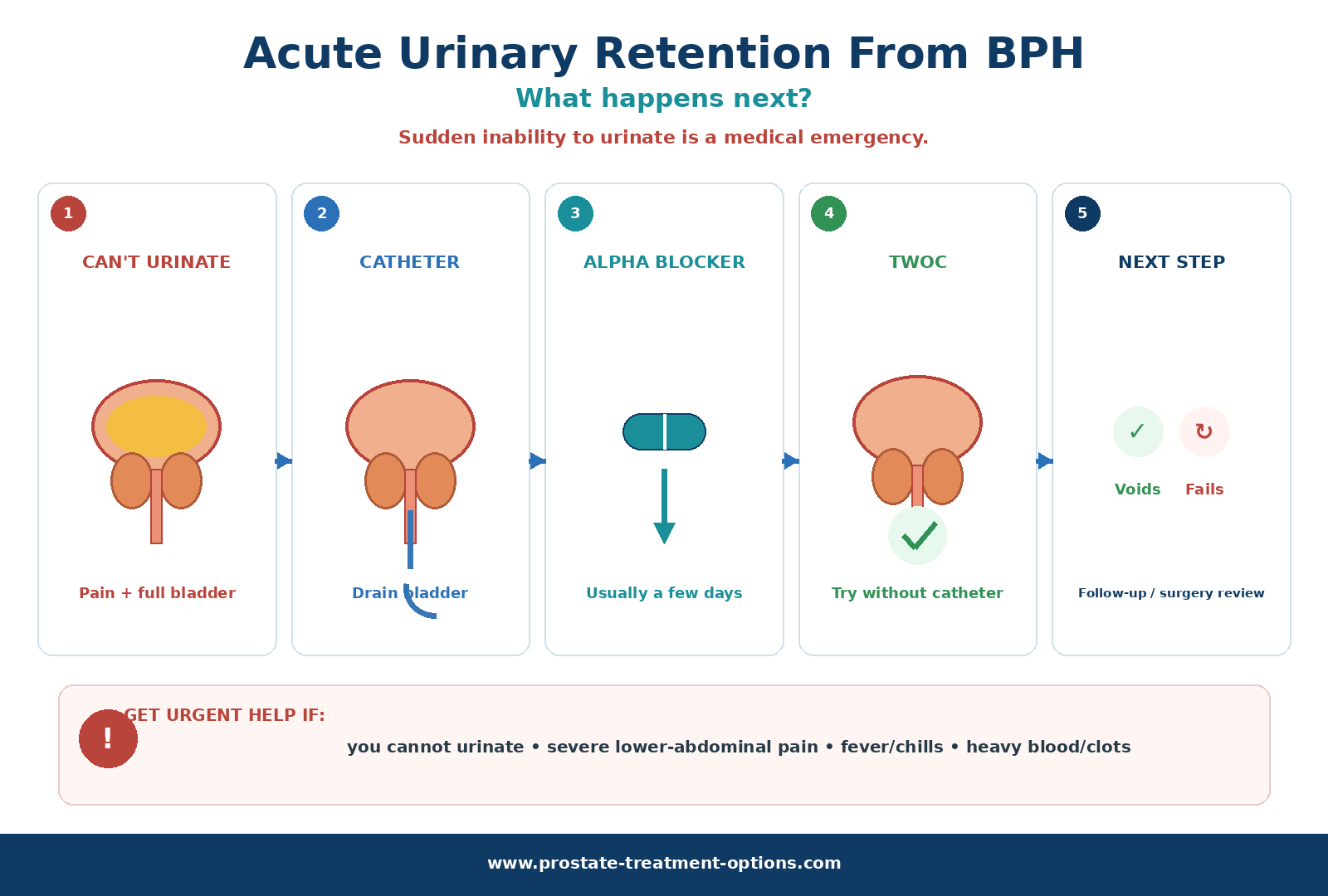
The first treatment is usually immediate bladder drainage with a urinary catheter. This relieves pain and helps protect the bladder and kidneys. Once the bladder is drained, the next steps are to identify the cause, start an alpha blocker when appropriate, and plan a trial without catheter (TWOC) after a short period.
Current evidence supports giving an alpha blocker such as tamsulosin, alfuzosin or silodosin for a few days before catheter removal because this improves the chance of successful spontaneous urination. If TWOC fails, the catheter is usually replaced and the urologist reassesses the prostate, bladder function and whether more definitive BPH treatment is needed.
What Is Acute Urinary Retention?
Acute urinary retention is the sudden inability to urinate despite having a full bladder.
It is different from chronic urinary retention, in which the bladder empties poorly over time and the patient may have only mild symptoms—or sometimes no obvious symptoms at all.
NIDDK describes acute urinary retention as a potentially serious condition that can cause severe lower-abdominal pain and requires urgent medical treatment.
How Can BPH Cause Acute Retention?
In benign prostatic hyperplasia (BPH), enlarged prostate tissue increases resistance at the bladder outlet.
A man may compensate for years by making his bladder contract harder. Then a trigger can push the system beyond the point where the bladder can overcome the obstruction.
Possible triggers include:
- progressive BPH obstruction;
- a protruding median lobe;
- constipation;
- urinary infection or prostatitis;
- cold/decongestant medicines containing alpha-adrenergic agonists;
- anticholinergic medicines;
- opioids and some other medications;
- surgery or anesthesia;
- immobility or acute illness.
Retention Is a Symptom, Not a Diagnosis
BPH is a common cause in older men, but acute retention can also result from urethral stricture, infection, stones, neurological disease, medications, pelvic masses or a weak bladder. The cause should be confirmed rather than assumed.
What Does Acute Urinary Retention Feel Like?
Typical symptoms include:
- complete inability to urinate;
- severe urgency but no urine flow;
- pain or pressure in the lower abdomen;
- visible swelling/fullness over the bladder;
- restlessness and increasing discomfort.
A man may pass only a few drops and still be in retention if the bladder remains very full.
Do Not Wait at Home
If you cannot urinate and your bladder feels painfully full, seek urgent medical care. Acute retention can injure the bladder and, if prolonged or associated with high-pressure obstruction, can affect the kidneys.
Do not try to treat complete retention by drinking more water, drinking less water, taking extra prostate medicine, or waiting until the next morning.
Why Is a Catheter the First Treatment?
The immediate goal is to empty the bladder.
NIDDK recommends prompt bladder drainage with a catheter in acute urinary retention because this:
- relieves pain;
- reduces bladder overdistension;
- restores urine drainage;
- and helps prevent bladder and kidney damage.
Urethral Catheter
Most men are initially drained through a catheter passed through the urethra into the bladder.
Once the catheter enters the bladder, urine drains into a collection bag.
What If a Urethral Catheter Cannot Be Passed?
Difficult catheterization can occur with:
- a very obstructing prostate;
- urethral stricture;
- false passage or previous urethral injury;
- or altered anatomy.
Repeated forceful catheter attempts should be avoided because they can injure the urethra.
A urologist may use a different catheter, cystoscopic guidance or—in selected cases—a suprapubic catheter placed through the lower abdomen directly into the bladder.
Should a Very Full Bladder Be Drained Slowly?
Older practice sometimes involved clamping the catheter and draining the bladder gradually because of concern about bleeding or blood-pressure changes.
Modern randomized evidence and systematic review data do not show an advantage to gradual decompression in ordinary acute retention. Immediate complete drainage is generally considered safe.
Large Retention Volumes May Need Extra Monitoring
After substantial obstruction is relieved, some patients produce very large amounts of urine—a phenomenon called post-obstructive diuresis. Men with very large retained volumes, kidney impairment, electrolyte abnormalities or upper-tract obstruction may need closer monitoring after drainage.
What Happens After the Catheter Is Inserted?
The catheter solves the immediate emergency, but it does not answer why retention occurred.
The next evaluation commonly includes:
- history of prior urinary symptoms;
- medication review;
- physical examination;
- urinalysis and culture when infection is suspected;
- kidney-function blood tests when indicated;
- PSA later when clinically appropriate and after acute factors are considered;
- prostate-size/anatomy assessment;
- and follow-up planning for catheter removal.
Retention can temporarily affect PSA and other urinary findings, so an acutely elevated PSA should not automatically be interpreted as prostate cancer.
For the broader workup, see Prostate & Urinary Tests for BPH.
Why Are Alpha Blockers Often Started After Acute Retention?
Alpha blockers such as:
- tamsulosin;
- alfuzosin;
- silodosin;
- and other appropriate alpha-1 blockers
reduce smooth-muscle tone at the prostate and bladder neck.
They do not remove the enlarged tissue, but they can reduce outlet resistance enough to improve the chance of urinating successfully after the catheter is removed.
What Does Current Evidence Show?
A 2025 evidence-based guideline from the French Urological Association concluded that alpha blockers given for approximately 2–3 days before a trial without catheter significantly improve the chance of successful catheter removal, with no clear evidence that one alpha blocker is superior.
Older randomized evidence specifically with tamsulosin found that men receiving tamsulosin were substantially more likely to avoid re-catheterization after TWOC than men receiving placebo.
Alpha Blockers Help the TWOC—They Do Not Prevent Future BPH Progression
Alpha blockers can improve the chance of spontaneous urination, but they do not shrink the prostate and do not reduce the long-term risk of another episode of retention or future BPH surgery.
For medication details, see BPH Medications.
What Is a Trial Without Catheter (TWOC)?
A trial without catheter means removing the urinary catheter and testing whether you can urinate adequately on your own.
A TWOC is usually performed after the bladder has had time to recover from the acute episode and after an alpha blocker has been started when appropriate.
When Is the Catheter Removed?
There is no single timing rule for every patient.
The 2025 French guideline supports relatively short catheterization and reports that catheter duration under approximately 3–5 days reduces catheter-related complications without clearly compromising TWOC outcomes.
Other trials have used 3, 4 or 7 days. The timing is individualized according to:
- how much urine was retained;
- infection;
- kidney function;
- prostate anatomy;
- previous episodes;
- medications;
- and local urology practice.
What Happens During TWOC?
The catheter is removed and the patient is asked to urinate normally.
The clinician may record:
- whether spontaneous urination occurs;
- voided urine volume;
- urinary flow;
- and post-void residual (PVR).
There is no universal PVR value that defines success for every man; the whole clinical picture matters.
What Affects the Chance of a Successful TWOC?
No single factor can predict the outcome with certainty.
Studies suggest that TWOC is more likely to fail when there is:
- older age;
- larger prostate volume;
- larger volume drained during the retention episode;
- more severe pre-existing urinary symptoms;
- marked intravesical prostatic protrusion / median-lobe obstruction;
- or poor bladder contractility.
These are probability factors, not reasons to deny a patient an appropriate TWOC.
How Often Does TWOC Work?
Success rates vary substantially because studies differ in patient selection, catheter duration and definitions of success.
For example, randomized trials using alpha blockers have reported successful spontaneous urination in roughly half or more of selected patients, while individual cohorts range considerably.
The most useful message is that a first episode of BPH-related retention does not automatically mean permanent catheterization or immediate surgery.
What Happens If the Trial Without Catheter Fails?
If you cannot urinate adequately after the catheter is removed, the bladder generally needs to be drained again.
Options may include:
- replacing an indwelling catheter;
- clean intermittent catheterization in selected patients;
- another planned TWOC after further treatment;
- additional BPH medication;
- or discussion of definitive BPH surgery/procedure.
Failure should also prompt the clinician to reconsider whether the cause is:
- severe prostate obstruction;
- an obstructing median lobe;
- urethral stricture;
- infection;
- or a weak bladder muscle.
If bladder contractility is uncertain, urodynamics may sometimes help distinguish obstruction from detrusor underactivity.
Where Do Finasteride and Dutasteride Fit After Retention?
Finasteride and dutasteride do not work fast enough to solve an acute retention episode.
However, if the prostate is demonstrably enlarged, these 5-alpha-reductase inhibitors can reduce prostate volume over time and lower the future risk of:
- another acute urinary retention episode;
- and BPH-related surgery.
They are therefore often relevant to the long-term plan after the emergency has been stabilized.
For the direct comparison, see Finasteride vs Dutasteride for BPH.
Does One Episode of Acute Retention Mean You Need BPH Surgery?
Not always.
A first episode may be followed by successful TWOC and medical management, particularly when:
- the bladder empties acceptably afterward;
- there is no kidney impairment;
- there is no recurrent infection or bladder stone;
- and symptoms can be controlled.
However, recurrent or refractory urinary retention is a compelling indication for BPH surgery in current EAU guidance.
Surgery also becomes more strongly indicated when BPH causes:
- upper urinary tract dilation/hydronephrosis;
- kidney impairment;
- recurrent urinary infection;
- bladder stones;
- overflow incontinence;
- or treatment-resistant BPH bleeding.
Which Procedure Is Used?
The choice depends on prostate size, anatomy, bleeding risk, bladder function, sexual priorities and surgeon expertise.
Options may include:
- HoLEP or another anatomic enucleation procedure;
- TURP;
- Aquablation;
- selected laser procedures;
- or simple prostatectomy for very large glands.
Men with retention are not automatically ideal candidates for every minimally invasive office procedure.
Can Acute Urinary Retention Damage the Kidneys?
Yes, particularly if high-pressure obstruction is prolonged or if the patient already has chronic retention.
Urine may back up toward the kidneys and cause:
- hydroureter;
- hydronephrosis;
- and impaired kidney function.
After drainage, kidney function may improve if obstruction is relieved before permanent damage occurs.
Men with very large retention volumes, hydronephrosis, abnormal creatinine/eGFR or very high urine output after catheterization may require closer monitoring.
What Is Post-Obstructive Diuresis?
After a severely obstructed bladder is drained, the kidneys may temporarily produce unusually large volumes of urine.
This is called post-obstructive diuresis.
Most cases are self-limited, but excessive urine loss can cause:
- dehydration;
- low blood pressure;
- sodium or potassium abnormalities;
- and other electrolyte disturbances.
A 2025 review found that post-obstruction high urine output is common in published retention cohorts, especially with larger initial bladder volumes and impaired kidney function, although most complications were self-limited.
Why Some Patients Stay for Observation
If a very large volume was drained, renal function is abnormal, or urine output becomes excessive, clinicians may monitor urine output, blood pressure and electrolytes after catheterization rather than sending the patient home immediately.
Which Medicines Can Trigger Urinary Retention?
NIDDK lists several medication groups that can contribute to retention in susceptible patients.
Examples include:
- decongestants / alpha-adrenergic agonists;
- anticholinergic and antispasmodic drugs;
- some antidepressants;
- antihistamines;
- some antipsychotic medicines;
- benzodiazepines;
- opioids;
- some calcium-channel blockers;
- and other medications that alter bladder or urethral function.
This does not mean every man with BPH must avoid every medicine in these classes.
But if retention occurs, the medication list should be reviewed carefully, including over-the-counter cold and allergy products.
How Can Another Retention Episode Be Prevented?
No strategy guarantees prevention, but the risk can often be reduced by addressing the underlying BPH and avoidable triggers.
Depending on the case, this may include:
- continuing an appropriate alpha blocker;
- adding finasteride or dutasteride when the prostate is enlarged and progression risk is high;
- treating infection when present;
- managing constipation;
- reviewing medicines that may worsen retention;
- monitoring PVR and urinary flow;
- and choosing definitive surgery when retention becomes recurrent or refractory.
Avoid severely restricting fluids to try to prevent retention. The solution is to treat the obstruction and bladder dysfunction—not to keep the bladder artificially empty through dehydration.
Dr. Albana’s Note
If a man suddenly cannot urinate, the first priority is not to debate which prostate medicine is best. The priority is to drain the bladder safely and relieve the obstruction.
After that, I would want to understand why the retention happened. Was this a first episode in a man with otherwise manageable BPH? Is there a large median lobe? Was a decongestant involved? Is there infection? Is the bladder weak? Are the kidneys being affected?
For many men, catheterization followed by a short course of an alpha blocker and a trial without catheter is appropriate. A successful TWOC can allow the catheter to stay out while longer-term BPH treatment is planned.
If the trial fails, that is not simply “bad luck.” It tells us that outlet obstruction, bladder function or both deserve closer assessment.
I would also distinguish a first acute episode from recurrent or refractory retention. Recurrent retention is a much stronger reason to discuss definitive surgery, especially when there are kidney, infection, stone or bladder complications.
— Dr. Albana Greca, MD, MMedSc, Family Physician / General Practitioner
Frequently Asked Questions About Acute Urinary Retention From BPH
Is acute urinary retention from BPH an emergency?
Yes. Sudden complete inability to urinate with a full bladder requires urgent medical evaluation and usually prompt catheter drainage.
How long does the catheter stay in after BPH retention?
It varies. Evidence supports relatively short catheterization in many uncomplicated cases, often a few days, with an alpha blocker given before trial without catheter. Infection, very large retained volume, kidney problems and other factors can change the plan.
What is a trial without catheter?
A TWOC is a planned catheter removal to see whether you can urinate adequately on your own. The clinician may check urinary flow and post-void residual afterward.
Does tamsulosin help after acute urinary retention?
Yes. Randomized evidence shows that tamsulosin improves the chance of successful voiding after catheter removal compared with placebo in men with BPH-related retention.
Do finasteride or dutasteride help immediately?
No. They act over months, not days. Their role is long-term prostate shrinkage and reducing the future risks of retention and BPH surgery in appropriately enlarged glands.
What happens if I fail a TWOC?
The bladder usually needs to be drained again. The urologist may continue medication, arrange another trial, assess bladder/prostate function further or discuss definitive BPH treatment.
Does one retention episode automatically mean TURP or HoLEP?
No. A first episode may be managed with catheterization, medication and TWOC. Recurrent or refractory retention is a much stronger surgical indication.
Can a catheter damage the bladder or cause infection?
Catheters can cause discomfort, urethral trauma and urinary infection, especially when left in longer. That is one reason clinicians try to remove them when safe rather than leave them indefinitely without a plan.
Can acute retention damage the kidneys?
Yes, especially when obstruction is severe or prolonged. Hydronephrosis and impaired kidney function increase the urgency of definitive treatment.
Can cold medicines trigger retention?
Some decongestants and antihistamines can worsen bladder emptying in susceptible men. Always check the ingredients and discuss safer alternatives if you have significant BPH or a history of retention.
Related BPH Guides
Medical References
- National Institute of Diabetes and Digestive and Kidney Diseases (NIDDK). Urinary Retention: Definition, Symptoms, Diagnosis and Treatment. Acute urinary retention is a sudden inability to urinate and requires immediate catheter drainage.
- European Association of Urology. Guidelines on the Management of Non-neurogenic Male Lower Urinary Tract Symptoms: Disease Management. 2026. Recurrent or refractory urinary retention and upper-tract dilation due to benign prostatic obstruction are compelling indications for surgical treatment.
- Goueli R, et al. Management of Lower Urinary Tract Symptoms Attributed to Benign Prostatic Hyperplasia: AUA Guideline (2026), Parts I–III. J Urol. 2026.
- French Urological Association Male LUTS Panel. Management of acute urinary retention in men with benign prostatic hyperplasia: literature review and guidelines. 2025. Alpha blockers given for 2–3 days improve TWOC success; shorter catheterization under approximately 3–5 days reduces complications without compromising outcomes.
- Lucas MG, et al. / randomized evidence on alpha-blockers before trial without catheter. Tamsulosin significantly improved successful voiding after catheter removal compared with placebo.
- The Effect and Safety of Rapid and Gradual Urinary Decompression in Urine Retention: A Systematic Review and Meta-Analysis. Rapid complete decompression did not increase clinically important hematuria or circulatory collapse versus gradual drainage. PMID 36295601.
- Prevalence and Clinical Implications of Post-obstruction Hyperdiuresis Among Patients with Urinary Retention: A Mini Review. 2025. PMID 40041096.
Medical information notice: Acute urinary retention is a medical emergency. This page is for patient education and does not replace urgent assessment, catheterization or individualized urological care.
Written & medically reviewed by Dr. Albana Greca, MD, MMedSc • Family Physician / General Practitioner • Founder & Lead Medical Author • Last medically reviewed: September 2026