
Quick Answer
HoLEP and TURP are both highly effective operations for bladder-outlet obstruction caused by BPH. In randomized trials and current guidelines, both produce major and durable improvements in urinary symptoms and urine flow.
HoLEP generally has the advantage in bleeding control, catheter duration, hospital stay and long-term retreatment risk, and it can be used across a very wide range of prostate sizes. TURP remains a well-established reference operation, especially for prostates around 30–80 mL, and is more widely available.
Neither procedure should be chosen because of the word “laser” or “traditional” alone. The practical decision depends on prostate size and anatomy, bleeding risk, surgeon experience, local equipment, how strongly you prioritize durability and how important ejaculation is to you. Dry or retrograde ejaculation is common after both standard HoLEP and TURP.
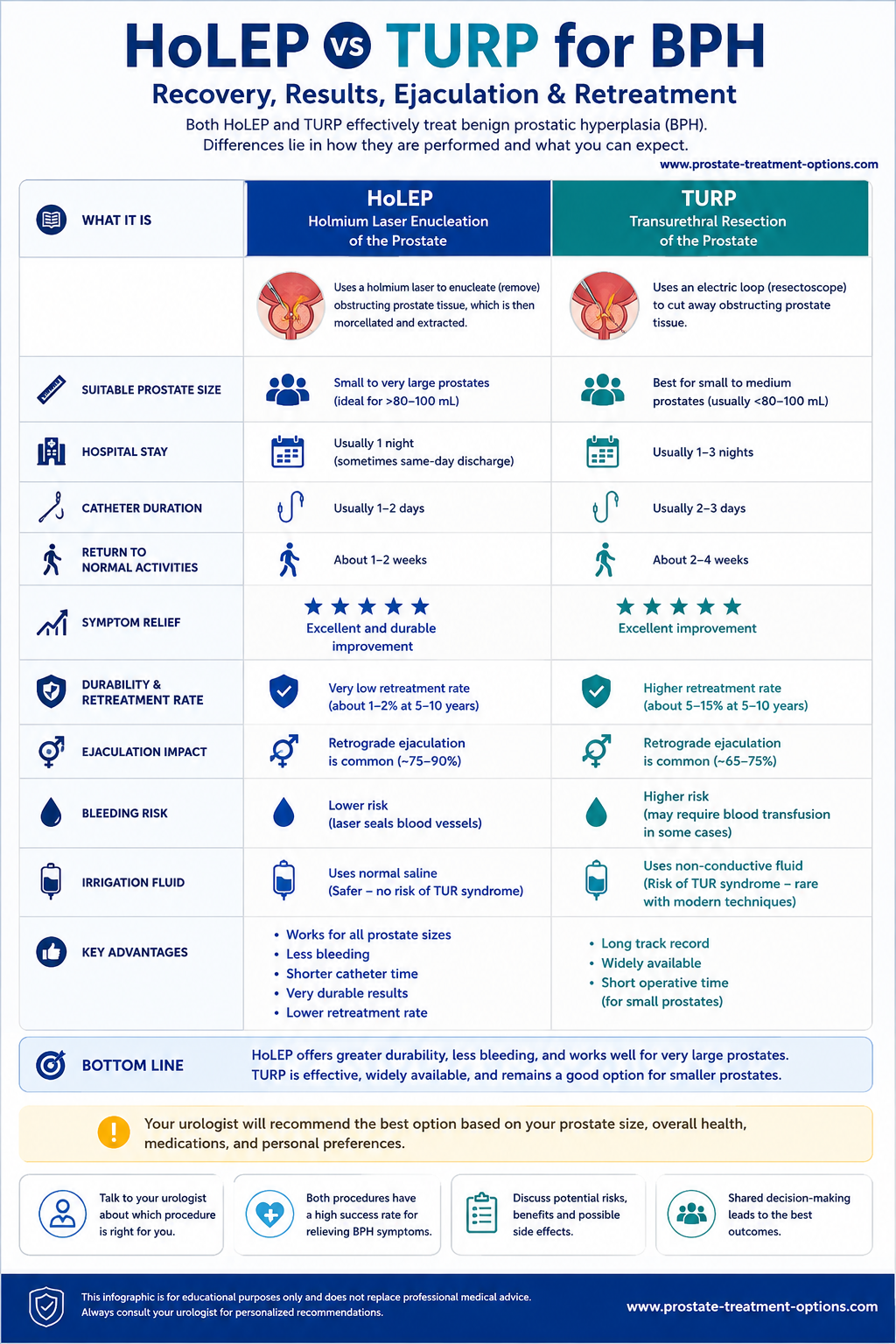
What Are HoLEP and TURP?
HoLEP
HoLEP stands for holmium laser enucleation of the prostate.
The surgeon passes an instrument through the urethra and uses a holmium laser to separate the obstructing BPH adenoma from the prostate capsule. The tissue is then moved into the bladder, mechanically morcellated into smaller pieces and removed.
The concept is similar to removing the inside of an orange while leaving the peel. This enables the surgeon to remove a large proportion of obstructing adenoma without making an external incision.
TURP
TURP stands for transurethral resection of the prostate.
A resectoscope is passed through the urethra and an electrosurgical loop removes obstructing prostate tissue in smaller chips.
Modern TURP may be:
- monopolar TURP, the traditional technique; or
- bipolar TURP, which can use normal saline and has a more favorable perioperative safety profile than monopolar TURP.
Neither HoLEP nor TURP is a radical prostatectomy. The operations treat benign obstructing tissue; they are not cancer-removal operations.
See the main BPH Surgery & Procedures guide for the broader procedural landscape.
HoLEP vs TURP: Quick Comparison
| Question | HoLEP | TURP |
|---|---|---|
| Symptom relief | Excellent and durable | Excellent and durable |
| Urinary flow improvement | Strong | Strong |
| Best prostate-size range | Effectively size-independent in experienced hands | EAU standard mainly for approximately 30–80 mL |
| Operation time | Often longer | Often shorter |
| Bleeding / transfusion | Generally lower | Higher than HoLEP, although bipolar TURP improves perioperative safety |
| Catheter duration | Generally shorter | Generally longer |
| Hospital stay | Generally shorter | Generally longer |
| Erectile function | Usually preserved; comparable with TURP | Usually preserved; comparable with HoLEP |
| Dry/retrograde ejaculation | Very common with standard HoLEP | Common |
| Retreatment | Very low; generally lower than TURP | Durable, but retreatment is higher than HoLEP in comparative evidence |
| Main practical limitation | Requires equipment and an experienced HoLEP surgeon; learning curve matters | Less suitable as gland size becomes very large; bleeding burden greater |
Which Gives Better BPH Results: HoLEP or TURP?
For most patients, the important first point is that both work very well.
EAU 2026 concludes that HoLEP has similar mid- to long-term efficacy to TURP. Randomized studies have shown sustained improvements in:
- International Prostate Symptom Score (IPSS);
- quality of life;
- maximum urinary flow (Qmax);
- and post-void residual urine (PVR).
A 2025 meta-analysis of 13 randomized trials involving more than 1,300 patients found broadly similar symptom and flow outcomes. HoLEP had advantages in several perioperative outcomes, while TURP generally had a shorter operating time.
A larger contemporary meta-analysis of endoscopic enucleation versus TURP also found that enucleation produced outcomes at least comparable with TURP and often favorable for flow, residual urine and longer-term reoperation.
Does This Mean TURP Does Not Last?
No. TURP is itself a durable operation with decades of evidence. The difference is that HoLEP removes the adenoma more completely through an anatomic enucleation plane, which helps explain its particularly low rate of recurrent BPH requiring another outlet operation.
HoLEP vs TURP by Prostate Size
Prostate volume is one of the clearest practical differences between these procedures.
TURP: Traditionally 30–80 mL
EAU 2026 strongly recommends bipolar or monopolar TURP for men with bothersome moderate-to-severe LUTS/BPH and a prostate volume of approximately 30–80 mL.
This does not mean a surgeon can never resect a prostate above 80 mL. Rather, as gland size increases:
- resection time becomes longer;
- bleeding risk can increase;
- fluid and perioperative burden increase;
- and other operations become more efficient.
HoLEP: A Size-Independent Option
HoLEP can be used in small, moderate, large and very large prostates when the surgeon has appropriate expertise.
EAU strongly recommends HoLEP as an alternative to TURP or open/simple prostatectomy for moderate-to-severe benign prostatic obstruction.
This makes HoLEP particularly useful for glands well beyond the traditional TURP range.
If you are trying to interpret a scan report first, see Normal Prostate Size by Age: What Do 30, 40, 50 and 80 cc Mean?
Which Has Faster Recovery: HoLEP or TURP?
Across randomized trials and meta-analyses, HoLEP generally produces:
- shorter catheterization;
- shorter hospital stay;
- less need for prolonged bladder irrigation;
- and less perioperative blood loss.
The 2025 randomized-trial meta-analysis found shorter catheter use and hospital stay after HoLEP, while TURP had the shorter operation time.
A 2026 network meta-analysis likewise found that HoLEP had significantly shorter catheterization than bipolar TURP.
When Can You Return to Normal Activities?
Exact recovery instructions vary by:
- amount of tissue removed;
- bleeding;
- catheter duration;
- baseline health;
- type of work;
- and your surgeon’s protocol.
Many HoLEP patients return to ordinary light routine sooner than after TURP, but either operation can cause urinary urgency, burning, frequency or intermittent blood in the urine for several weeks.
“Going Home Earlier” Does Not Mean the Urinary Tract Is Fully Healed
Even after a short hospital stay, heavy lifting, strenuous exercise and sexual activity may remain restricted for a period determined by the treating surgeon.
Which Has Less Bleeding: HoLEP or TURP?
HoLEP generally has the advantage.
The holmium laser cuts while producing effective hemostasis. Meta-analyses consistently find:
- smaller hemoglobin drops;
- lower transfusion rates;
- and a more favorable perioperative bleeding profile
compared with TURP.
The 2025 meta-analysis of 13 randomized trials found significantly fewer blood transfusions after HoLEP.
This can make laser enucleation particularly attractive when bleeding risk is an important consideration, although anticoagulant and antiplatelet management must still be individualized.
Bipolar TURP Is Safer Than Classic Monopolar TURP
Bipolar TURP has similar efficacy to monopolar TURP but a more favorable perioperative profile and permits normal saline irrigation.
Therefore, a modern comparison should not treat all TURP as if it were the older monopolar technique.
HoLEP vs TURP: Ejaculation and Erectile Function
This is where terminology matters.
Erection, ejaculation and orgasm are different functions.
Erections
Comparative evidence indicates that erectile-function outcomes are broadly similar after HoLEP and TURP.
EAU states that the impact on erectile function is comparable. A man can therefore maintain useful erections after either operation.
Ejaculation
Standard HoLEP and TURP both commonly alter ejaculation.
After surgery, the bladder neck/outlet no longer closes in the same way during ejaculation. Semen may travel backward into the bladder or little/no semen may be seen externally. This is often described as:
- retrograde ejaculation;
- dry ejaculation;
- or dry orgasm.
Older randomized-trial meta-analyses found no clear difference between standard HoLEP and TURP in retrograde-ejaculation rates.
Orgasmic sensation can remain even when semen is no longer expelled normally.
Future Fertility Matters
Dry or retrograde ejaculation can substantially impair natural fertility. If future fatherhood is important, discuss sperm preservation and ejaculation-preserving alternatives before surgery.
Can HoLEP Preserve Ejaculation?
Modified ejaculation-sparing enucleation techniques are being studied and can preserve antegrade ejaculation in selected patients, but they are not identical to standard complete HoLEP and durability may differ.
For a broader comparison of sexual and urinary tradeoffs, see BPH Treatment Side Effects.
What About Urinary Leakage After HoLEP or TURP?
Temporary urinary leakage can occur after either procedure.
After HoLEP, short-term stress urinary incontinence is particularly discussed because removal of a large obstructing adenoma suddenly changes the outlet anatomy.
Leakage often improves as:
- postoperative irritation settles;
- the sphincter adapts;
- and pelvic-floor control recovers.
Persistent significant incontinence is much less common than temporary leakage and should be reassessed by the urologist.
Comparative evidence does not show a major long-term incontinence disadvantage for HoLEP compared with TURP.
Which Has the Lower Retreatment Risk?
HoLEP generally has the advantage in durability.
EAU cites a randomized comparison in prostates above 80 mL in which symptom and flow outcomes were similar at three years but overall retreatment was significantly lower after HoLEP.
A 2026 network meta-analysis also found significantly lower surgical retreatment with HoLEP compared with both bipolar and monopolar TURP.
Why?
HoLEP follows the anatomical surgical capsule and removes most of the obstructing adenoma rather than resecting tissue progressively from inside the channel.
TURP remains durable, but prostate tissue can remain or regrow sufficiently to require another treatment years later.
EAU reports long-term TURP reoperation/retreatment rates that accumulate over time, although many men never require another prostate operation.
Retreatment Is Not the Same as “Failure”
A man can have excellent relief for many years after TURP and eventually need another procedure. Durability should be considered alongside operative risk, availability, anatomy and surgeon expertise.
HoLEP vs TURP for an 80 cc, 100 cc or Larger Prostate
As prostate size approaches and exceeds about 80 mL, HoLEP generally becomes increasingly attractive.
For a very large prostate, HoLEP can often provide:
- complete adenoma enucleation;
- strong improvement in flow;
- low bleeding burden;
- short catheterization;
- and very durable relief.
This can avoid the need for a more invasive open or robotic simple prostatectomy in many men.
TURP can still be performed beyond traditional size ranges by experienced surgeons, but longer resection time and greater perioperative burden make it less efficient for very large glands.
A large prostate also does not automatically mean surgery is required. Symptoms, post-void residual urine, flow, bladder function, retention and complications remain part of the decision.
What If You Have a Median Lobe?
Both HoLEP and TURP can directly treat an obstructing median lobe.
HoLEP can enucleate median-lobe tissue along with the lateral adenoma, while TURP can resect the protruding tissue.
Therefore, a median lobe is not a contraindication to either operation.
The important issue is understanding the full anatomy, especially if you are comparing these operations with minimally invasive procedures whose median-lobe indications may be more restricted.
See Median Lobe BPH: Symptoms, Diagnosis & Best Treatment Options.
HoLEP or TURP: Which Is Better for You?
HoLEP May Be Especially Attractive If:
- your prostate is large or very large;
- maximum durability is a priority;
- bleeding risk is an important concern;
- you want shorter catheter/hospital time;
- you have recurrent BPH after prior treatment;
- an experienced HoLEP surgeon is available.
TURP May Be Especially Reasonable If:
- your prostate is in the typical 30–80 mL range;
- a skilled TURP surgeon is readily available;
- HoLEP expertise/equipment is not locally available;
- you prefer a long-established operation with extensive evidence;
- your surgeon believes TURP best fits your anatomy and health.
Surgeon Experience Matters
This is particularly important with HoLEP.
EAU explicitly notes that surgeon experience is one of the most important factors affecting HoLEP complications and emphasizes the learning curve and mentorship.
A technically excellent TURP by an experienced surgeon may be preferable to HoLEP performed by a team early in its learning curve.
Your Priorities Matter Too
Ask about:
- expected urinary improvement;
- catheter time;
- hospital stay;
- bleeding/transfusion risk;
- temporary leakage;
- dry ejaculation;
- erectile function;
- time away from work;
- and long-term retreatment.
For the complete decision pathway, see BPH Treatment: Medications, Procedures, Surgery & How to Choose.
When BPH Obstruction Needs Prompt Attention
Seek prompt medical attention if you:
- cannot urinate at all;
- have a painful full lower abdomen with inability to empty the bladder;
- develop fever/chills with urinary symptoms;
- have substantial blood or clots in the urine;
- develop kidney impairment or hydronephrosis related to obstruction;
- or experience recurrent significant urinary retention.
Surgery is not chosen only because the prostate is large. It is chosen according to symptoms, complications, obstruction, bladder function and patient preference.
Dr. Albana’s Note
If a patient asks me whether HoLEP is “better” than TURP, I would first say that both are excellent BPH operations. TURP has decades of evidence behind it and remains a highly effective reference treatment.
HoLEP’s strongest advantages become clearer when we look beyond symptom scores. It usually produces less blood loss, shorter catheterization and hospital stay, can treat very large glands, and has an exceptionally low chance of needing another operation for regrowth.
That does not mean every patient should automatically choose HoLEP. The operation has a meaningful learning curve, and the experience of the surgeon matters. Local expertise should be part of the decision.
I would also make sure the patient understands sexual outcomes before either operation. Standard HoLEP and TURP both commonly cause dry or retrograde ejaculation. That is different from erectile dysfunction; many men maintain erections and orgasm despite the change in semen flow.
For a man with a very large prostate who wants a durable operation and has access to an experienced HoLEP surgeon, I would expect HoLEP to be a particularly strong option. For a man with a moderate-size gland treated by an experienced TURP surgeon, TURP remains an entirely reasonable and effective choice.
— Dr. Albana Greca, MD, MMedSc, Family Physician / General Practitioner
Frequently Asked Questions About HoLEP vs TURP
Is HoLEP more effective than TURP?
Both provide strong symptom and flow improvement. Long-term efficacy is broadly comparable, while HoLEP tends to have advantages in bleeding, catheter/hospital time and retreatment risk.
Which has a faster recovery, HoLEP or TURP?
HoLEP generally has shorter catheterization and hospital stay. Return-to-activity timing varies by patient and surgeon, but the overall perioperative recovery profile tends to favor HoLEP.
Which is better for a large prostate?
HoLEP is particularly well suited to large and very large prostates because it is an anatomic enucleation technique and is not restricted to the traditional 30–80 mL TURP range.
Does HoLEP cause less bleeding than TURP?
Generally yes. Comparative trials and meta-analyses show less hemoglobin loss and fewer transfusions after HoLEP.
Does HoLEP cause retrograde ejaculation?
Yes. Dry/retrograde ejaculation is very common after standard HoLEP. It is also common after TURP. Erectile function can remain intact despite ejaculation changing.
Does HoLEP cause erectile dysfunction?
ED can occur after any prostate procedure, but comparative evidence does not show a major erectile-function disadvantage for HoLEP versus TURP.
Can BPH grow back after HoLEP?
Clinically significant recurrent obstruction after complete HoLEP is uncommon because most of the adenoma is enucleated. Retreatment rates are generally lower than after TURP.
Can BPH grow back after TURP?
Yes, although TURP is durable and many men never need another operation. Long-term studies show a gradual accumulation of reoperations over years.
Is TURP outdated?
No. TURP remains an established guideline-supported surgical standard, particularly for prostates around 30–80 mL. Bipolar TURP has improved perioperative safety compared with older monopolar techniques.
Does HoLEP require a more experienced surgeon?
HoLEP has a recognized learning curve. EAU specifically highlights surgeon experience and structured mentorship as important determinants of safety and performance.
Related BPH Surgery Guides
Medical References
- European Association of Urology. Guidelines on the Management of Non-neurogenic Male Lower Urinary Tract Symptoms: Disease Management. 2026. TURP is a standard surgical option for approximately 30–80 mL glands; HoLEP has comparable mid/long-term efficacy, a more favorable perioperative profile and strong guideline support as an alternative to TURP/open prostatectomy.
- Goueli R, et al. Management of Lower Urinary Tract Symptoms Attributed to Benign Prostatic Hyperplasia: AUA Guideline (2026) Part III: Procedural/Surgical Management. J Urol. 2026;216(2):161-170. PMID 42095468.
- Chen et al. Holmium laser enucleation of the prostate versus transurethral resection of the prostate in treatment of benign prostatic hyperplasia: A meta-analysis of 13 randomized control trials. 2025. PMID 40313420.
- Endoscopic enucleation of the prostate versus transurethral resection of the prostate for benign prostatic hyperplasia: a systematic review and meta-analysis. PMID 40348823.
- Minimally invasive treatments for benign prostatic obstruction: a systematic review and network meta-analysis of randomized controlled trials at 12 months. 2026. PMID 42635725.
- Gilling PJ, et al. Long-term results of a randomized trial comparing HoLEP and TURP: results at 7 years. BJU Int. PMID 21883820.
Medical information notice: Procedure outcomes depend on prostate size and anatomy, baseline bladder function, medications, surgeon experience and center-specific technique. Discuss individualized risks and expected outcomes with the treating urologist.
Written & medically reviewed by Dr. Albana Greca, MD, MMedSc • Family Physician / General Practitioner • Founder & Lead Medical Author • Last medically reviewed: September 2026