
Quick Answer
Post-void residual (PVR) is the amount of urine left in your bladder immediately after you finish urinating. It is measured in milliliters (mL), usually with a bladder ultrasound scanner.
There is no single PVR cutoff that by itself proves BPH obstruction or automatically means you need surgery. Current EAU guidance specifically states that no PVR threshold for treatment decisions has been established because PVR varies between measurements and can be caused by bladder outlet obstruction, weak bladder muscle function, or both.
As a practical orientation—not a rigid treatment rule—less than about 100 mL is often considered a relatively small residual, persistent values above roughly 200 mL indicate increasingly incomplete emptying, and values around 300–400 mL or more raise greater concern for urinary retention. In men with LUTS/BPH, a baseline PVR of 350 mL or more has been associated with a higher risk of symptom progression in major studies.
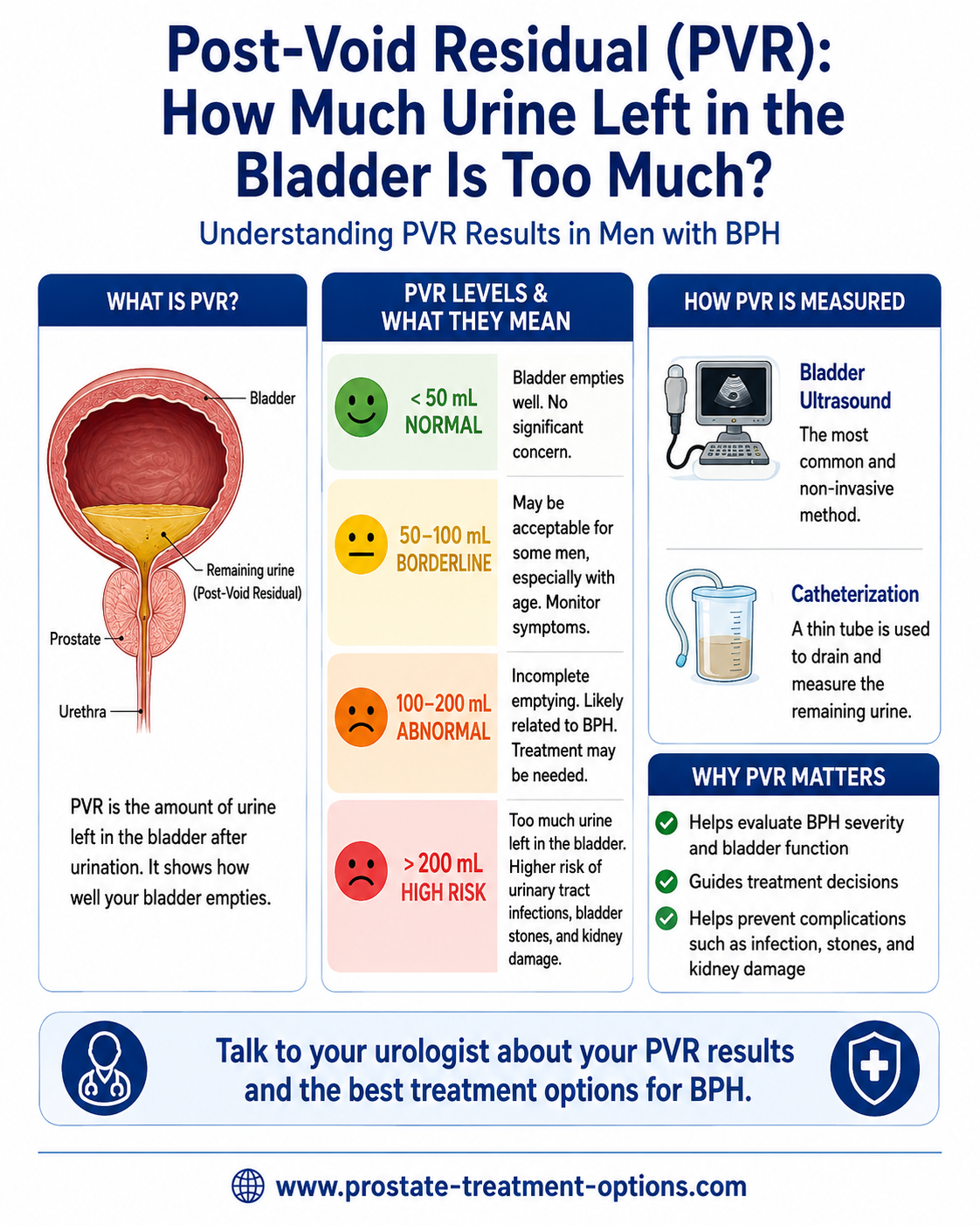
What Is Post-Void Residual Urine?
PVR is simply the amount of urine that remains inside the bladder after you have tried to empty it normally.
If you void 350 mL and the bladder scanner then detects 50 mL still inside, your PVR is 50 mL.
If 300 mL remains after you finish, the bladder has emptied much less efficiently.
PVR is frequently measured in men with benign prostatic hyperplasia (BPH) because an enlarged prostate can obstruct the bladder outlet. But PVR is not a “BPH test” by itself.
A high result tells us that the bladder did not empty well. It does not tell us exactly why.
What PVR Can Tell You
PVR helps answer the question: “How effectively did my bladder empty?” It does not, by itself, answer: “Is my enlarged prostate definitely the cause?”
How Is PVR Measured?
Bladder Ultrasound / Bladder Scan
The most common method is a portable bladder ultrasound scanner placed over the lower abdomen after urination.
It is:
- non-invasive;
- quick;
- usually painless;
- repeatable;
- and avoids passing a catheter through the urethra.
Catheter Measurement
A catheter can be passed into the bladder immediately after urination and the remaining urine drained and measured.
This is more invasive but may sometimes be used when an exact measurement is needed or catheterization is already clinically necessary.
NIDDK recognizes both ultrasound and catheterization as methods for measuring post-void residual urine during evaluation of urinary retention.
Timing Matters
PVR should be measured soon after voiding. If too much time passes, the kidneys continue producing urine and the scanner may count newly produced urine as “residual.”
Hydration, bladder fullness before voiding, anxiety and how strong the urge was can also change the result.
This is one reason one isolated PVR should not automatically determine treatment.
For the broader evaluation, see Prostate & Urinary Tests for BPH.
How Much Post-Void Residual Is Too Much?
This is the question most patients want answered—and it requires some nuance.
Published clinical references often use rough ranges such as:
| PVR | Practical Interpretation | What It Does NOT Mean |
|---|---|---|
| <50 mL | Usually a small residual and often reassuring. | Does not exclude every urinary problem. |
| 50–100 mL | May still be acceptable depending on age, symptoms, voided volume and repeat measurements. | Does not prove BPH obstruction. |
| 100–200 mL | Increasing evidence of incomplete emptying; usually deserves clinical context and follow-up if persistent. | Does not automatically mean catheter or surgery. |
| >200 mL | More substantial incomplete bladder emptying. | Still cannot distinguish prostate obstruction from weak bladder contraction by itself. |
| ≈300–400+ mL | Raises significant concern for urinary retention, particularly when persistent or accompanied by symptoms/complications. | There is still no universal number that replaces clinical assessment. |
These Are Practical Ranges, Not Official Surgery Cutoffs
EAU 2026 explicitly states that no PVR threshold for treatment decisions has been established.
Even a threshold as low as 50 mL performs poorly for diagnosing bladder outlet obstruction. EAU reports a positive predictive value of only 63% and a negative predictive value of 52% when 50 mL is used to predict obstruction.
A 2026 review of chronic urinary retention definitions found that published PVR thresholds varied enormously—from 150 mL to 1,000 mL. A threshold around 300 mL was the most commonly used, further demonstrating why “one universal number” is misleading.
What Causes a High Post-Void Residual?
A high PVR can result from several different mechanisms.
Bladder Outlet Obstruction
BPH, a protruding median lobe, urethral stricture, bladder-neck obstruction or occasionally a stone can make it difficult for urine to leave the bladder.
Detrusor Underactivity
The bladder muscle may not contract strongly or long enough to empty fully. This is sometimes called a weak bladder or underactive bladder.
Medication Effects
Some anticholinergic drugs, antihistamines, decongestants, opioids and other medicines can contribute to urinary retention in susceptible patients.
Neurological Disease
Diabetes-related neuropathy, spinal disease, Parkinsonian disorders, stroke and other neurological conditions can affect bladder emptying.
Less common causes include severe constipation, postoperative retention and structural bladder abnormalities.
The critical message is:
High residual urine is a finding—not a diagnosis.
What Does PVR Mean in a Man With BPH?
In BPH, prostate tissue can narrow the bladder outlet and make the bladder work harder to empty.
Initially, the bladder muscle may compensate by contracting more strongly.
Over time, some men can develop:
- higher residual urine;
- increased bladder wall thickness/trabeculation;
- worsening flow;
- recurrent retention;
- or deterioration of bladder contractile function.
But PVR and prostate size do not move together perfectly.
A relatively small or moderate-size prostate with a prominent median lobe can create substantial obstruction, while another man with a much larger gland may still empty well.
This is why the new normal prostate size by age page should be interpreted together with PVR—not instead of it.
High PVR: Enlarged Prostate or Weak Bladder?
This distinction is essential before surgery.
A man may have a weak stream and 300 mL residual because:
- the prostate is strongly obstructing the outlet;
- the bladder muscle is weak;
- or both problems are present.
Removing prostate obstruction can work very well when outlet resistance is the dominant problem.
But if the bladder muscle is severely underactive, opening the prostate channel may not fully restore normal emptying.
How Can Doctors Tell the Difference?
They combine:
- symptoms;
- PVR;
- uroflowmetry / Qmax;
- prostate volume and anatomy;
- cystoscopy where appropriate;
- and selected urodynamic pressure-flow studies.
EAU explains that pressure-flow urodynamics distinguishes obstruction from detrusor underactivity by measuring bladder pressure together with urine flow.
A Low Flow Rate Does Not Solve the Puzzle Either
A weak Qmax can be caused by obstruction or poor bladder contraction. PVR and uroflowmetry are useful screening tools, but neither one alone proves the mechanism.
Does PVR Change Which BPH Medicines Can Be Used?
Sometimes.
Alpha Blockers
Alpha blockers can improve urinary flow and symptoms by relaxing smooth muscle at the bladder outlet.
A high PVR does not automatically mean they cannot be tried, but a very large or rising residual may indicate that medication alone will not provide adequate emptying.
Finasteride and Dutasteride
When the prostate is demonstrably enlarged and progression risk is meaningful, 5-alpha-reductase inhibitors can reduce gland volume and lower the future risk of acute urinary retention and BPH-related surgery.
PVR is one part of the overall progression-risk picture, not the sole criterion.
Antimuscarinic Medicines
These medicines can help urgency and frequency but deserve special attention when bladder emptying is already poor.
EAU notes that monitoring PVR is particularly relevant when antimuscarinic therapy is used because of the concern for worsening retention in susceptible patients.
See BPH Medications: Alpha Blockers, 5-ARIs, Tadalafil & More.
Does a High PVR Mean You Need BPH Surgery?
No—not by itself.
This is one of the most common misconceptions about PVR.
EAU explicitly says that even a large PVR is not automatically a contraindication to watchful waiting or medical treatment.
However, a large residual may:
- predict a poorer response to conservative management in some patients;
- signal significant obstruction or bladder dysfunction;
- increase concern when it rises over time;
- and become more important when complications are present.
In the MTOPS and ALTESS studies cited by EAU, a baseline PVR of 350 mL or more was associated with an increased risk of symptom progression.
That does not turn 350 mL into an automatic surgery threshold.
What Makes Surgery More Likely?
A procedure becomes more compelling when incomplete emptying occurs together with:
- recurrent or refractory urinary retention;
- kidney impairment caused by BPH obstruction;
- recurrent urinary infection related to poor emptying;
- bladder stones;
- recurrent BPH-related bleeding;
- or severe bothersome symptoms despite appropriate conservative treatment.
If a procedure is being considered, the urologist should determine whether prostate obstruction is truly an important part of the problem.
Why Is It Often Better to Follow PVR Over Time?
PVR can vary considerably from one measurement to another.
A single result of 180 mL does not necessarily mean the man’s “true residual” is permanently 180 mL.
Repeat measurements can show whether residual urine is:
- stable;
- improving after treatment;
- or progressively increasing.
EAU notes that monitoring changes in PVR may help identify men at risk of acute urinary retention.
A recent 2026 review similarly emphasizes that PVR is most useful as a dynamic parameter within a broader clinical assessment, rather than as a one-time diagnostic cutoff.
Why Can the Same Man Have Different PVRs?
Results can change because of:
- how full the bladder was before voiding;
- how urgently the patient needed to urinate;
- how much urine was voided;
- time between voiding and the scan;
- medications;
- anxiety or difficulty urinating in the clinic;
- and normal biological variability.
What Is Bladder Voiding Efficiency?
Because PVR alone can be misleading, researchers increasingly examine the residual in relation to the total bladder volume.
Bladder voiding efficiency (BVE) is calculated approximately as:
voided volume ÷ total bladder volume × 100
For example:
- you void 400 mL;
- 50 mL remains;
- total bladder volume was approximately 450 mL;
- voiding efficiency is about 89%.
This gives more context than simply saying “PVR = 50 mL.”
EAU also discusses the PVR ratio as another way of interpreting residual urine relative to bladder volume, particularly when detrusor underactivity is suspected.
Can High PVR Cause Urinary Tract Infections or Kidney Problems?
Persistently poor bladder emptying can contribute to urinary complications, but risk depends on the cause, degree and duration of retention.
Potential problems include:
- recurrent urinary infection;
- bladder stones;
- bladder overdistension;
- chronic retention;
- and, in severe prolonged obstruction, upper urinary tract dilation or kidney impairment.
Older urological literature has associated very large residuals—particularly above about 300 mL—with increased concern for upper-tract dilation and renal insufficiency.
But again, the clinical situation matters more than one isolated number.
When Is Residual Urine an Urgent Problem?
Seek prompt medical attention if you:
- cannot pass urine at all;
- have a painful, increasingly full lower abdomen;
- have fever or chills with urinary symptoms;
- have heavy blood or clots in the urine;
- have worsening kidney function or hydronephrosis linked to retention;
- develop severe new back pain with leg weakness/numbness or new loss of bladder/bowel control.
Acute urinary retention often requires prompt bladder drainage with a catheter. Do not attempt to treat a blocked bladder simply by drinking less water.
Dr. Albana’s Note
When a patient tells me, “I have 250 mL of urine left in my bladder—do I need surgery?”, I would not make that decision from the number alone.
I would first want to know whether this was one isolated measurement or a repeated pattern. I would also look at the urinary flow, voided volume, prostate size and anatomy, symptoms, previous retention episodes, kidney function and whether the bladder muscle may be weak.
The distinction between obstruction and detrusor underactivity is especially important. A prostate procedure can remove obstruction, but it cannot directly make a severely weakened bladder muscle contract normally again.
I would take a persistent residual above 200–300 mL seriously, particularly if it is increasing or accompanied by complications, but I would still avoid telling a patient that one specific cutoff automatically means catheterization or surgery.
The most useful question is not simply “Is this PVR high?” It is: Why is my bladder not emptying, is it getting worse, and is it causing harm?
— Dr. Albana Greca, MD, MMedSc, Family Physician / General Practitioner
Frequently Asked Questions About Post-Void Residual
Is a PVR of 50 mL normal?
A residual around 50 mL is generally relatively small in an adult, but there is no universal cutoff. It should be interpreted in relation to symptoms, voided volume and repeated measurements.
Is 100 mL of urine left in the bladder too much?
100 mL suggests some incomplete emptying, but it does not automatically mean disease or require treatment. Persistent values are more meaningful than one isolated result.
Is a PVR of 200 mL dangerous?
It represents more significant incomplete emptying and deserves clinical evaluation if persistent, but it is not by itself an emergency or automatic indication for surgery.
What does a PVR of 300 mL mean?
A residual around 300 mL is commonly used in the literature as a threshold suggestive of chronic urinary retention, but definitions vary and the cause must still be established.
Does a high PVR prove enlarged prostate obstruction?
No. High PVR can be caused by prostate/bladder-outlet obstruction, a weak bladder muscle, neurological disease, medications or a combination of factors.
Can a weak bladder cause high PVR?
Yes. Detrusor underactivity is an important cause of incomplete emptying, particularly in older men and people with neurological or metabolic disease.
Can PVR improve with BPH medication?
It can improve when bladder-outlet resistance decreases, although response varies. Persistent or rising residual despite treatment may require reassessment.
Can a high PVR damage the kidneys?
Severe or prolonged retention—especially when it produces high bladder pressures or upper urinary tract dilation—can contribute to kidney impairment. Risk cannot be predicted from one PVR number alone.
Does PVR need to be measured more than once?
Often yes. PVR can vary substantially, and EAU guidance emphasizes monitoring changes over time when clinically relevant.
Related Prostate & BPH Guides
Medical References
- European Association of Urology. Guidelines on the Management of Non-neurogenic Male Lower Urinary Tract Symptoms: Diagnostic Evaluation. 2026. PVR should be measured in male LUTS; high PVR may reflect obstruction and/or detrusor underactivity; no treatment-decision threshold has been established.
- Goueli R, et al. Management of Lower Urinary Tract Symptoms Attributed to Benign Prostatic Hyperplasia: AUA Guideline (2026) Part I: Presentation and Evaluation. J Urol. 2026;216(2):143-151.
- Gammie A, et al. Postvoided Residual/Bladder Emptying: A Mini Review. Eur Urol Focus. 2026. PMID 42243040.
- Postvoid Residual Thresholds Used to Define Chronic Urinary Retention: A Systematic Review. 2026. PMID 42436676.
- National Institute of Diabetes and Digestive and Kidney Diseases (NIDDK). Diagnosis of Urinary Retention. Postvoid residual may be measured with ultrasound or catheterization.
Medical information notice: PVR is a clinical measurement, not a diagnosis. The significance of residual urine depends on symptoms, voided volume, repeat measurements, prostate anatomy, bladder function, medications, neurological factors and complications.
Written & medically reviewed by Dr. Albana Greca, MD, MMedSc • Family Physician / General Practitioner • Founder & Lead Medical Author • Last medically reviewed: September 2026