Written & medically reviewed by Dr. Albana Greca, MD, MMedSc • Family Physician / General Practitioner • Last medically reviewed: August 2026
Question: How does Mucinex affect an enlarged prostate? Can a man with BPH take it for a cough or cold?

Quick Answer: Can You Take Mucinex With an Enlarged Prostate?

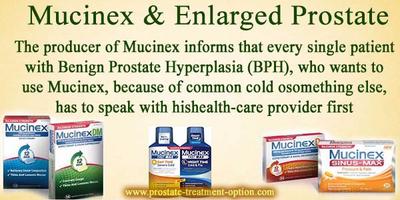
It depends on which Mucinex product you mean. “Mucinex” is a brand name used for several products with different active ingredients.

  • Plain Mucinex contains guaifenesin, an expectorant. Current U.S. labeling does not list enlarged prostate or difficulty urinating as a specific warning for guaifenesin-only Mucinex.
  • Mucinex D contains guaifenesin plus pseudoephedrine. Pseudoephedrine can make urination more difficult in men with BPH, and the product label specifically advises men who have trouble urinating because of an enlarged prostate to ask a doctor before use.
  • Mucinex DM contains guaifenesin plus dextromethorphan and does not contain pseudoephedrine.
  • Other Mucinex cold-and-flu combinations may contain additional ingredients, so always check the Drug Facts label rather than relying on the brand name alone.
Plain Mucinex Guaifenesin only. BPH is not a specific warning on the current U.S. product label.
Mucinex D Contains pseudoephedrine. This is the version of greatest concern when urinary obstruction or BPH is present.
Read the Ingredients Similar brand names can contain very different medicines.

The Most Important Point: “Mucinex” Is Not One Medicine

The previous version of this page treated all Mucinex products as though they contained the same active ingredient. They do not.

This matters greatly for men with benign prostatic hyperplasia (BPH) because some ingredients used in cold medicines can make it more difficult to pass urine.

Product Typical Active Ingredients in Current U.S. Product Purpose BPH Consideration
Mucinex Guaifenesin Expectorant; loosens mucus Enlarged prostate is not a specific warning on the current guaifenesin-only label.
Mucinex D Guaifenesin + pseudoephedrine Expectorant + nasal decongestant Important caution: pseudoephedrine may worsen difficulty urinating.
Mucinex DM Guaifenesin + dextromethorphan Expectorant + cough suppressant Does not contain pseudoephedrine, but other medical conditions and drug interactions still need consideration.
Other Mucinex combinations Ingredients vary May target congestion, cough, fever or several symptoms Read the active ingredients carefully before use.
Brand name is not enough. Look at the section marked “Active ingredient” or “Drug Facts” on the package.

Does Plain Mucinex Worsen an Enlarged Prostate?

Current U.S. plain Mucinex extended-release tablets contain guaifenesin.

Guaifenesin is an expectorant. It helps loosen mucus and thin bronchial secretions so that a mucus-producing cough can be more productive.

The current U.S. Drug Facts labeling for guaifenesin-only Mucinex does not list BPH or difficulty urinating due to an enlarged prostate among its specific warnings.

Therefore, the statement that “Mucinex must be avoided by every man with BPH” is too broad.

This Does Not Mean Every Patient Should Automatically Take It

If you have significant urinary obstruction, kidney disease, multiple medical problems, take several medicines, or are unsure which Mucinex product you have, ask a pharmacist or doctor to check the exact formulation.

What About Mucinex D and an Enlarged Prostate?

Mucinex D is different.

Current U.S. Mucinex D contains:

  • guaifenesin, and
  • pseudoephedrine.

Pseudoephedrine is a decongestant. It can increase adrenergic activity around the bladder outlet and may make it more difficult for a susceptible man to start or maintain urine flow.

This is why current Mucinex D labeling tells people who have trouble urinating due to an enlarged prostate gland to ask a doctor before using it.

If You Already Have Weak Flow or Incomplete Emptying

Be particularly cautious with pseudoephedrine-containing cold medicines if you already experience:

  • difficulty starting urination;
  • a weak or interrupted stream;
  • straining to urinate;
  • a feeling that the bladder has not emptied;
  • or previous urinary retention.

Ask a healthcare professional or pharmacist before using the product.

Why Can Decongestants Make BPH Symptoms Worse?

BPH can narrow the urinary outlet because prostate tissue surrounds part of the urethra.

The degree of difficulty urinating depends not only on prostate size but also on muscle tone around the prostate and bladder neck and on how well the bladder contracts.

Systemic decongestants such as pseudoephedrine stimulate adrenergic receptors. In a man whose urinary outlet is already narrowed, this may increase resistance to urine flow.

That is different from the explanation that the medicine simply “constricts the blood vessels of the prostate.” The clinically important issue is its effect on the urinary outlet and bladder emptying.

NIDDK specifically advises men with prostate problems to be aware that decongestants can contribute to urinary retention.

Is Mucinex DM Different?

Yes.

Current U.S. Mucinex DM contains:

  • guaifenesin — an expectorant, and
  • dextromethorphan — a cough suppressant.

It does not contain pseudoephedrine.

The current Mucinex DM label does not carry the same enlarged-prostate urination warning found on Mucinex D.

However, this should not be interpreted to mean Mucinex DM is appropriate for every person. Dextromethorphan has its own precautions and drug interactions, including an important interaction with monoamine oxidase inhibitor (MAOI) medicines.

The better question is not “Is Mucinex safe?”
Ask: “What are the active ingredients in this exact product, and are they appropriate for my urinary symptoms, other diseases and current medicines?”

What About Antihistamines in Cold Medicines?

Some combination cold products contain antihistamines.

Certain antihistamines—particularly medicines with stronger anticholinergic effects—can reduce bladder contraction and may contribute to urinary retention in susceptible men.

NIDDK therefore lists both decongestants and antihistamines among OTC cold and cough medicines that can worsen BPH symptoms.

It is too simplistic to say that every newer antihistamine is completely safe for every man with BPH. The patient’s symptoms, dose, other medicines and medical history matter.

How Should a Man With BPH Choose a Cold or Cough Medicine?

Try to treat the symptom you actually have instead of automatically choosing an “all-in-one” cold-and-flu product.

  1. Read the active ingredients.
    Do not select a medicine by brand name alone.
  2. Look specifically for a decongestant.
    If the product contains pseudoephedrine and you have difficulty urinating from BPH, ask a clinician or pharmacist before using it.
  3. Avoid unnecessary combination medicines.
    A product containing several ingredients may expose you to medicines you do not actually need.
  4. Tell the pharmacist about your BPH medicines.
    This includes tamsulosin, finasteride, dutasteride and other BPH treatments .
  5. Consider your other conditions.
    High blood pressure, heart disease, glaucoma, kidney disease and other conditions may also affect which cold medicine is appropriate.

Do Not Replace Medication With an Unproven Herbal Cough Remedy

“Natural” does not automatically mean safer. Herbal cough products can have side effects, variable ingredients and drug interactions. Choose treatments according to the cause and type of cough rather than simply replacing one OTC product with an herbal product.

What If Your Urination Gets Worse After Starting Cold Medicine?

Pay attention to a noticeable change in urinary symptoms after starting an OTC cold, allergy or sinus medicine.

Possible warning symptoms include:

  • a suddenly weaker urine stream;
  • increasing difficulty starting urination;
  • straining more than usual;
  • increasing lower-abdominal fullness;
  • or feeling unable to empty the bladder.

Stop and review the OTC medicine with a healthcare professional, particularly if the product contains a decongestant.

Unable to Urinate? This Is Urgent

Complete inability to urinate is acute urinary retention and requires prompt medical attention.

Do not wait for the cold medicine to wear off if your bladder is becoming painful and full and you cannot pass urine.

Seek urgent care, particularly if inability to urinate is accompanied by severe lower-abdominal pain, fever, chills or feeling seriously unwell.

Dr. Albana’s Answer

Hello,

The most important thing I would clarify is exactly which Mucinex product you are taking.

Plain Mucinex currently contains guaifenesin, and enlarged prostate is not listed as a specific warning for that ingredient on the current U.S. product label.

Mucinex D is different because it contains pseudoephedrine. Pseudoephedrine can make it more difficult to urinate in men who already have bladder-outlet obstruction from BPH, which is why the label specifically tells men with difficulty urinating because of an enlarged prostate to ask a doctor before using it.

Mucinex DM contains guaifenesin and dextromethorphan rather than pseudoephedrine, although it has its own precautions and potential drug interactions.

So I would not advise you to avoid every product carrying the Mucinex brand. I would advise you to check the active ingredients and, if you already have significant urinary symptoms, ask your pharmacist or doctor before taking a decongestant-containing product.

— Dr. Albana Greca, MD, MMedSc, Family Physician / General Practitioner

Most Asked Questions About Mucinex and BPH

Can Mucinex make an enlarged prostate worse?

It depends on the formulation. Plain guaifenesin-only Mucinex does not carry a specific BPH warning on its current U.S. label. Mucinex D contains pseudoephedrine, which can worsen difficulty urinating in some men with BPH.

Does regular Mucinex contain pseudoephedrine?

No. Current U.S. plain Mucinex extended-release tablets contain guaifenesin. Mucinex D contains guaifenesin plus pseudoephedrine.

Why is pseudoephedrine a problem with BPH?

It can increase resistance at the bladder outlet and make urine flow more difficult in susceptible men, increasing the risk of urinary retention.

Is Mucinex DM the same as Mucinex D?

No. Mucinex D contains pseudoephedrine. Mucinex DM contains dextromethorphan. The letters are important because these products have different ingredients and precautions.

Can I take guaifenesin if I have BPH?

BPH is not a specific warning on the current U.S. guaifenesin-only Mucinex label. However, your other medical conditions and medicines still need to be considered.

Can cold medicine cause urinary retention?

Yes. Certain decongestants and antihistamines can make bladder emptying more difficult in susceptible people, particularly men who already have urinary obstruction from BPH.

What should I do if I cannot urinate after taking cold medicine?

Complete inability to urinate requires urgent medical assessment. Do not continue waiting at home with a painful, full bladder.

Related Enlarged Prostate Guides

Medical References

  • U.S. National Library of Medicine. DailyMed. Mucinex — guaifenesin extended-release tablets. Updated June 2026.
    DailyMed: Mucinex
  • U.S. National Library of Medicine. DailyMed. Mucinex D Maximum Strength — guaifenesin and pseudoephedrine. Updated April 2026.
    DailyMed: Mucinex D
  • U.S. National Library of Medicine. DailyMed. Mucinex DM — guaifenesin and dextromethorphan. Updated June 2026.
    DailyMed: Mucinex DM
  • National Institute of Diabetes and Digestive and Kidney Diseases. Enlarged Prostate (Benign Prostatic Hyperplasia).
    NIDDK
  • National Library of Medicine. Pseudoephedrine: Drug Information.
    MedlinePlus

Medical information notice: This page provides general educational information. Brand formulations can change and may differ between countries. Always check the current active ingredients on your own package and discuss significant BPH, urinary retention or medication interactions with a healthcare professional.

Written & medically reviewed by Dr. Albana Greca, MD, MMedSc • Family Physician / General Practitioner • Last medically reviewed: August 2026