Quick Answer
BPH surgery or another procedural treatment may be considered
when enlarged prostate symptoms remain troublesome despite appropriate
treatment, when a man prefers a procedural approach, or when BPH causes
complications such as persistent urinary retention, recurrent urinary
infections, bladder stones, bleeding related to BPH, or effects on kidney
function.
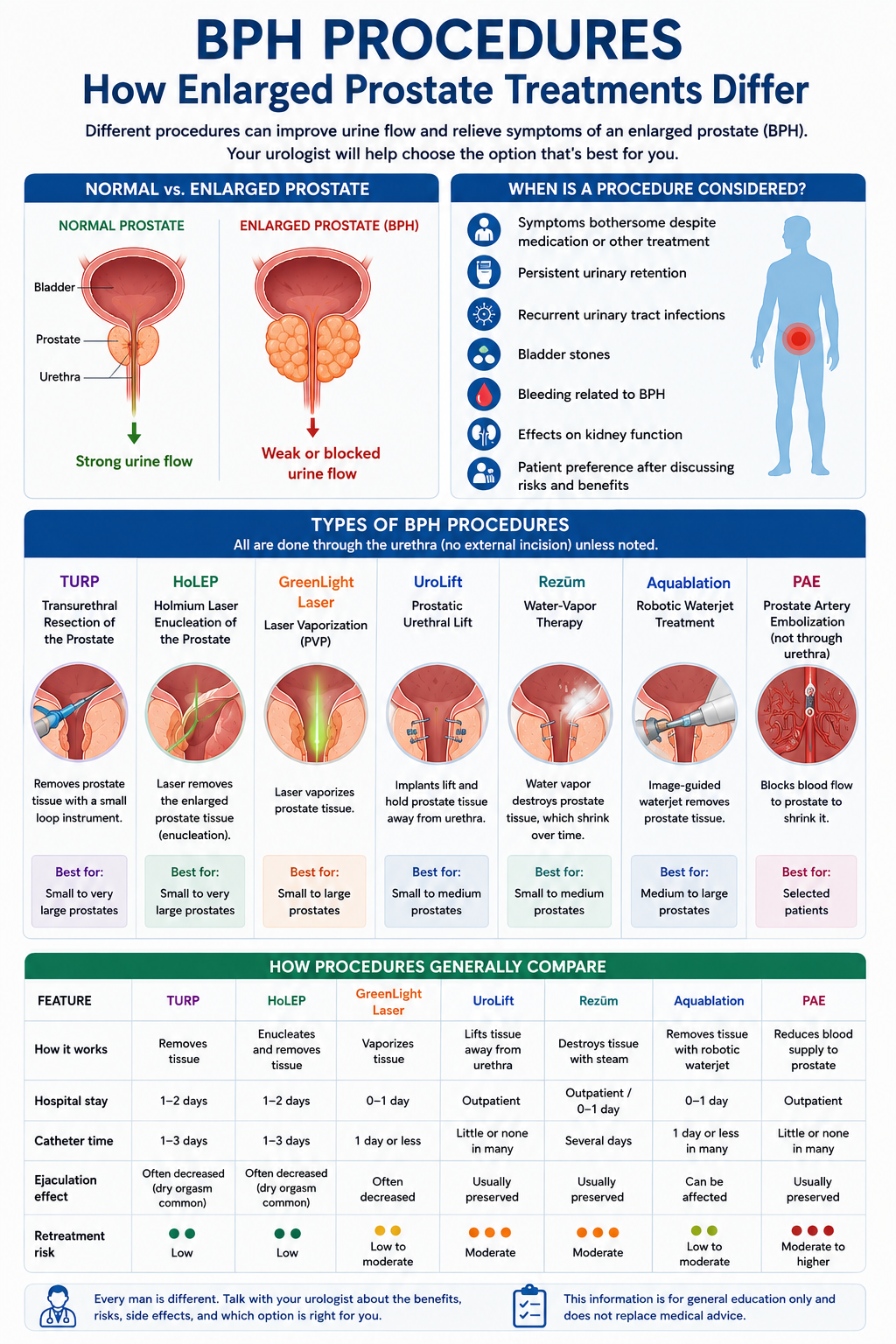
Modern options include TURP, HoLEP and other laser procedures,
UroLift, water-vapor treatment such as Rezūm, Aquablation, simple
prostatectomy and selected prostate artery embolization .
There is no single procedure that is best for every man. Your urologist
can determine which options are technically suitable and which best match
your symptoms, prostate anatomy, health and treatment priorities.
On This Page
Surgery used to be discussed as if it were the inevitable final step for
every man with an enlarged prostate.
That is no longer an accurate way to think about
benign prostatic hyperplasia (BPH) .
Many men can manage BPH with monitoring, lifestyle measures or medication.
Others benefit from one of several modern procedures designed to reduce
urinary obstruction and improve symptoms.
The important question is therefore not simply
“Do I need surgery?”
but:
“Which treatment offers the right balance of symptom improvement,
durability, recovery, side effects and future retreatment risk for my
situation?”
When Is BPH Surgery or a Procedure Considered?
A urologist may discuss procedural treatment when symptoms remain
troublesome despite appropriate conservative or medical treatment, or
when a patient prefers an intervention after discussing alternatives.
Procedures are particularly important when BPH leads to complications
such as:
persistent or refractory urinary retention;
kidney impairment related to urinary obstruction;
recurrent urinary tract infections associated with BPH;
recurrent bladder stones;
recurrent significant bleeding caused by BPH;
or lower urinary tract symptoms that remain unacceptable despite other treatment.
Surgery Is Not Automatically the “Last Resort”
Some men choose a procedural treatment earlier because they do not want
long-term medication, have troublesome medication side effects, or
prefer a treatment that may provide greater or more durable symptom
improvement. This decision should be made after discussing expected
benefits and risks with a urologist.
Does BPH Surgery Provide a 100% Cure?
No BPH procedure should be described as a guaranteed
100% cure .
Procedures can substantially improve urinary symptoms and relieve
obstruction in appropriately selected patients, but results vary.
Some procedures remove more obstructing prostate tissue than others.
Procedures that remove a greater amount of adenoma may provide greater
durability, while some less invasive or ejaculation-preserving options can
carry a greater likelihood of needing additional treatment later.
This is why modern BPH counseling includes discussion of
retreatment risk as well as symptom improvement.
BPH Surgery Is Not Radical Prostatectomy
Radical prostatectomy is primarily an operation for prostate
cancer and is not routine treatment for benign BPH.
Most BPH procedures remove, vaporize, enucleate, reposition or otherwise
treat the tissue causing urinary obstruction rather than removing the
entire prostate as is done in a radical prostatectomy.
Is a Urinary Catheter a BPH Surgery?
No. A urinary catheter is not BPH surgery.
If a man develops acute urinary retention and cannot
urinate, a catheter may be inserted to drain the bladder and relieve the
immediate problem.
This can be a temporary measure while doctors determine why the retention
occurred and what longer-term treatment is appropriate.
Men who remain dependent on a catheter because of obstruction from BPH may
benefit from a procedure that removes or reduces the obstructing prostate
tissue, depending on their health and clinical situation.
TURP: Transurethral Resection of the Prostate
TURP is one of the established surgical treatments for
BPH and has historically been used as a reference procedure against which
newer treatments are compared.
A surgeon passes an instrument through the urethra and removes obstructing
prostate tissue from inside the prostate.
This means there is usually no external abdominal incision for a standard
TURP.
Potential Advantages
well-established technique;
substantial improvement in urinary symptoms for many patients;
improved urinary flow;
and long clinical experience with the procedure.
Possible Considerations
Potential effects can include bleeding, infection, temporary urinary
symptoms, urinary incontinence in some patients, urethral or bladder-neck
narrowing, and changes in ejaculation.
Your urologist should explain the risks that are most relevant to your
individual situation.
HoLEP and Other Prostate Enucleation Procedures
HoLEP stands for holmium laser enucleation of the
prostate.
Instead of shaving away small pieces of obstructing tissue as in a
traditional resection, enucleation separates the enlarged adenoma from the
prostate capsule and removes the obstructing tissue endoscopically.
Current urological guidelines recognize laser enucleation techniques such
as HoLEP and ThuLEP as evidence-based options for BPH.
Does HoLEP Work for Large Prostates?
HoLEP is often considered for larger prostates because enucleation can
remove a substantial amount of obstructing tissue. However, procedure
choice also depends on surgeon expertise, equipment, anatomy, health and
patient priorities.
Laser Vaporization / GreenLight Treatment
Photoselective vaporization of the prostate (PVP) , often
associated with GreenLight laser technology, uses laser energy to vaporize
obstructing prostate tissue.
It is another recognized option for lower urinary tract symptoms caused by
BPH.
Laser approaches may be particularly relevant in selected patients where
bleeding risk is an important consideration, although medication use,
anticoagulation and individual procedural risks must be discussed with the
treating team.
Minimally Invasive BPH Procedures
Not every procedural treatment involves removing a large amount of
prostate tissue.
Modern BPH care includes several less invasive options that may offer a
shorter recovery or different sexual-function trade-offs in appropriately
selected patients.
Prostatic Urethral Lift — UroLift
Small permanent implants are used to move prostate tissue away from
the urethra, creating a wider urinary channel.
It may be attractive to selected men who place particular importance
on preserving ejaculation, but anatomy and prostate size influence
suitability.
Water-Vapor Therapy — Rezūm
Water vapor is delivered into selected areas of prostate tissue,
causing tissue injury followed by gradual reduction in obstruction.
Improvement occurs over time rather than immediately.
Robotic Waterjet Treatment — Aquablation
Aquablation uses image-guided robotic waterjet technology to remove
obstructing prostate tissue.
It is an evidence-based procedural option for selected prostate sizes
and has been studied in comparison with TURP.
Prostate Artery Embolization — PAE
PAE reduces blood supply to prostate tissue through a catheter-based
vascular procedure performed by an appropriately trained
interventional radiologist.
It may be an option for selected patients after appropriate urological
assessment, but retreatment and functional outcomes need to be
discussed.
What About Surgery for a Small Prostate?
In selected men with a relatively small prostate and suitable anatomy,
a urologist may consider
transurethral incision of the prostate (TUIP) .
Rather than removing a large amount of tissue, small incisions can reduce
resistance at the bladder outlet.
Anatomy matters, so this is not an option that can be chosen simply from
symptoms alone.
What Procedures Are Used for a Very Large Prostate?
Larger prostates can require a treatment capable of removing a greater
amount of obstructing tissue.
Options may include techniques such as:
HoLEP or another appropriate enucleation technique;
robotic waterjet treatment in selected prostate sizes;
or simple prostatectomy for selected large prostates.
A simple prostatectomy is very different from radical prostatectomy.
In simple prostatectomy, the obstructing adenoma is removed for benign
disease rather than removing the entire prostate for cancer treatment.
Which BPH Surgery Is Best?
There is no single BPH surgery that is best for every man .
Your urologist may consider:
prostate size;
prostate anatomy;
presence of a median lobe;
severity of obstruction;
urinary retention;
bladder function;
other medical conditions;
bleeding risk and anticoagulant or antiplatelet treatment;
previous prostate procedures;
importance of preserving ejaculation;
desired recovery time;
expected durability;
possible need for retreatment;
and surgeon experience with each technique.
Ask About Durability as Well as Recovery
A less invasive procedure may offer an attractive recovery profile, but
the likelihood of requiring another BPH treatment later can differ among
procedures.
Discuss both the short-term experience and the expected long-term
durability before choosing a procedure.
Can BPH Surgery Affect Sexual Function?
Yes. Different BPH procedures can affect sexual function differently.
It is useful to separate:
erection; ejaculation; and orgasm .
A procedure may have a significant effect on ejaculation without causing
the same degree of effect on erections.
For example, some tissue-removing procedures commonly change or reduce
forward ejaculation, whereas some minimally invasive treatments may be
chosen partly because preservation of ejaculation is an important
treatment goal.
Current guidance specifically recommends discussing potential changes in
erectile, ejaculatory and orgasmic function before procedural treatment.
What Other Side Effects Can Occur?
Risks vary by procedure but may include:
bleeding;
urinary infection;
temporary burning or urgency;
difficulty urinating during early recovery;
temporary catheter use;
urinary incontinence in some patients;
urethral or bladder-neck narrowing;
changes in ejaculation;
and the possibility of needing additional BPH treatment later.
The likelihood of each complication varies substantially between
procedures and between patients.
What Happens Before BPH Surgery?
Before recommending a procedure, a urologist usually confirms that the
symptoms are likely related to BPH and collects enough information to
choose an appropriate treatment.
Assessment may include:
your urinary symptom history;
medication review;
urinalysis;
PSA when clinically appropriate;
assessment of prostate size and anatomy;
post-void residual urine;
urinary flow testing;
cystoscopy in selected patients;
or other testing when needed.
Not every patient requires every test.
Do Diabetes, Blood Pressure or Blood Thinners Matter?
Yes. Other health conditions can influence the safety and planning of BPH
procedures.
Your surgical team needs to know about:
diabetes;
high blood pressure;
heart disease;
kidney disease;
lung disease;
anticoagulant or antiplatelet medicines;
and all prescription medicines, over-the-counter products and supplements.
Do not stop a blood thinner or other important prescription medicine on
your own before surgery. Medication changes should be coordinated by the
treating clinicians.
How Long Is Recovery After BPH Surgery?
Recovery varies widely because “BPH surgery” includes procedures ranging
from office-based minimally invasive treatments to endoscopic tissue
removal and larger operations.
Recovery may depend on:
which procedure you have;
how much tissue is treated;
whether a catheter is needed afterward;
bleeding and urinary symptoms;
your overall health;
and your urologist’s postoperative instructions.
Some urgency, frequency or burning can occur temporarily after a
procedure even when urinary flow has improved.
Your treating team should tell you when you may return to driving,
exercise, lifting, work and sexual activity.
Do You Still Need Follow-Up After BPH Surgery?
Yes.
Current AUA guidance recommends follow-up after BPH procedures to assess
symptom response and possible adverse effects.
Depending on the procedure and your situation, follow-up may include:
a symptom score;
discussion of urinary and sexual function;
post-void residual urine;
urinary flow testing;
and evaluation for recurrent symptoms if they develop.
Seek Prompt Medical Attention After a BPH Procedure If You:
cannot urinate;
develop fever or chills;
have heavy or increasing bleeding or significant blood clots;
develop severe or worsening pain;
feel faint, unusually weak or very unwell;
or develop another rapidly worsening symptom.
Follow the specific discharge instructions given by your urologist because
expected symptoms and warning signs can differ between procedures.
Dr. Albana’s Note
One of the most important changes in BPH treatment is that men now have
more choices than simply “medicine or major surgery.”
When discussing these options with patients, I encourage them to look
beyond the name of the procedure.
Ask what the treatment is expected to improve, how durable the result may
be, whether you are likely to need a catheter, how it may affect
ejaculation or erections, what recovery usually involves, and what the
chances are of needing another treatment later.
A procedure that is an excellent choice for one man may not be appropriate
for another because prostate anatomy, urinary function, other medical
conditions and personal priorities differ.
— Dr. Albana Greca, MD, MMedSc, Family Physician / General Practitioner
Most Asked Questions About BPH Surgery
When does an enlarged prostate need surgery?
A procedure may be considered when urinary symptoms remain troublesome
despite appropriate treatment, when the patient prefers procedural
treatment, or when complications such as persistent urinary retention,
recurrent infections, bladder stones, significant BPH-related bleeding
or kidney effects develop.
Is TURP still used for BPH?
Yes. TURP remains an established evidence-based treatment and an
important reference procedure against which many newer BPH treatments
have been compared.
Is HoLEP better than TURP?
Both are effective treatments, but they work differently and have
different considerations. Prostate size, anatomy, surgeon experience,
bleeding risk, sexual-function priorities and expected durability all
matter. A urologist can determine which options are suitable for an
individual patient.
Can BPH surgery affect ejaculation?
Yes. Changes in ejaculation are common after some BPH procedures, while
certain minimally invasive options may have a lower likelihood of
ejaculatory dysfunction. Discuss sexual-function priorities before
selecting a procedure.
Can an enlarged prostate come back after surgery?
Symptoms can recur or further BPH treatment may be needed after some
procedures. Retreatment rates vary according to how the procedure works,
how much obstructing tissue is treated and the length of follow-up.
Does BPH surgery remove the whole prostate?
Usually not. Most BPH procedures treat the obstructing inner prostate
tissue. Radical prostatectomy, which removes the entire prostate, is
primarily a cancer operation and is not standard BPH treatment.
Medical References
Goueli R, et al.
Management of Lower Urinary Tract Symptoms Attributed to Benign
Prostatic Hyperplasia: AUA Guideline (2026) Part III:
Procedural/Surgical Management.
Journal of Urology. 2026.
View AUA guideline
National Institute of Diabetes and Digestive and Kidney Diseases.
Enlarged Prostate (Benign Prostatic Hyperplasia).
View NIDDK guidance
European Association of Urology.
2026 Guidelines on the Management of Non-neurogenic Male Lower
Urinary Tract Symptoms.
View EAU guideline
Medical information notice:
This article provides general patient education and does not replace
individualized assessment or procedural advice from a qualified
urologist. The most appropriate BPH procedure depends on prostate anatomy,
symptoms, test findings, overall health, personal priorities and local
specialist expertise.
Written & medically reviewed by Dr. Albana Greca, MD, MMedSc • Family Physician / General Practitioner • Last medically reviewed: August 2026